Stay up-to-date with the antiques world

By subscribing, you are agreeing to the privacy policy. Unsubscribe anytime.

Barnebys

Barnebys HQ

Brahegatan 10
BOX 5038
114 37 Stockholm

Company

  • About Us
  • Join Barnebys
  • Our Partners
  • Press
  • Career

Explore More

  • Barnepedia
  • Buying / Selling at auction
  • Auction Houses / Dealers / Galleries

Support

  • FAQ
  • Terms of Use
  • Privacy and Cookies policy
  • Contact us
  • Barnebys Group AB
  • Barnebys.se
  • Barnebys.com
  • Barnebys.co.uk
  • Barnebys.de
  • Barnebys.fr
  • Barnebys.es
  • Barnebys.it
  • Barnebys.hk
  • All auction items
  • Categories
  • Auction results
  • Magazine
  • Ancient Art
  • Arts & Graphics
  • Asian Art
  • Books, Maps & Manuscripts
  • Carpets, Rugs & Textile
  • Coins & Banknotes
  • Contemporary Art
  • Ethnographical
  • Fashion & Vintage
  • Folk Art
  • Furniture, Design & Mirrors
  • Glass
  • Jewellery & Gems
  • Lighting
  • Medals, Arms & Armour
  • Miscellaneous
  • Music & Musical Instruments
  • Nautica, Technica & Optic
  • Photographs
  • Porcelain & Pottery
  • Postcards & Stamps
  • Sculptures
  • Silver & Gold
  • Sports & Leisure
  • Tin & Metals
  • Toys & Collectables
  • Vehicles
  • Watches & Clocks
  • Wine & Spirits
  • Works of art
  • All auction items
  • Auction results
  • Magazine
  • Get a valuation
  • Auction system

Barnebys Magazine

LatestEditor's picksTopics
Magazine/Antiquities/Intern Unearths 2,000-year-old Dagger

Intern Unearths 2,000-year-old Dagger

In Haltern am See in Germany, a sensational find was discovered in the burial ground of a former Roman camp.

21 March 2020Gritta von Toll
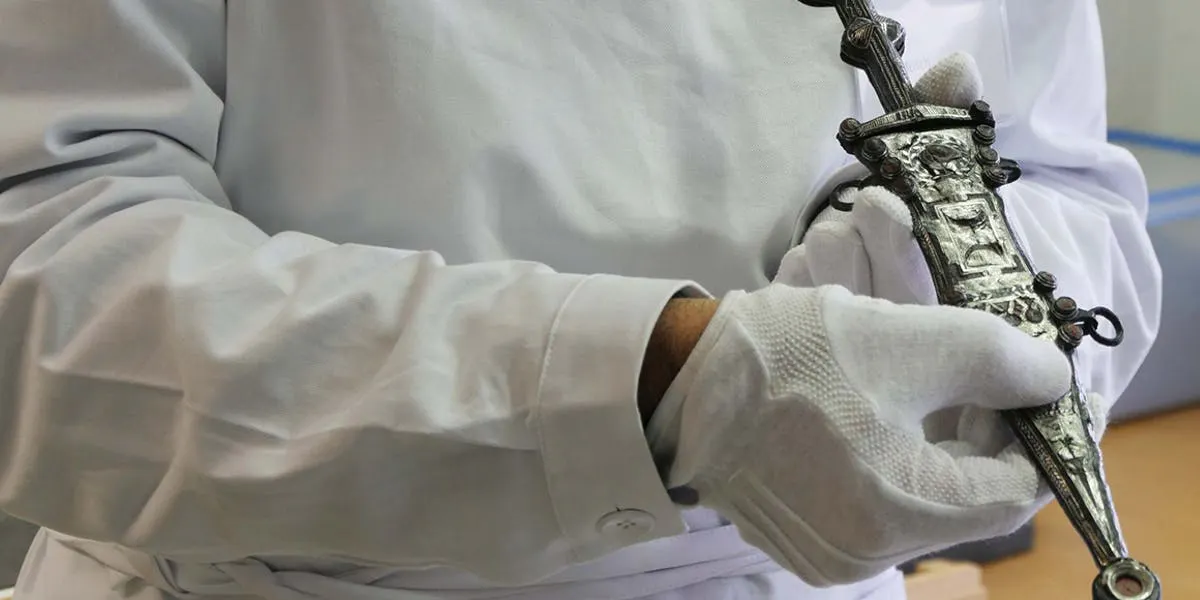
Sensational find in Haltern am See: A Roman puglio with an elaborately decorated scabbard | Photo: © LWL / C. Steimer (detail)

Sensational find in Haltern am See: A Roman puglio with an elaborately decorated scabbard | Photo: © LWL / C. Steimer (detail)

During the excavation campaign of the Westphalia-Lippe Landscape Association (LWL) on the burial ground of the former Haltern Roman camp, 19-year-old intern Nico Calmund made a sensational find in April 2019: a dagger including sheath and belt remnants of a Roman legionnaire.

The iron dagger was heavily corroded when it was found – a case for fibre optic restorer Eugen Müsch, who, after the first computer tomographic examinations, spent nine months carefully removing corrosion layers.

See also: Archaeologists Discover the World's Oldest Illustrated Book

A double-edged puglio (the usual secondary weapon of the Roman legionnaire) emerged, the handle and scabbard of which are adorned with complex designs made of sheet iron in the form of half-moons, diamonds and leaves. In addition, there are fine wires and sheets made of silver and brass, as well as inserts of red enamel and glass.
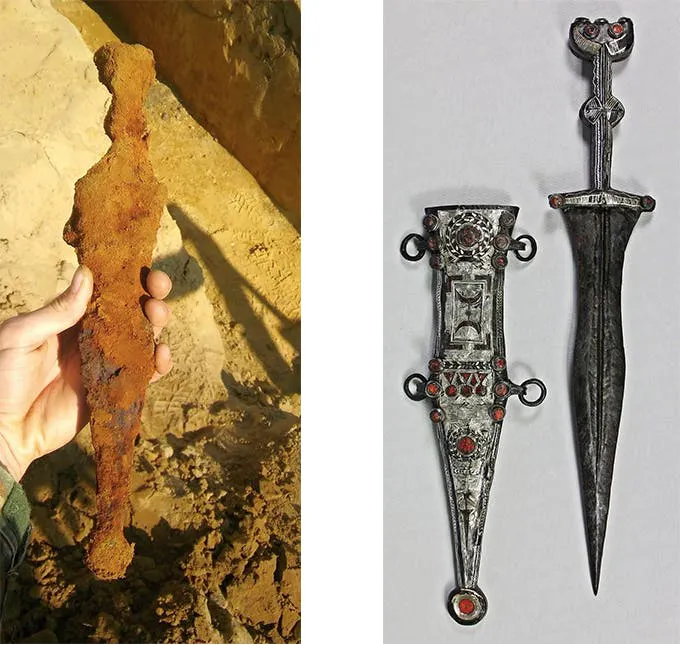
Before and after restoration. Left: Heavily corroded, the dagger and sheath came out of the earth in April 2019 | Photo: © LWL / Josef Mühlenbrock || Right: The result of the excellent restoration by LWL restorer Eugen Müsch | Photo: © LWL / Eugen Müsch

"Of course, we cannot make a 2,000-year-old object appear as new. However, the black, silver, red and gold colours largely correspond to the former look," explains Eugen Müsch.

See also: Exceedingly Rare Work by Isaac Newton is Discovered

The Haltern Roman Camp was one of several military camps that the Romans built along the Lippe River around the time of Christ's birth in order to invade free Germania. This plan came to a standstill a few years after the Varus battle (AD 9). The warehouse in Haltern was also abandoned.

The camp, which consisted of several areas, was rediscovered in 1816. Archaeological excavations have been carried out since 1899. The dagger was discovered on this camp's burial ground. Romans burned their dead and buried them in urns covered by a mound of earth.

The dagger was not found in the urn itself, but in the mound. "This site is very unusual for a classic grave addition," comments LWL Roman expert Dr. Bettina Tremmel.

See also: The Oldest Drawing of Venice is Discovered
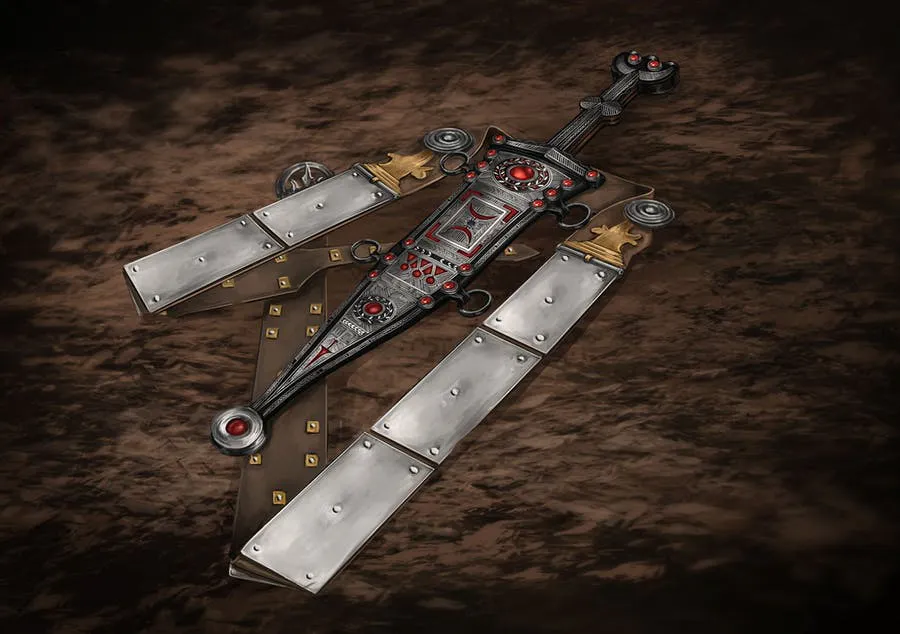
Attempt to reconstruct the original location of the find in the burial mound Graphic: Elif Siebenpfeiffer | Photo: LWL

But it is not only the place of discovery that is of great interest. "The combination of the fully preserved blade, scabbard and weir belt, including the important information about the exact location, has not been compared so far," says LWL chief archaeologist Prof. Dr. Michael Rind. So far, no such find has been found in such a good state of conservation in Europe.

The sensational find is to be exhibited at the LWL Roman Museum in Haltern am See in March 2022 as part of the archaeological exhibition of North Rhine-Westphalia in Rome.

Find more antiquities on Barnebys

antiquitiesdaggerancient romegermanyexcavation

Subscribe to Barnebys Magazine

By subscribing, you are agreeing to the privacy policy. Unsubscribe anytime.

About the author

Gritta von Toll

Gritta von Toll is the German Editor at Barnebys Magazine. She completed studies in pre- and early history and archaeology, and since 2015, after a short detour into the world of advertising, she has worked at Barnebys, where she immerses herself in art history in order to bring bygone epochs closer to today's readers.

Read more from this author
Gritta von Toll

Explore related articles

Schwerin Castle, aerial view. Photo by Harald Hoyer - Own work (licence CC BY-SA 3.0) via Wikimedia Commons / https://creativecommons.org/licenses/by-sa/3.0/deed.en (detail)
Ancient Art

The New UNESCO World Heritage Sites for 2024

Bring your auction to collectors worldwide!