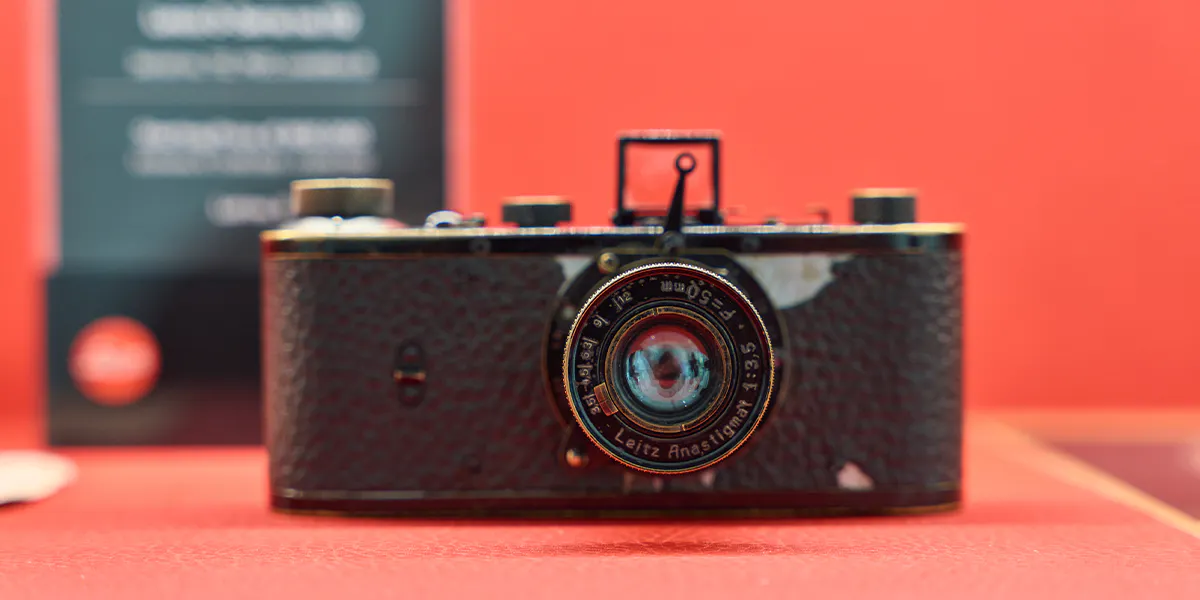
On 27 June, the 46th Leitz Photographica Auction took place at Leica Welt in Wetzlar, featuring over 400 lots, including historic cameras, accessories, and other collectible photography items.
The standout piece was a Leica 0-series camera from 1923, developed by Oskar Barnack. This model was an early prototype for what would become the world’s first mass-produced 35mm camera: the Leica I, introduced in 1925.
See also: Is a New Auction Record for a Camera on the Horizon?
“These prototypes were used to develop the trailblazing Leica I, which took photojournalism into new spheres and transformed photography from an extravagant hobby into an ubiquitous phenomenon,” said Alexander Sedlak, Managing Director of Leitz Photographica Auction. “It is a truly special occasion for our auction house, to offer a 0-Series in the midst of the 100th anniversary of the Leica I. Even more so, since this particular 0-Series was received by Oskar Barnack after production.”
Only 25 Leica 0-series prototypes were made, numbered 101 to 125. Fewer than half are known to exist today. Number 112 was the one offered at auction on 27 June. Its historical significance, rarity, and connection to Barnack led to a pre-sale estimate of €1.5 to €2 million. It ultimately sold for €7.2 million (about £6.1 million, including buyer’s premium), far surpassing expectations.
See also: The 5 Most Expensive Cameras Ever Auctioned
This sale makes Leica 0-series no. 112 the second most expensive camera ever sold at auction. The record still belongs to another 0-series model — no. 105, Barnack’s personal camera — which sold for €14.4 million (about £12.4 million) at the 40th Leitz Photographica Auction in 2022.