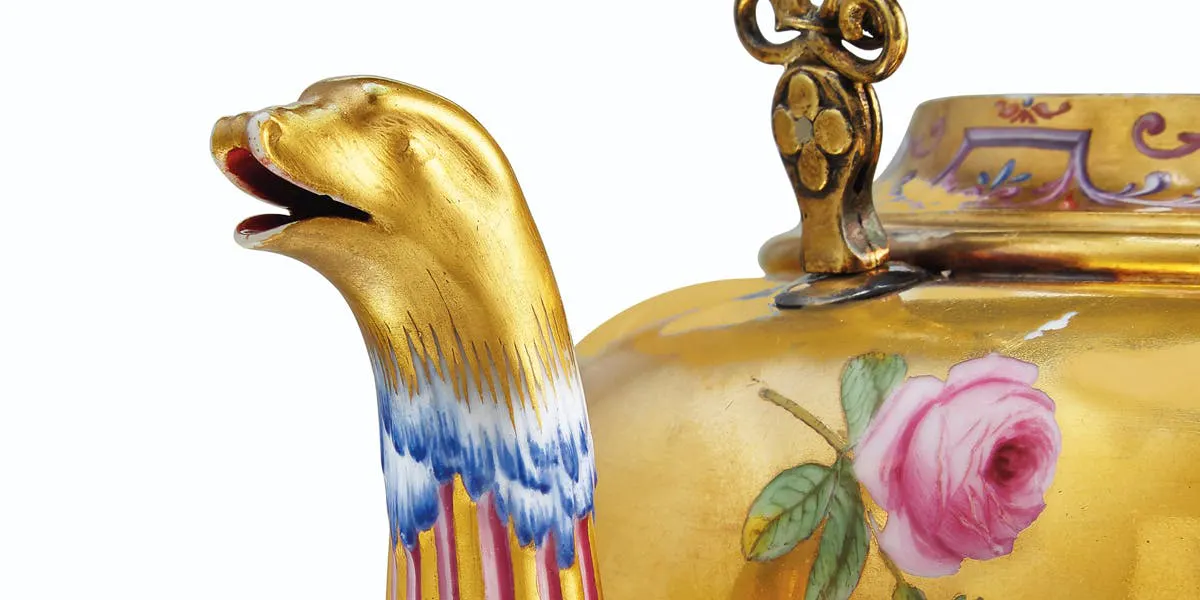
A ‘bouillotte’ teapot with royal provenance has arrived on the auction market. Made of porcelain encrusted with gold, it would have been commissioned by Queen Marie Antoinette or Louis XVI during the Versailles exhibition in December 1779. It was also during this event, where the Sèvres factory presented its creations, that the king had bought two ‘egg’ vases for the sum of £3,600, in order to offer them to his sister, Madame Élisabeth.

Although 89 examples of the teapot are listed in the sales registers of the Sèvres manufacture, only 12 can be accounted for today. Of these, eight are kept in museums, while the other four are in the United States (including three in two different private collections). This copy, acquired by the Dalva Brothers Gallery at the prestigious Hector Binney Collection auction in 1989, appears to be the only one whose golden handle threads do not form the pattern of a lyre, but rather interlace to resemble ‘L’s’.
See also: 5 Facts About Royal Mistress Madame du Barry
Produced in two sizes, the bouillotte model was introduced in 1774, with most models manufactured between 1778 and 1783. Unfortunately, the sales records contain very few references to the decoration of the models, simply noting the prices ranging from from less than £100 to £360.
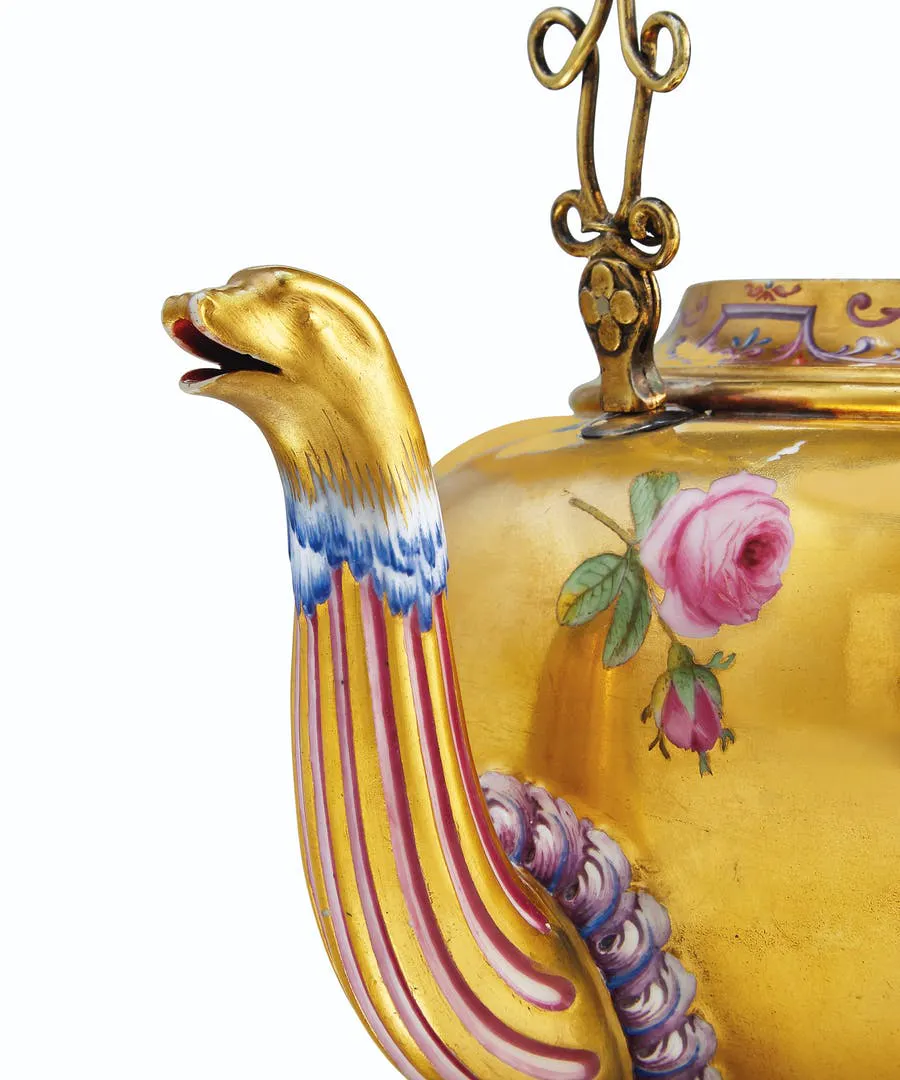
The model presented today, with its rich bouquets of flowers on a gold background, may well have been the one sold to the king for £312 or to the queen for £288, as the documents state. The teapot also bears the mark of Philippe Parpette, a painter-decorator specialising in flower decorations who was employed at the Sèvres factory after his beginnings of Chantilly and Vincennes, and after fifteen years as an enameller in Paris.
See also: Why is Napoleon So Popular at Auction?
According to payment statements dated 19 January 1779, this copy would be the one for which Parpette was paid £48. The piece is described there as a bouillotte teapot with flowers on a gold background. Specialising in this type of decoration on a gold background, Parpette counted among his clients such prestigious personalities as Tsar Paul and Empress Maria Feodorovna of Russia, who bought some of his pieces during their trips to France in 1781-82 (these objects are now kept in Pavlovsk).

The year of the creation of this teapot, 1779, was also that of furnishing the large interior cabinet of the queen, then the main room of her cabinets, entrusted to the architect Charles Gondoin. For this project, Marie Antoinette, already known for her slightly too luxurious tastes and her reckless spending, did not hesitate to order the most refined objects. If the reasons for the acquisition of the teapot are not known, we can imagine that it was used by the queen in her new quarters.
The royal bouillotte teapot will be presented at Christie's on 22 October with an estimate of $30,000 to $50,000 (£23,200 to £38,700), during the auction of the Dalva Brothers collection in New York.