
Last December, Max Beckmann's Self-portrait yellow-pink from 1943 set a new auction record in Germany, sold for 23.2 million euros (including buyer's premium) at Grisebach.
The renowned German auction house has once again prepared a first-class catalogue for its forthcoming summer sale on 1 and 2 June, which includes exceptional works from various artistic masters. The '19th Century Art' session, which will open the auction series on 1 June at 2 pm, includes, in addition to a group of 14 works by the romanticist Philipp Otto Runge, a second version of the portrait of the 19th-century German beauty Helene Sedlmeyer by Josef Stieler.
As usual, the 'Selected Works' catalogue is a true rendezvous of important painters, with 45 lots going under the hammer at 6pm.
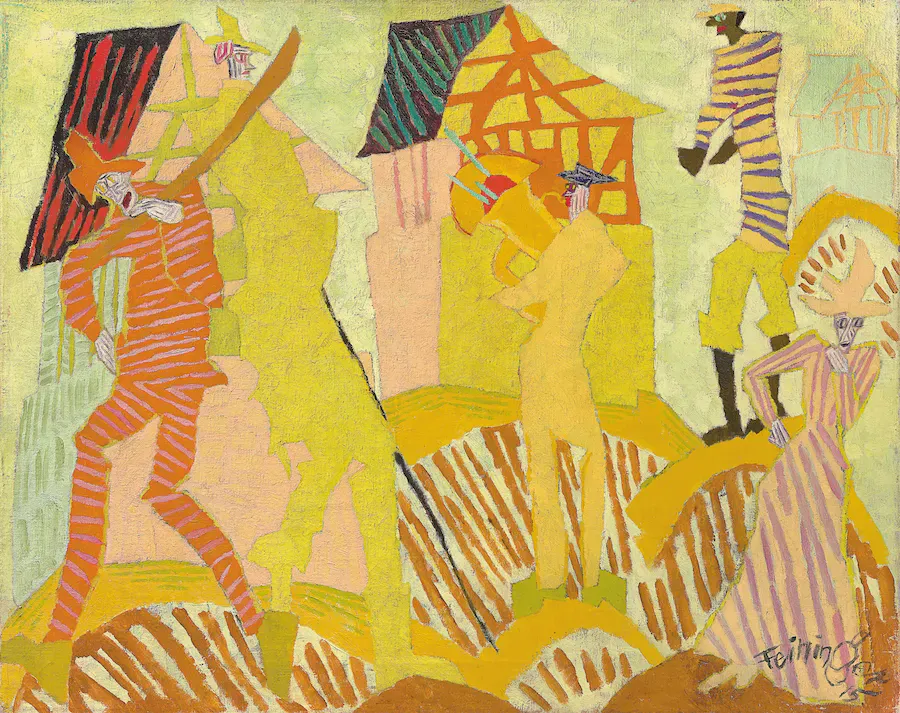
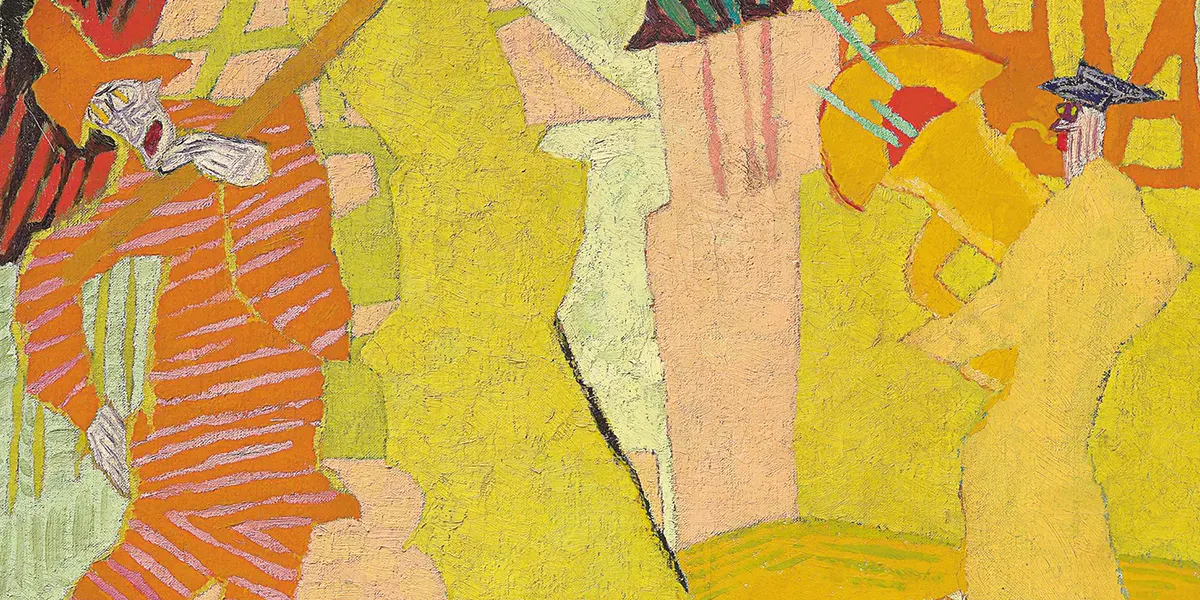
The top lot is Lyonel Feininger's oil painting Trompetenbläser im Dorf (Trumpeter in the Village) from 1915, which reflects the American artist's journey from caricaturist to painter after living in Germany. In fact, Feininger, who was later appointed to the Bauhaus by Walter Gropius, had only turned to painting a few years earlier in his mid-thirties. In this early phase, carnival images with musicians were among his recurring motifs. A musician with a tuba – contrary to the title – can also be seen in the centre of the present work. But there can be no question of an exuberant carnival atmosphere. Rather, the caricature-like figures turn away for the most part, and their hatched faces are marked by disdain. It was painted in September 1915, when the enthusiasm for war had already come to a standstill and disillusionment had set in. Trompetenbläser im Dorf comes from the estate of Lyonel Feininger and is now being offered on the auction market for the first time.

August Macke's Mann auf Bank (Man on Bench) was also acquired from the estate of its creator and is now being offered by the heirs of the buyer at the time. The painting, which is dated 1913, was probably created in the autumn of that year when Macke and his family retired to Switzerland to concentrate on his painting again. The present painting shows how Macke found a lightness that appears dynamic and idyllic at the same time - a lively composition of colour forms that appears absolutely harmonious through the skilful use of light and a reduced colour palette.
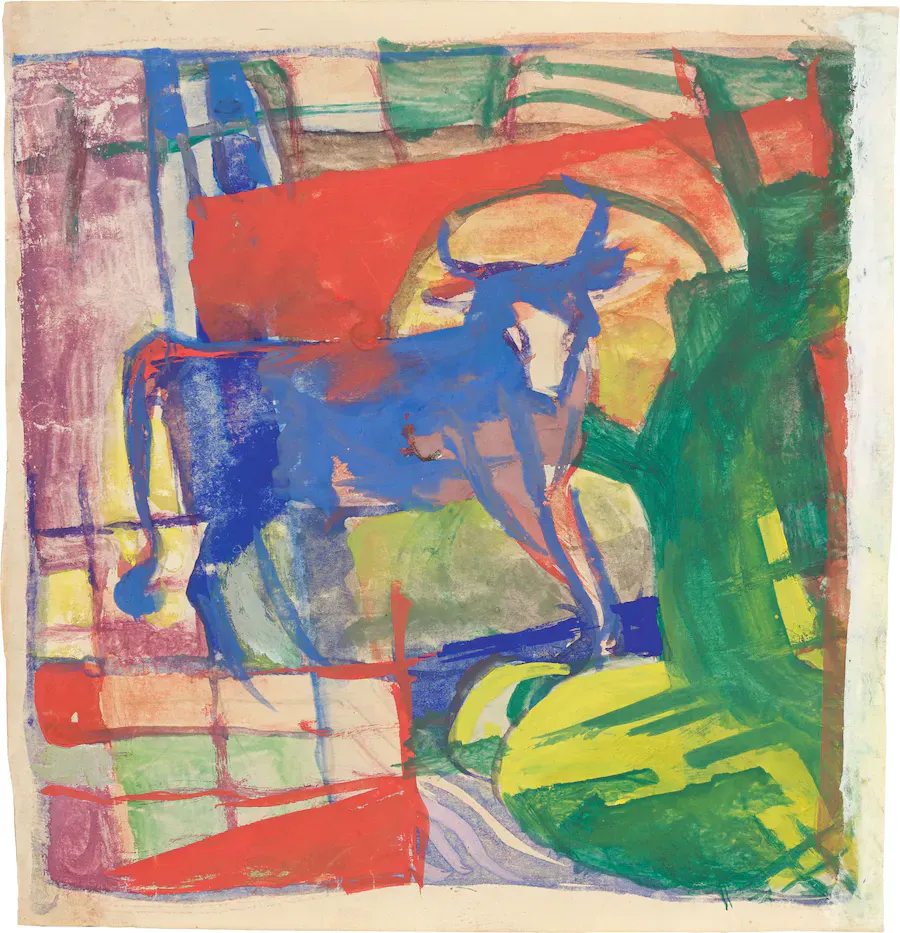
Encouraged by his friendship with the Swiss painter of animals, Jean-Bloé Niestlé, Franz Marc also turned to this subject in 1905 – albeit not in the traditional sense. Marc wanted to express the essence of animals, for him the embodiment of innocence and purity, in harmony with nature. He began to deal intensively with colours and finally created his own colour theory, which he used in his animal pictures, whereby blue stood for the male principle, yellow for the female principle and red for the all-dominating matter. Blaue Kuh (The Blue Cow,) executed in tempera on paper in 1913/14, shows a connection between a geometric composition and some natural forms.
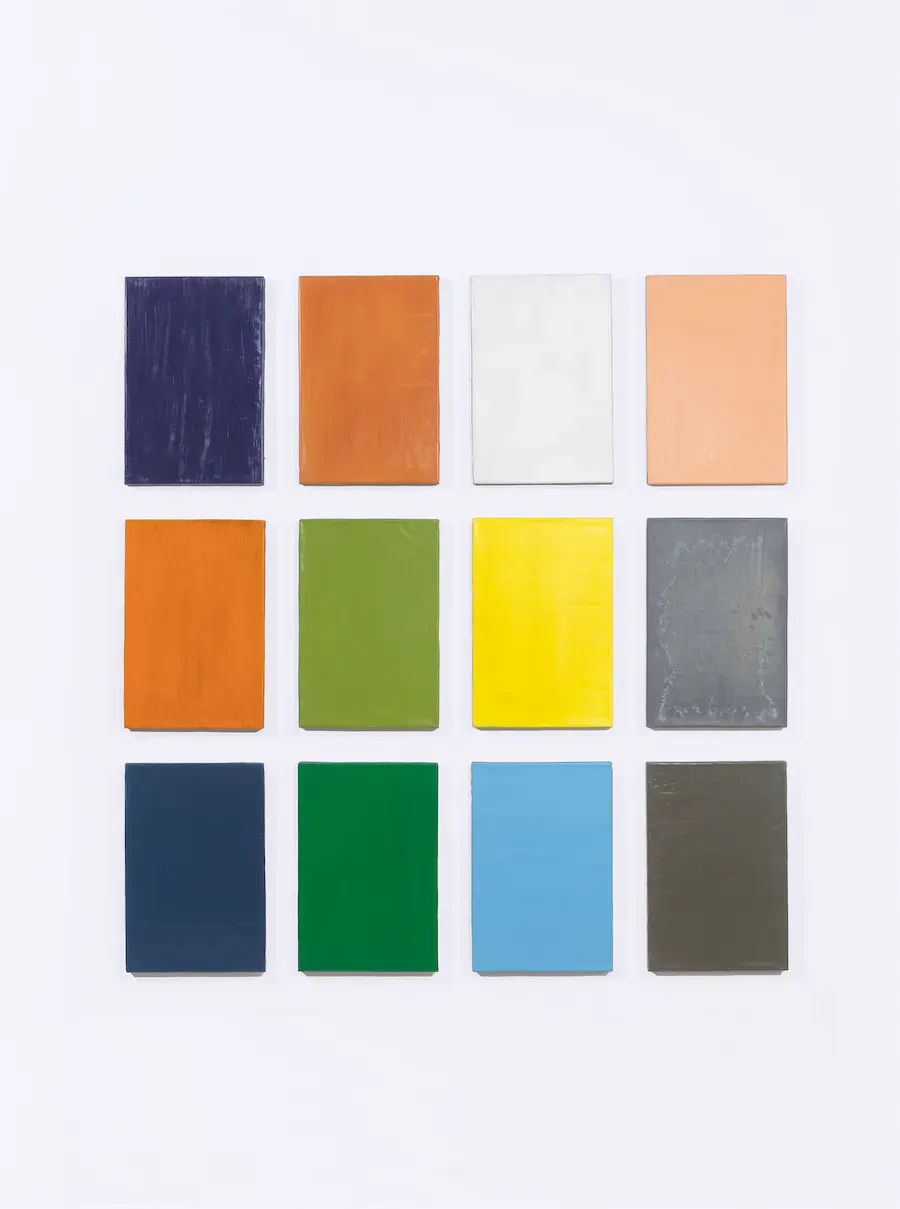
In 1984 Günther Förg discovered lead as the perfect base for his minimalist works, somehow fitting for an artist inspired by modern architecture. This unusual (and admittedly also heavy) canvas with its patina formed the perfect background for Förg's colour experiments, who applied the colours thinly or only partially, thus making the lead part of the artwork. Grisebach is offering a 12-part work from 1987 that comes from a private collection in Berlin.
Other highlights in the 'Selected Works' auction come from artists such as Lovis Corinth, Sol LeWitt, Hans Hartung, Max Pechstein and Max Beckmann. Masters of international renown will also be represented in the two auctions on 2 June dedicated to Modern Art & Contemporary Art.
The auctions will take place on 1 and 2 June at Grisebach, Fasanenstraße 27, in Berlin. The exhibition will be open there from 24 to 31 May.