
On 23 and 24 November, Tajan will host two sales of Modern and Contemporary Art with over 180 lots of spectacular works. Here are a few highlights to discover:
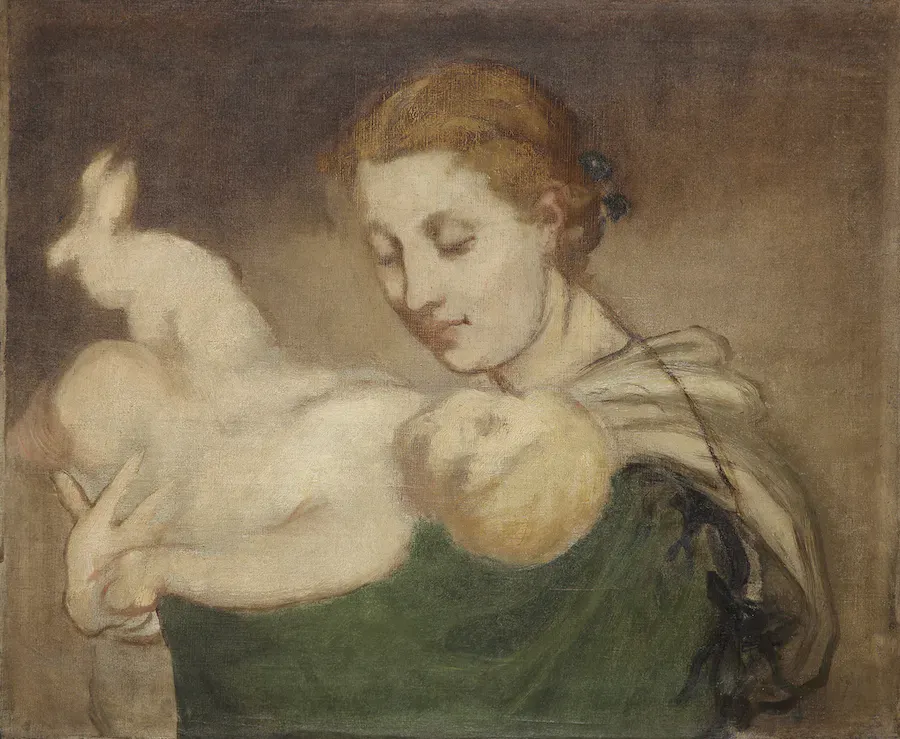
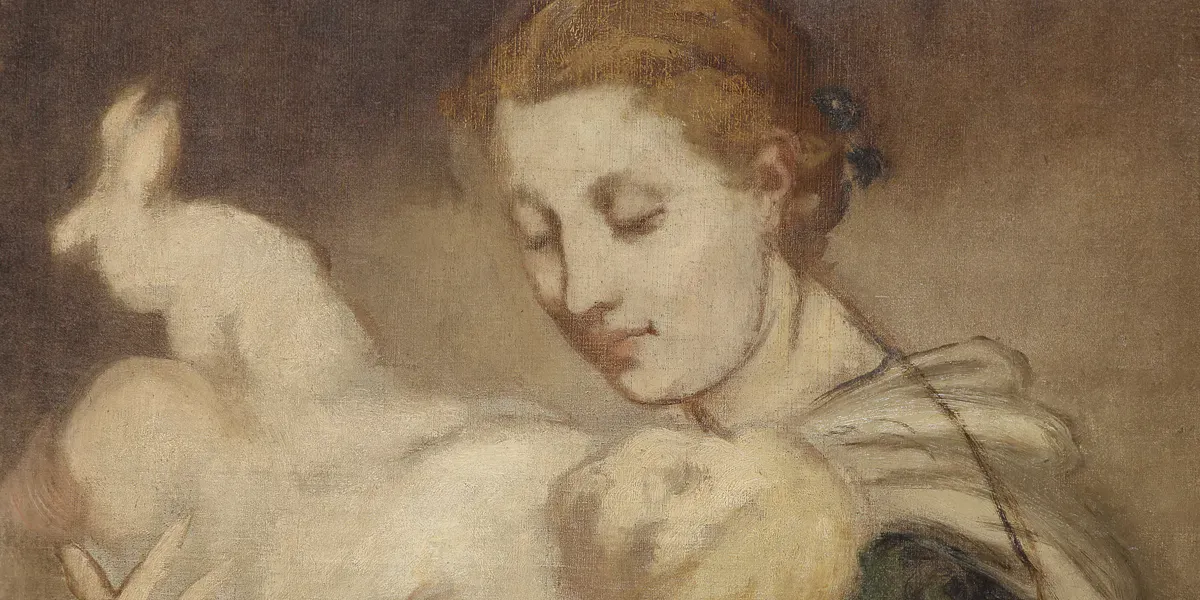
Seeking to represent modern life, Édouard Manet chose the realism of Courbet rather than the academic style of his master, Thomas Couture, with whom he had a tumultuous relationship. Leaving his studio, Manet embarked on a series of trips throughout Europe to develope his pictorial education. Moved by his wanderings, he returned to Paris, and, armed with all these memories, he undertook a series of studies from 1858 to 1860. As a link between his classical apprenticeship and his modern personal style Manet painted Moses Saved from the Waters, which he never finished. Only a figure he cut out of the canvas entitled The Surprised Nymph survives. This oil painting offered by Tajan from the collection of Paul Rosenberg is most likely related to the making of this painting, either as an independent work or as a fragment of The Surprised Nymph. In this work, we feel the influences of the great masters of the history of European art who refined the eye of Manet, if only by the Biblical subject, typical of Renaissance painters or the choice of colours with a very dark background, in homage to Vélasquez, whom he loved so much.
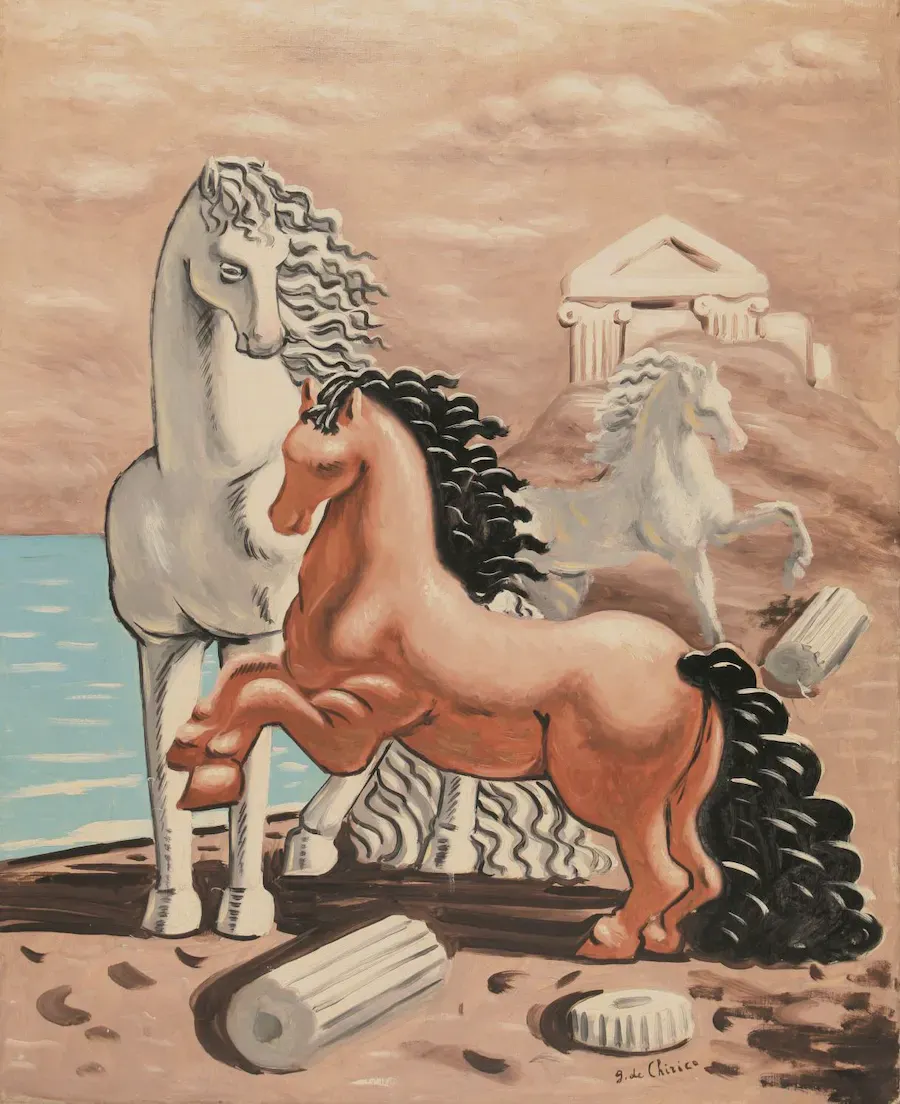
Giorgio de Chirico is one of the most influential artists of the 20th century and even, according to André Breton, the 'tutelary god' of Surrealist painting. His work is recognisable through a vocabulary of its own; deserted stations and squares, statues and lonely characters, or even these great perspectives created in the manner of the Quattrocento.
Born in Greece, he was immersed from the cradle in the myths of antiquity, and from 1906, he explored the polymorphic thought of Nietzsche as well as the symbolism of Arnold Böcklin and Max Klinger while studying in Germany. In 1910 he began his first period in Paris where he met with great success. Rubbing shoulders with André Breton, Max Jacob, Aragon, Blaise Cendrars, and even Apollinaire, "he built in calm and meditation harmonious and mysterious compositions", as the latter said. Inspired by Italy where he took refuge during the war, he began his second period in Paris in 1925, strongly disapproved of by André Breton but supported by Jean Cocteau.
Made between 1927 and 1929, this painting belongs to this second stay in Paris. It is particularly interesting since it takes up the fundamental pictorial iconography of the painter: the horse and the scenery tinged with Greek mythology. These three horses traversing a Mediterranean landscape disturbed by ancient vestiges, all in a modern style, unites the worlds of the past and the present, and is part of the continuity of his first metaphysical period.
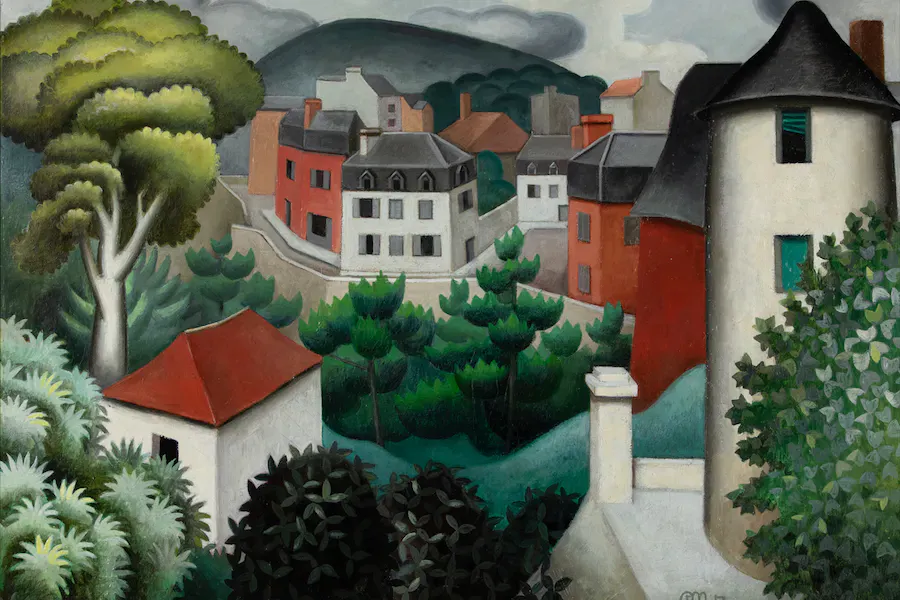
Jean Metzinger (1883-1956) was an important member of the Cubist movement. He painted and wrote poetry and essays, for example Du Cubisme with Albert Gleizes summarising the fundamentals of this key movement. Metzinger exhibited in 1907 with Robert Delaunay, Georges Braque, André Derain, and Auguste Herbin. He quickly enjoyed international recognition, particularly in the United States where he was represented by Léonce Rosenberg. This oil on canvas Suburban Landscape is one of the paintings that transited between France and the United States at that time. In this painting, Metzinger borrowed a colour palette typical of the 1920s and continued his exploration of Cubism with his own more rounded style, creating a panoramic perspective effect that would later be echoed in photography thanks to technological advances.
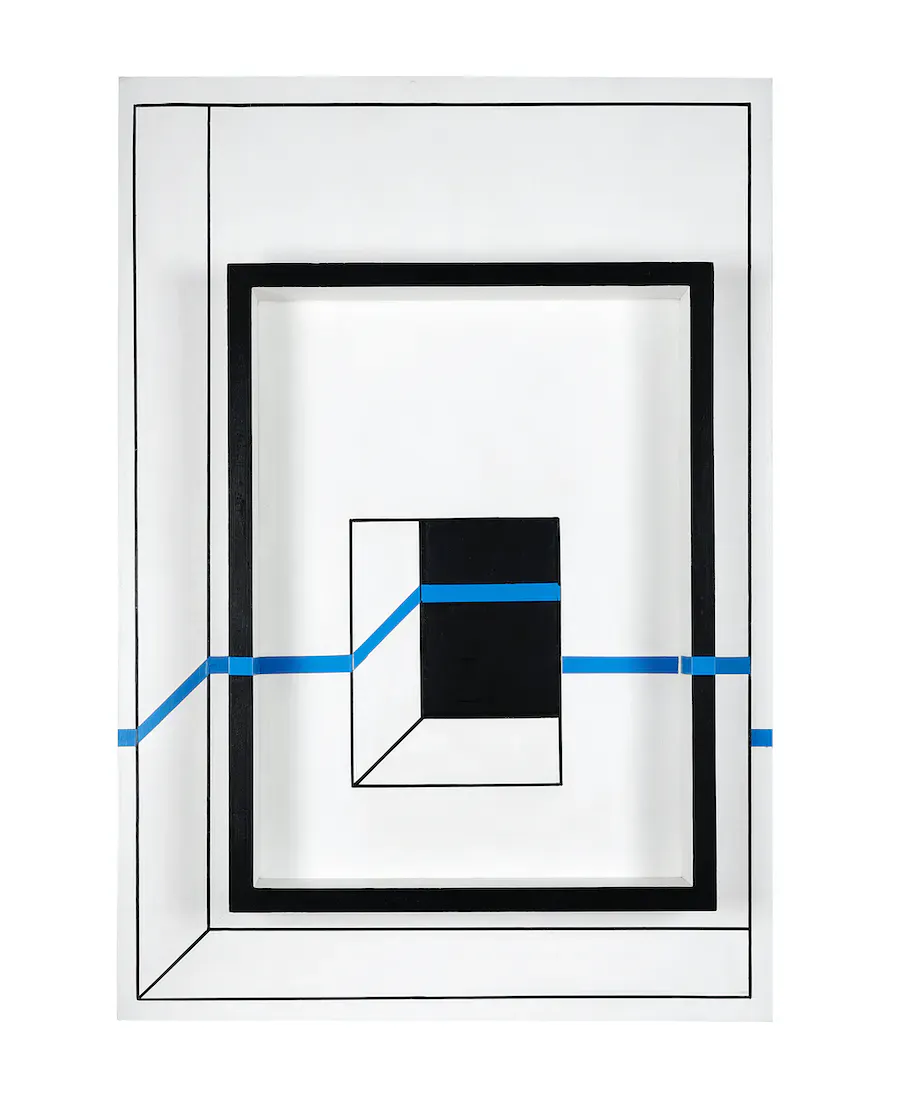
Born in what is now Ukraine in 1925, Edward Krasinski is today considered one of the biggest names in the new Polish avant-garde of the 60s and 70s. He began his artistic career in the 1950s by drawing erotica and paintings. Then in 1968 he found his signature: the blue adhesive tape that he applied everywhere, on drawings, sculptures and installations. Today, Edward Krasinski is considered one of the greatest Eastern European artists of the 20th century. Named Interventions, his axonometric paintings catch the viewer's eye and transcend two-tone lines. The artist began in the mid-1970s to add three-dimensional elements, such as frames or open cubes, to the surfaces of his axonometries, which complicate their interpretation. Here are one of those 'interventions' from 1977, whose few lines are enough to create a path in perspective inviting the gaze to sink into what could well be a tunnel.
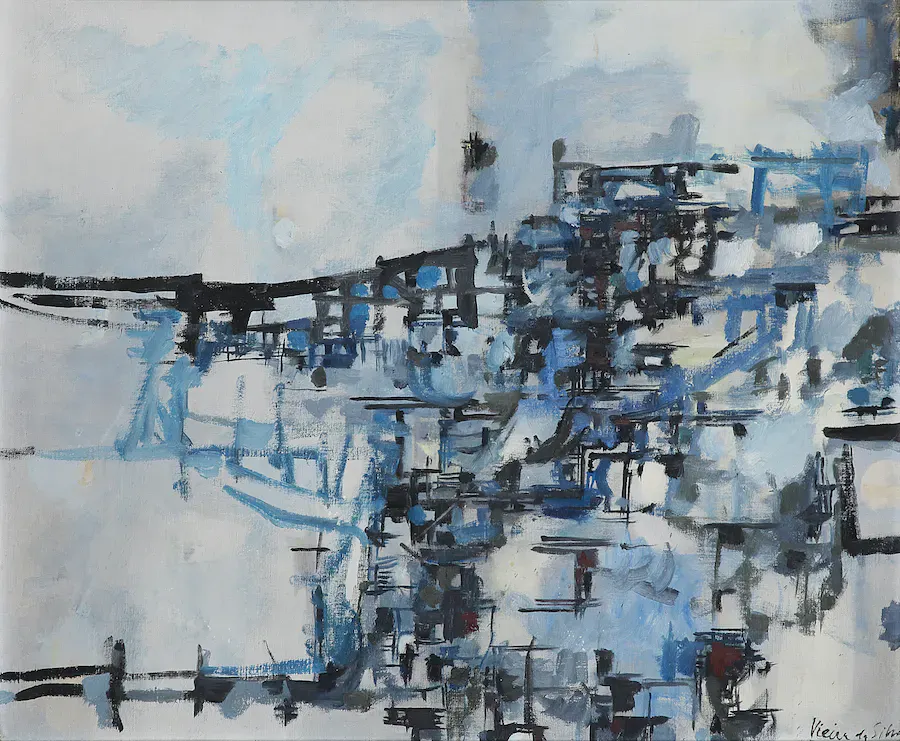
Maria Helena Vieira da Silva (1908-1992) was a Portuguese painter, naturalised French, who belonged to the School of Paris. Her pictorial style offers a space that combines networks and mosaics in compositions with fleeting perspectives. Both structured and unruly, this oil on canvas titled Storm is a fine example of Vieira Da Silva's research on the representation of space. In the 1949 words of the Galerie Pierre on this painting: “the beauty of the work is precisely this channeled power, this bursting seen in slow motion in a way [...] Rigour and freedom form an exhilarating marriage here. The art of a Mondrian was pure style, that of Van Gogh pure cry. With Vieira da Silva, style and cry are simultaneous in each painting, tightly intertwined."
Vieira da Silva received numerous awards, including the Grand Prix National des Arts from the French government in 1966. She was then named Chevalier de la Légion d'Honneur in 1979. Her works have been exhibited throughout the world and can be found today in the collections of the Guggenheim Museum in New York, the Center Pompidou in Paris, the Tate Modern in London, and a foundation in her name also exhibits her work in Lisbon.
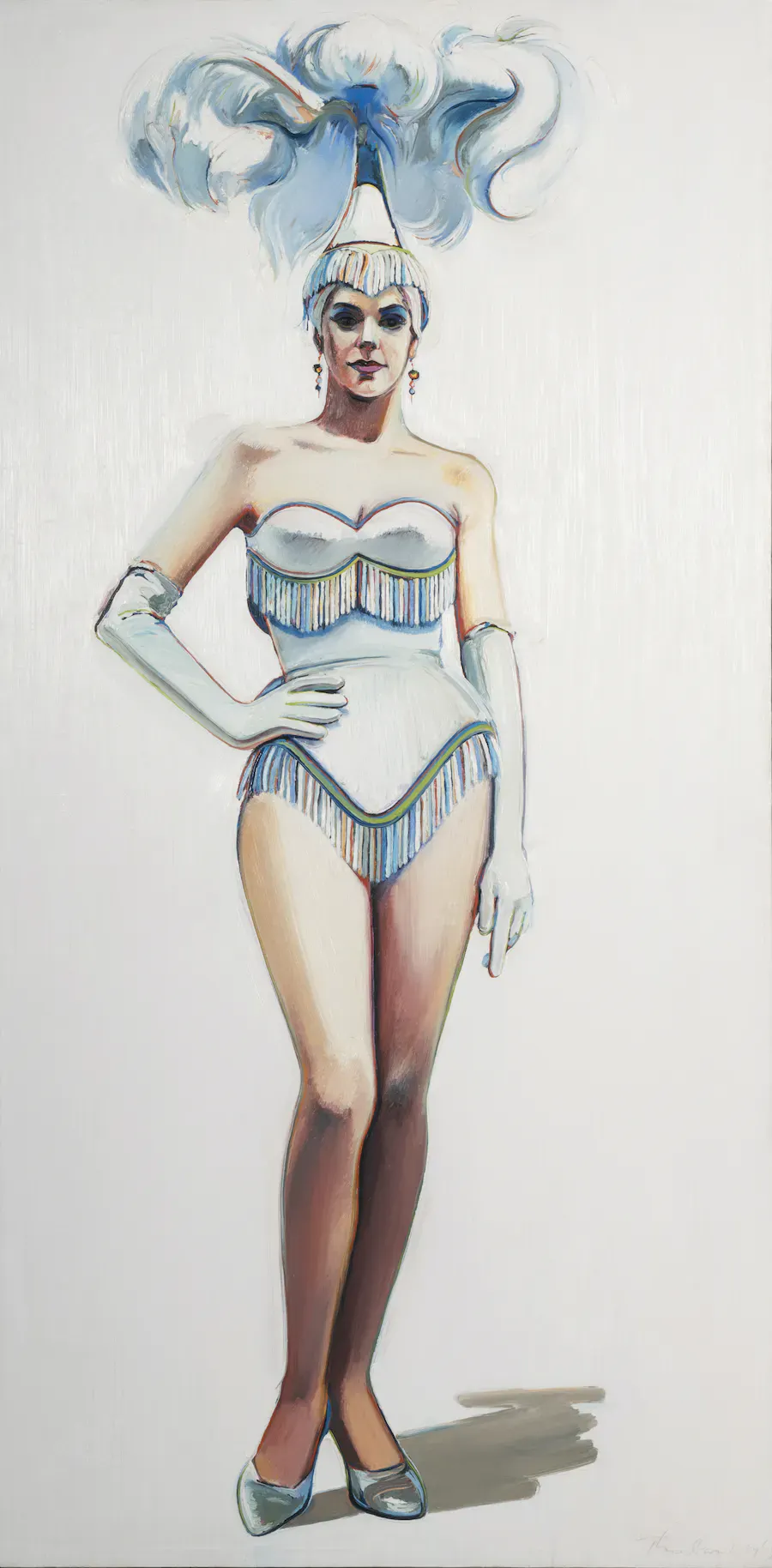
Wayne Thiebaud is an American painter known for his figurative style, notably through his still lifes of sweets and everyday objects which were exhibited very early on alongside the masters of Pop Art, Andy Warhol, Roy Lichtenstein and Ed Ruscha. Thiebaud nevertheless stands out from Pop Art, which was in full swing at the time, with a very distinctive figurative style falling within new 'American realism'.
Revue Girl is a mysterious and masterful interpretation of a burlesque star, probably actress Natalie Wood, portrayed by Warhol in the same year. This work is particularly interesting since the artist rarely painted human figures. The impassive air of the dancer despite her rather seductive and festive costume echoes the melancholy characters of Edward Hopper, a painter particularly admired by Thiebaud.
In 2019, Tajan already had the honour of presenting a work by Thiebaud from the same period, which sold for 3.3 million euros in Paris. The works of Thiebaud, who died last year, are very rare on the market.