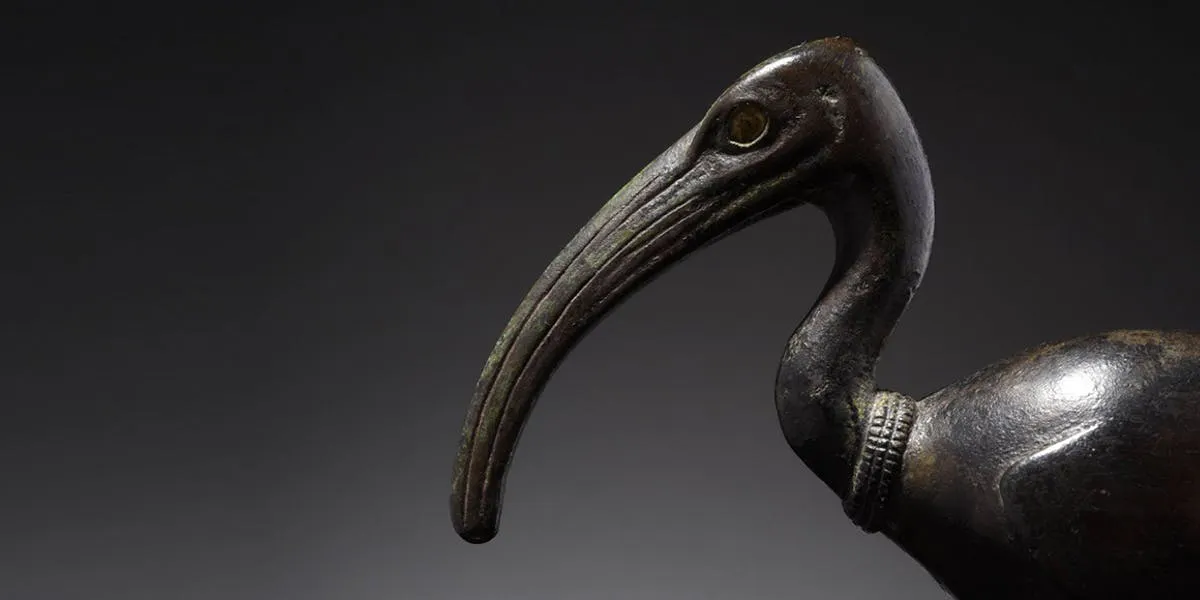
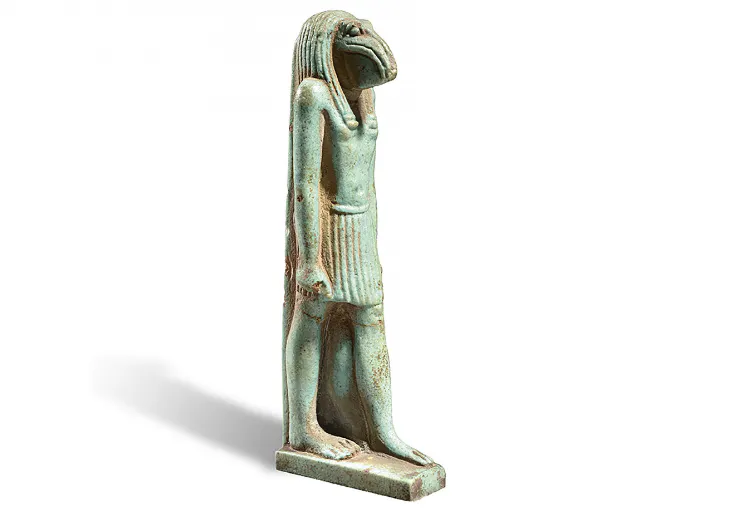
If you’re intrigued by mysterious objects from far away lands, on 22 January you’ll want to get your paddles ready.
Monaco auction house Hôtel des Ventes de Monte-Carlo (HVMC) is holding a ‘Classical Archeology’ sale, filled with an exciting mix of rare objects from all over the world, from stones and minerals to vials and vases, bowls, sculptures, totems and more. Each piece tells a unique history and story – and sheds light on a way of life far removed from our own, one that fills the pages of action-packed novels or the screens of Hollywood blockbusters.
We’ve compiled a small selection of some of the many fascinating items up for grabs.
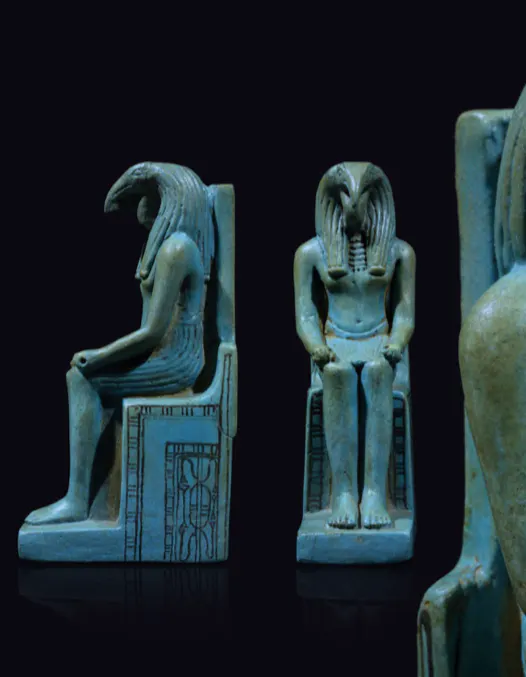
This statuette of Thoth-Ibis is made from Egyptian earthenware and black paint. He wears a striated tripartite wig, a five-row usekh necklace, and a loincloth that recalls the streaks of the headdress.
Thoth is one of the ancient Egyptian deities. In art, as is the case here, he was often depicted as a man with the head of an Ibis or a baboon, animals sacred to him. Here he is seated on a throne, his hands resting on his thighs, fists clenched.
On each side of the throne the sema-tawy (Upper and Lower Egypt) is represented, a symbol of the union of the two Lands.
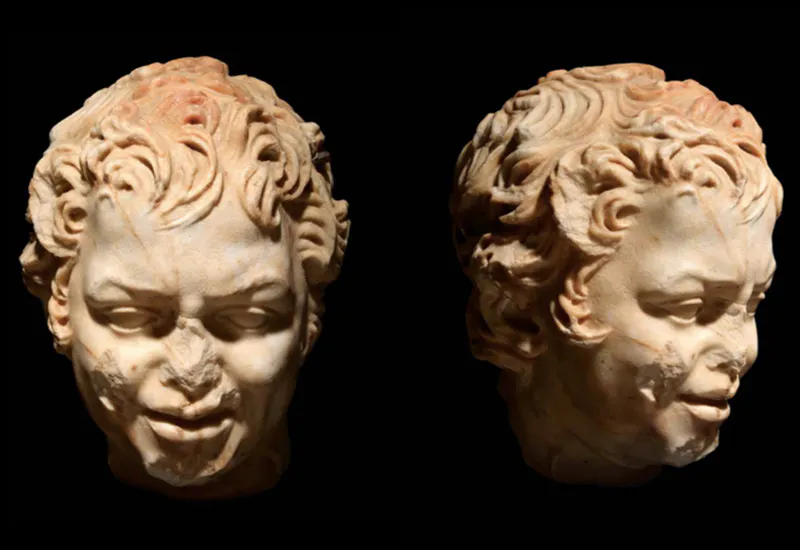
This Roman white marble head, with partial orange patina, of young Satyr is from 1st century AD. It comes from a private Belgian collection.
The Satyr is represented in juvenile lines. His head bends forward slightly, twisting to the left, his downward look accompanying his posture. His slightly open mouth sketches a smile, accentuated by the realistic designs of the cheek muscles and prominent cheekbones. The expression of his eye is accentuated by the frown of his eyebrows and wrinkles of apparent expressions.
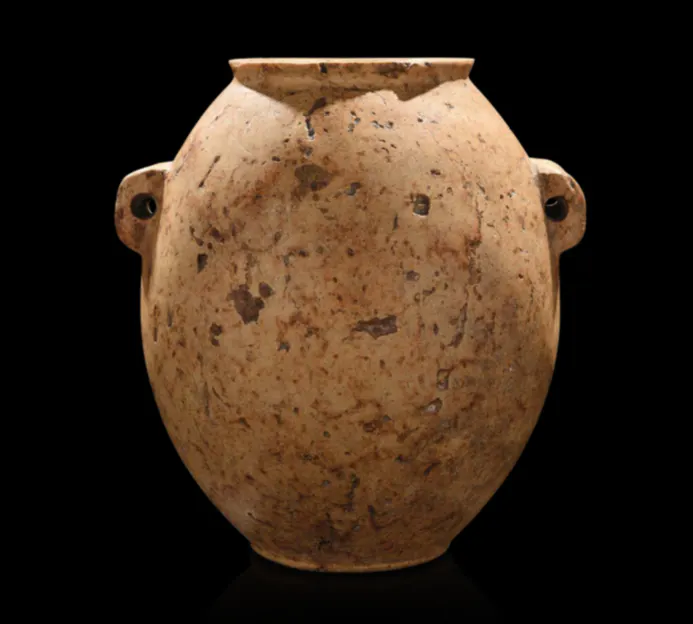
Calcite is a grey or clear carbonate mineral. This particular jar comes in yellow calcite at a height of 14.8 cm. It is Egyptian, from the Predynastic Period, Naqada II (c. 3500-3200 BC).
The jar has a round belly and flat discoidal base, slightly contoured. It has perforated tubular handles, lip slightly flared and flattened.
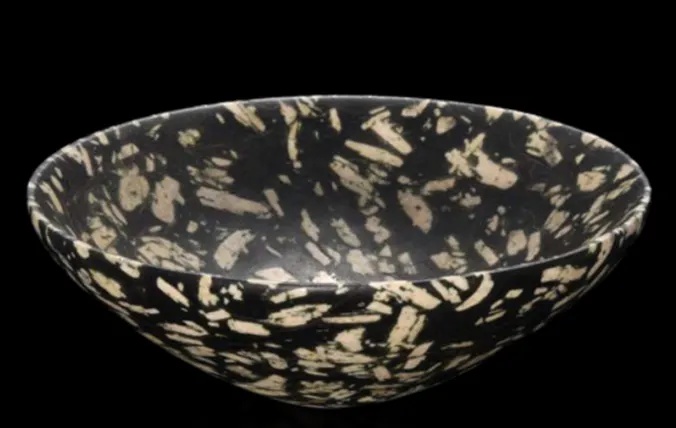
This Egyptian porphyritic diorite cup comes from the end of Naqada III (c. 3000 BC).
The cup is 12.5 cm in diameter and has a frustoconical wall and flat discoid base. It hails from France from a private collection; it was originally acquired from the Maurice Nahman Gallery in 1926, then passed by descent to the current owner.
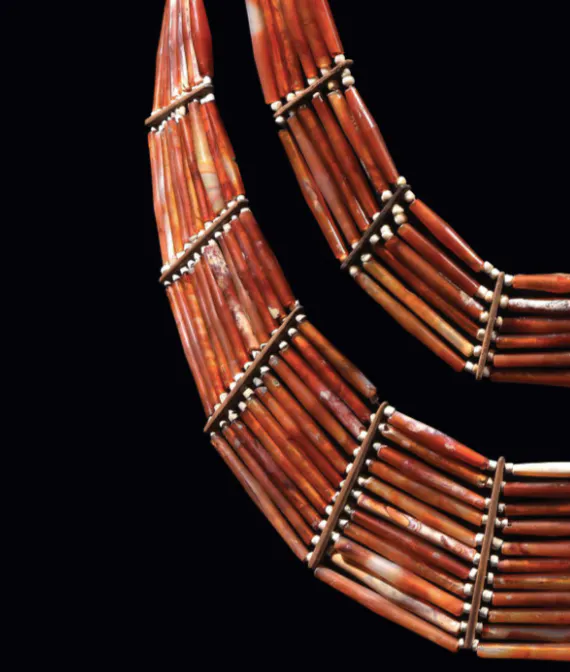
Finally, we end this foray into the past with this double necklace of pearls. It is made up of carnelian (a brownish-red mineral) hard stones. It functions with modern wooden clasps and is 42 x 45 cm. It comes from Mesopotamia, Sumer, a historical region in Western Asia (roughly corresponding today to Southern Iraq), from 3rd millennium BC.
The double necklace consists of seven rows of six conical- and biconical-shaped carnelian and agate beads for the inner necklace, and eleven rows of pearls for the large one. At the ends of the pearls are small, round white stone beads. Each row is separated by a thin wooden rod.
The necklace’s adornments of carnelian and agate are characteristic of Sumerian art, whose raw materials were imported from Turkey and Iran and India to transit through the port of Ur. Representations of these necklaces are distinguished on some terracotta anthropomorphic figures from the third and second millennium BC.
This lot is accompanied by a Certificate of Cultural Property issued by the Ministry of Culture, France and an Art Loss Register certificate.