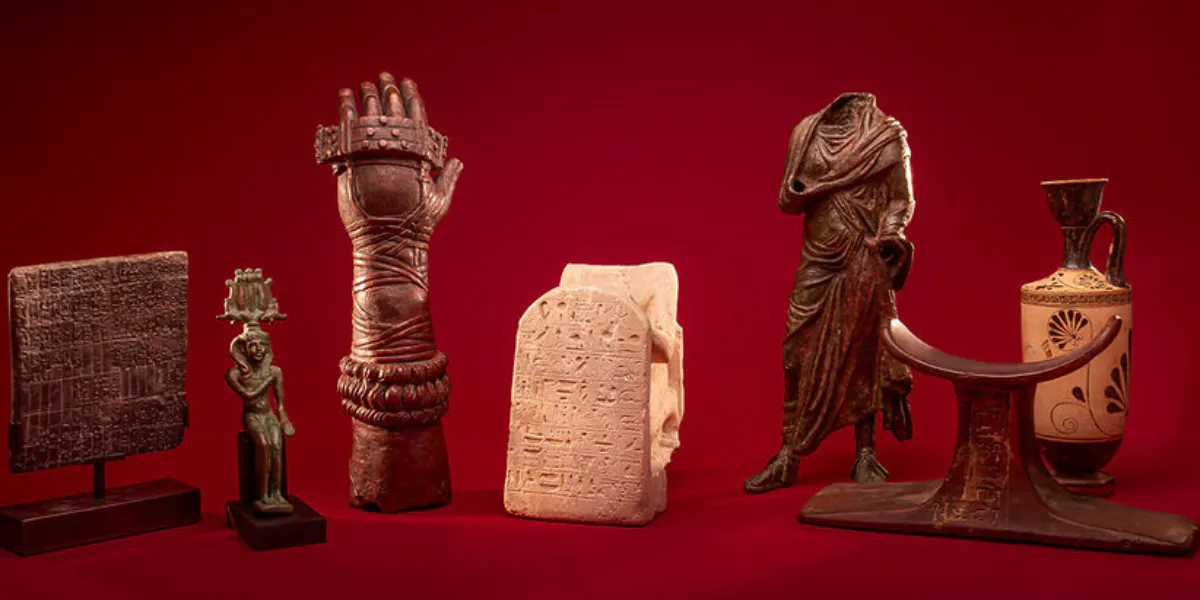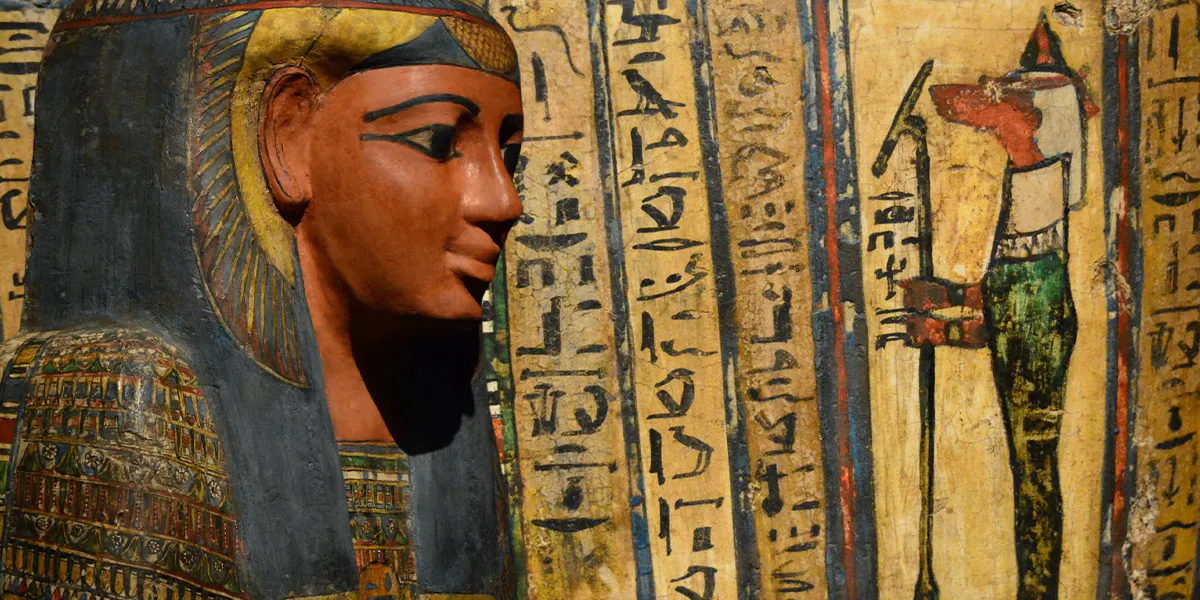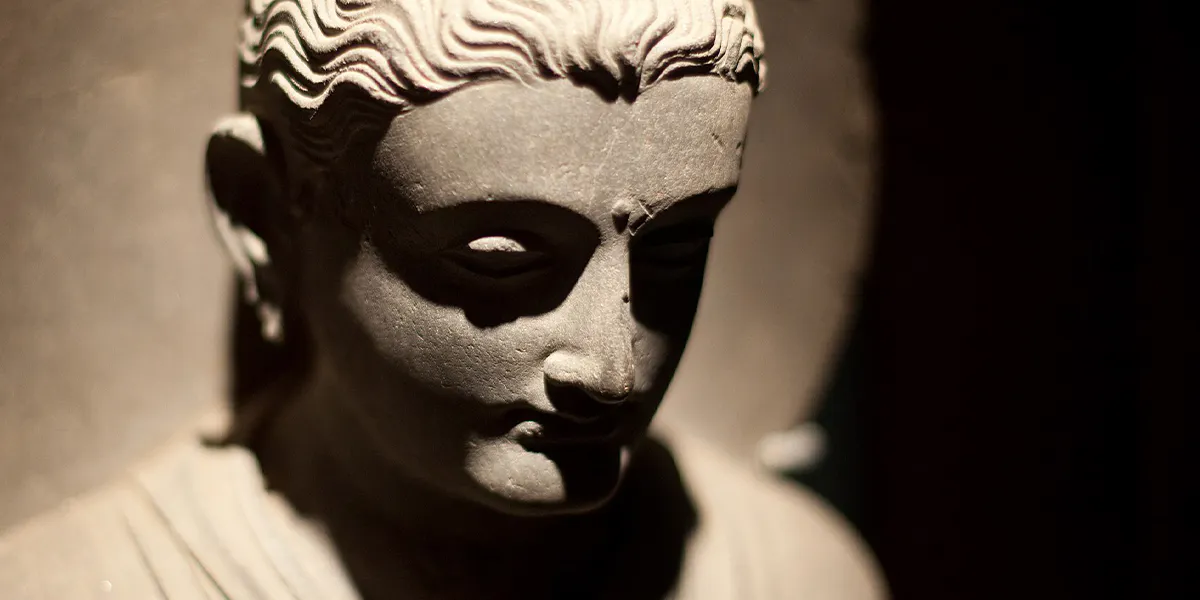
Apollo Art Auctions is set to present two major sales in late January, offering a diverse array of ancient artifacts from a variety of cultures and time periods. The Fine Ancient Art, Antiquities & Jewellery auction will take place on 25th January at 1 p.m. GMT, followed by the Fine Ancient Art & Antiquities – The Prince Collection sale on 26th January at 1 p.m. GMT. Both events will take place live at Apollo’s Central London showroom, 63–64 Margaret Street, W1W 8SW, and will also be available for online bidding through the Apollo Art Auctions platform.
The sales feature a carefully curated selection of ancient items with impeccable provenance, showcasing pieces from significant collections, including those of Axel Guttmann, Joseph Klein, and Countess Adelheid Lanckoronska, and the Prince Collection. Among the offerings are treasures from ancient Egypt, Greece, Rome, and beyond, spanning centuries of cultural history including Viking, Medieval, and Western Asiatic treasures.
Here are some of the top highlights of the sales:
Ptolemaic Gold Snake Bracelet
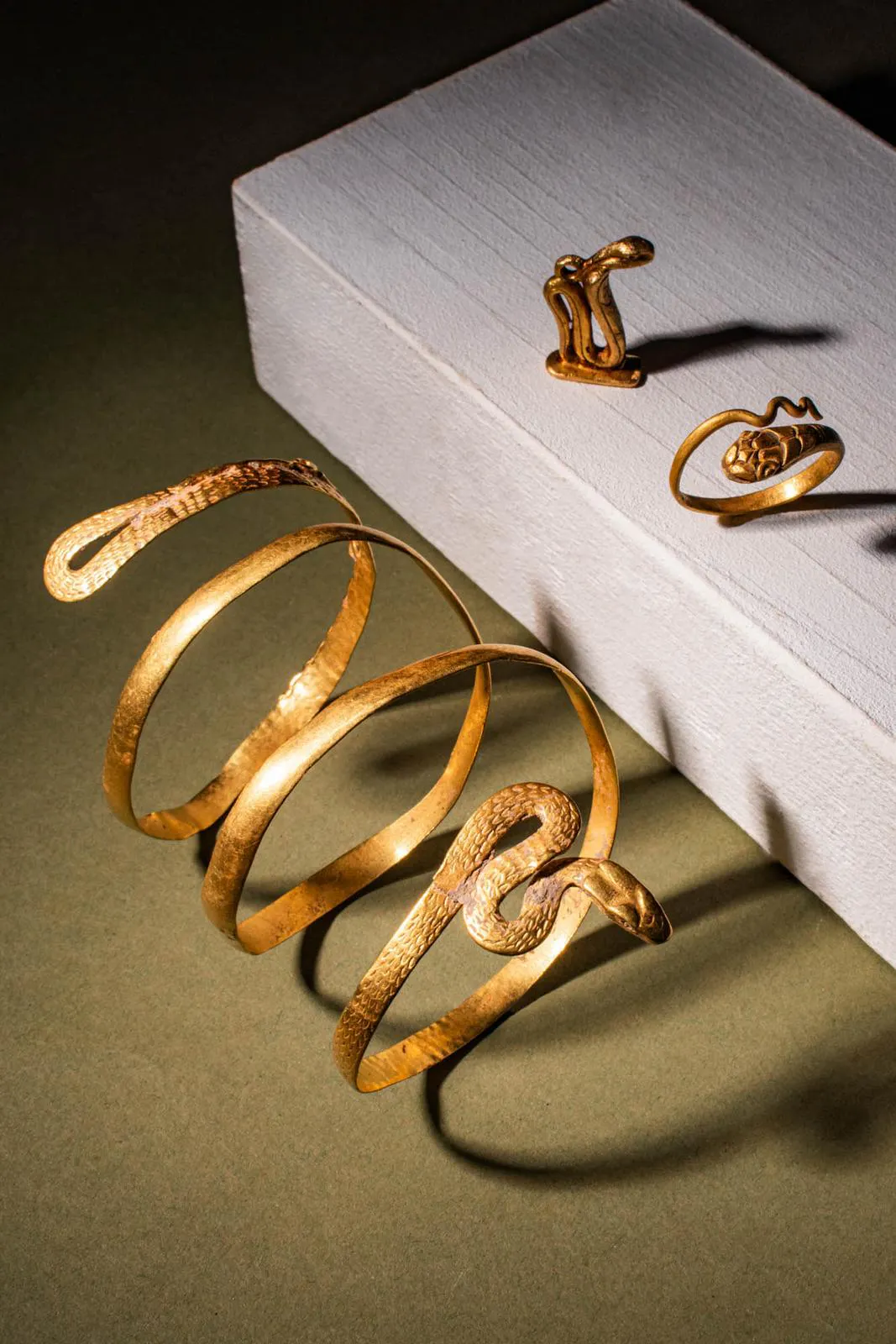
This exceptional gold snake bracelet, dating to the Ptolemaic Period (circa 332–30 BC), is crafted from 21-carat gold and features five coiled bands. The head and tail are detailed with engraved scales, while the central section of the body transitions to a smooth band. Snake motifs, popular in Ptolemaic Egypt and the wider Hellenistic world, symbolised fertility, healing, and the transition between life and death. Measuring 90 mm by 60 mm and weighing 45 grams, this bracelet traces back to a private London collection acquired during the 1980s, and has been cleared by the Art Loss Register. Additionally, the bracelet comes with an authentication statement by Sami Fortune, a specialist in ancient jewellery.
Attic Red-Figure Kylix with Oracle Scene – Circle of Douris
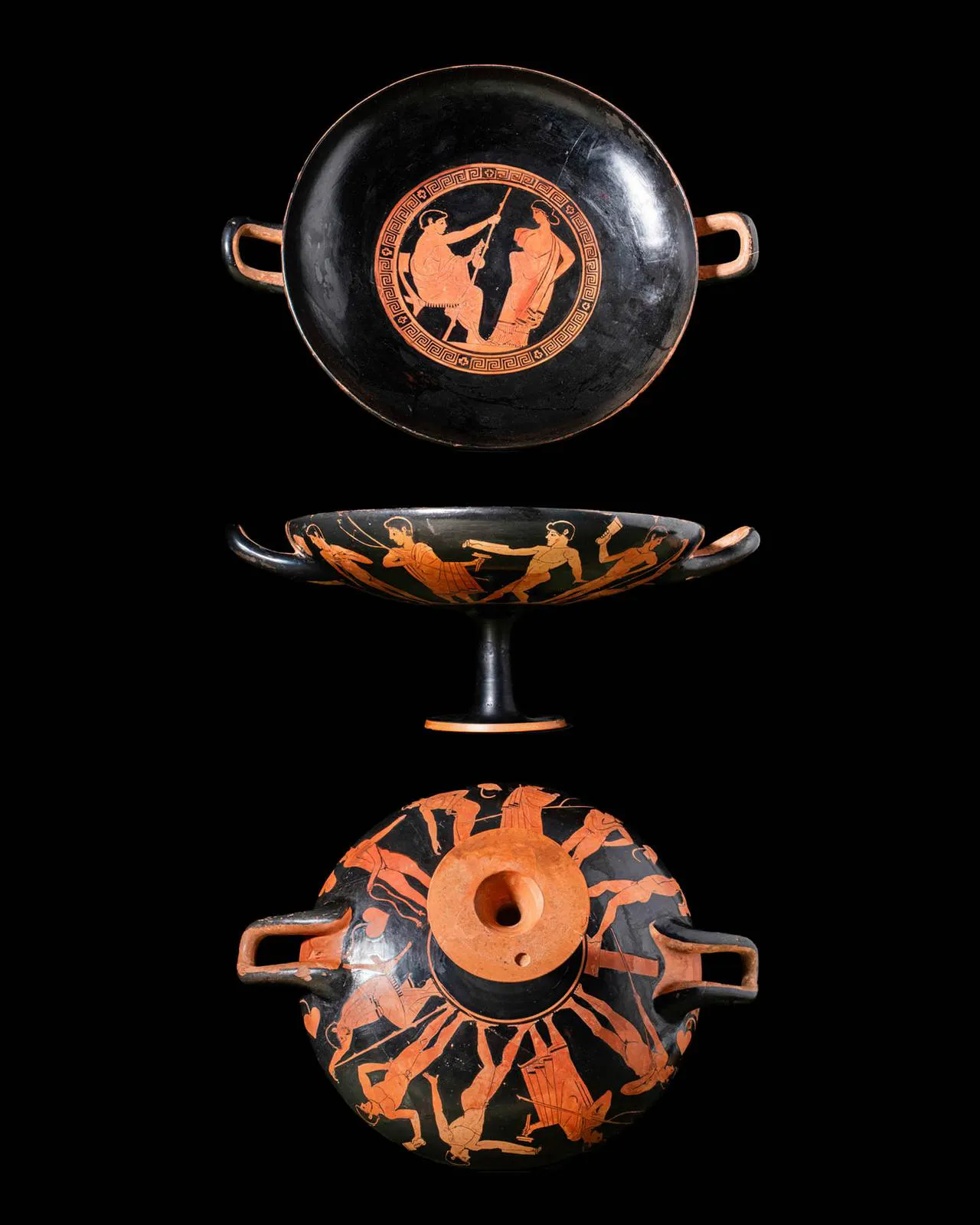
Dating to 470–450 BC, this exquisite Attic red-figure kylix from the circle of Douris, one of ancient Greece’s most renowned vase painters, depicts an oracle scene featuring a seated youth wearing a large himation holding a stick and bag, and a standing woman draped in a himation. The scene is framed by a staggered meander border, while the exterior displays ten nude athletes in various poses. Comparable to examples in major collections, such as the Metropolitan Museum of Art, this kylix is a fine example of the elaborately painted drinking cups used during symposia in ancient Greece. Its provenance traces back to the Philip Goddard collection (acquired in 1985) and Christopher Mann, London. Measuring 340 mm x 135 mm and weighing 690 g, it has been TL-tested by Ralf Kotalla, with the report included, and cleared by the Art Loss Register. A historical report by Alessandro Neri, Cultural Heritage expert, accompanies it.
Stunning Greek Corinthian Hoplite Bronze Helmet
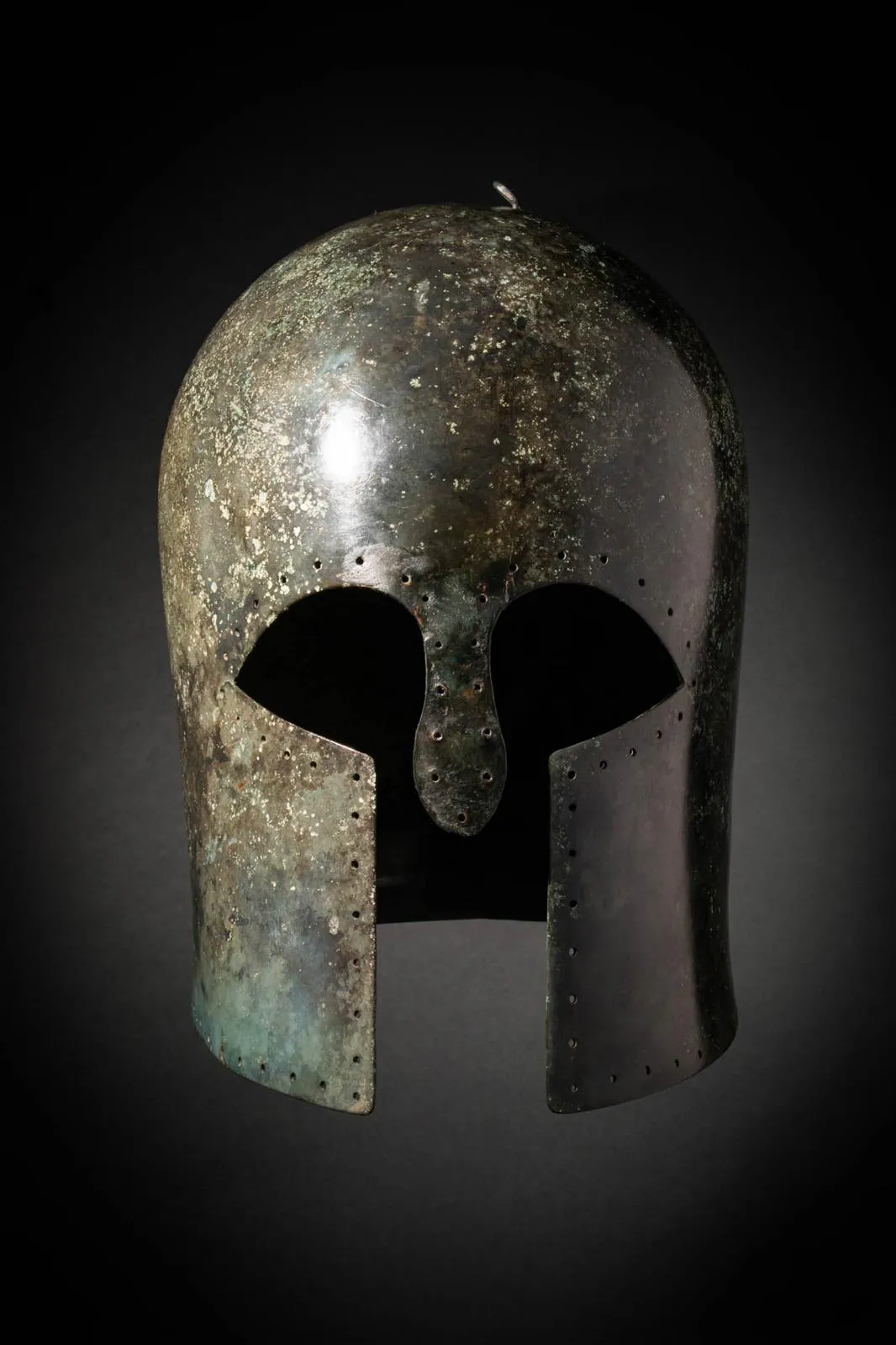
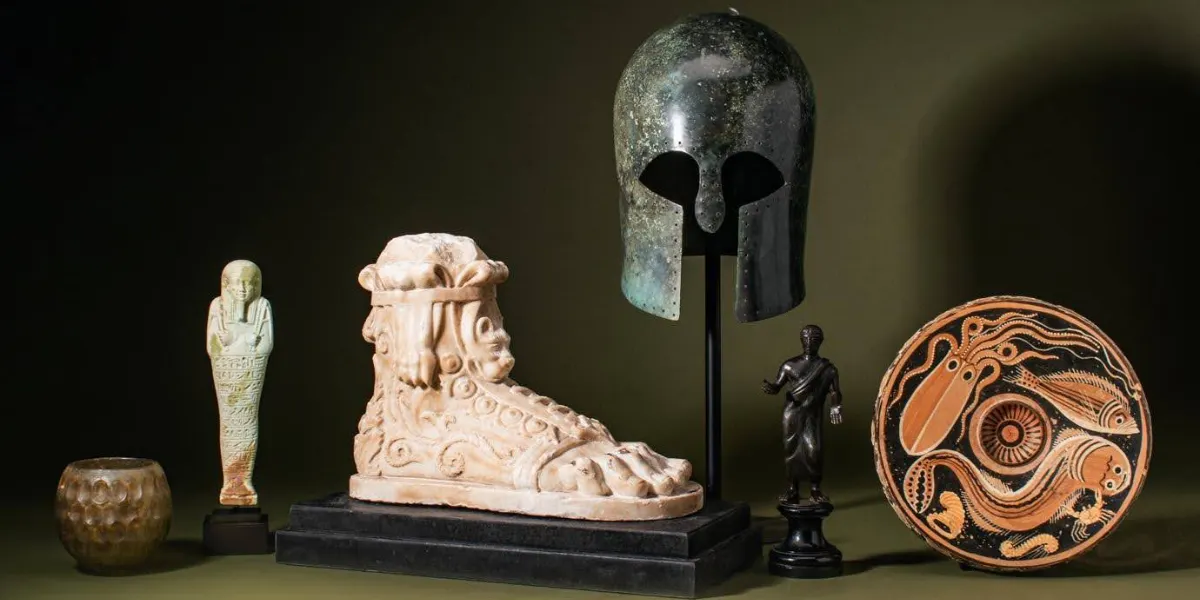
Dating to 500–450 BC, this exceptional Greek Corinthian bronze hoplite helmet is characterised by almond-shaped eye holes, large cheekpieces, and a wide nose guard. Likely cast and hammered into shape, it retains holes for rivets used to secure liners. The helmet remains in perfect, not restored condition with a smooth green patina, making it one of the best-preserved specimens on the market in recent years. Measuring 260 mm x 180 mm and weighing 1.2 kg, comparable examples can be found in the Cleveland Museum of Art, and the helmet traces back to the Wolfram Schmidt collection (1970s). Accompanied by an XRF report from an independent laboratory and a historical report by Alessandro Neri, this artifact has also been cleared by the Art Loss Register.
Roman Over Life-Size Marble Venus Statue of Campidoglio
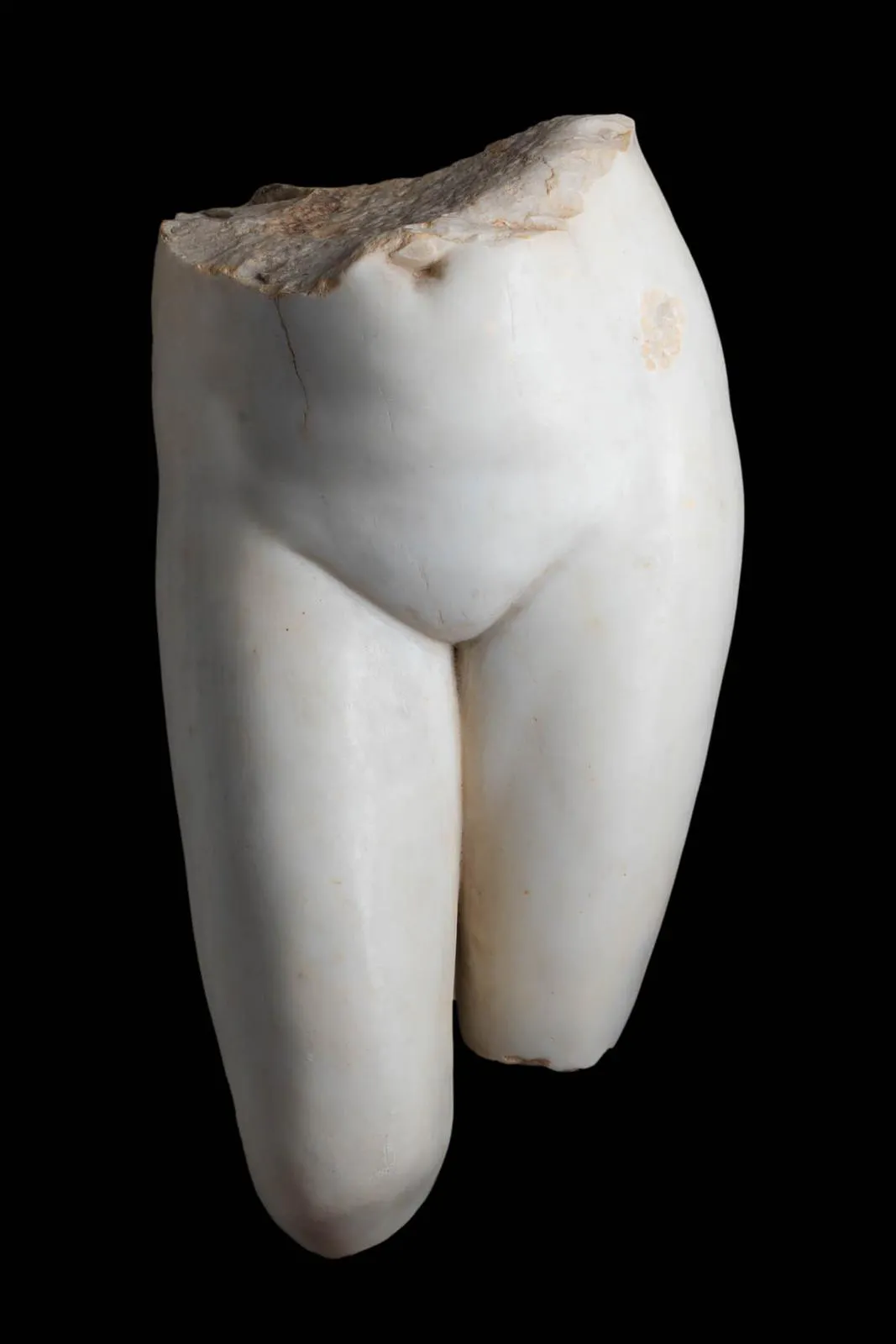
Dating to circa AD 160, this over life-size marble statue of Venus, inspired by the Venus of the Capitol and attributed to Cephisodotus the Younger, depicts the goddess emerging from the bath in a graceful, nude pose. The statue belongs to the Venus Pudica (modest Venus) tradition, with Venus depicted covering her breasts with her right hand and her groin with her left—a variation that emphasises both modesty and sensuality. This type, which traces its origins to a lost 3rd- or 2nd-century BCE variation on Praxiteles’ work, became a hallmark of imperial Roman artistry. The smooth surfaces and refined forms of the statue suggest it was created in an imperial workshop in Rome. Comparable examples include the Venus Pudica and Venus Marina in the Borghese collection. Measuring 950 mm x 400 mm and weighing over 25 kg, the piece has documented provenance from a Swiss collection (1970s), the Marcus Prill collection (2013), and Parthenon Gallery. It has been cleared by the Art Loss Register, with a confirmation letter provided, and is accompanied by a report from Prof. John Pollini, a leading expert in classical art and archaeology.
Egyptian Granodiorite Head of Amun with the Features of King Tutankhamun
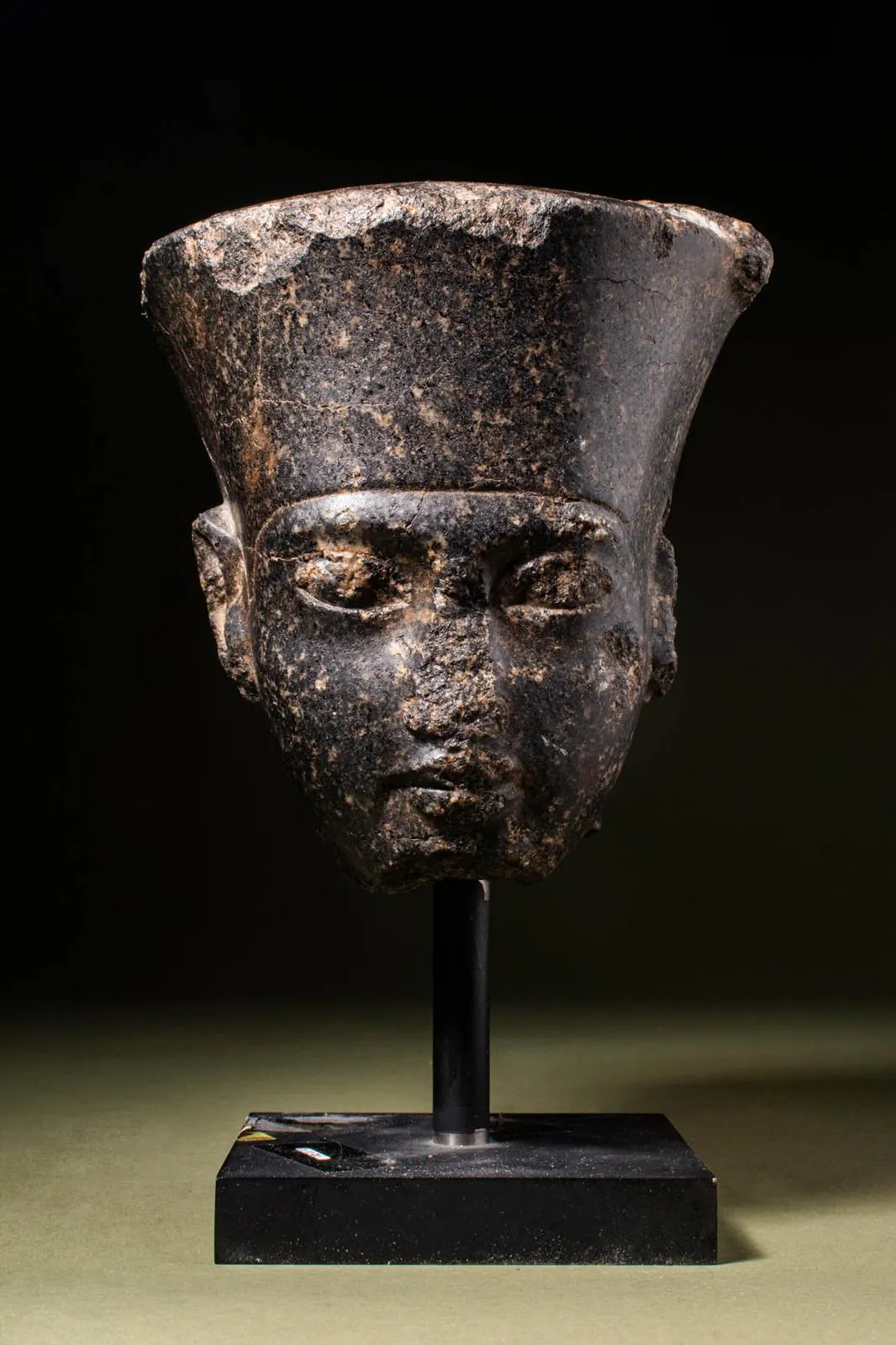
From the 18th Dynasty, circa 1336–1295 BC, this rare black stone head represents Amun, one of ancient Egypt’s most important deities, often associated with creation, kingship, and renewal. Depicted with the facial features of King Tutankhamun, the head features a braided beard, flat cap, and finely carved broad face with full lips and sharp contours. The fine carving, of excellent quality, reflect the religious importance that this piece played in antiquity, celebrating the young king’s restoration of polytheistic traditions after Akhenaten’s monotheistic experiment. Measuring 145 mm x 140 mm and weighing 4.05 kg, this exceptional piece is presented with a custom-made stand. Comparable examples include a piece in the Metropolitan Museum of Art and its provenance includes the Prince Collection (1990s–2014) and Sycomore Ancient Art (2002). The artifact is accompanied by an authentication report by Simone Musso, a historical report by Alessandro Neri, and has been cleared by the Art Loss Register.
Rare Egyptian Alabaster Royal Shabti of Amenhotep III 'The Magnificent'
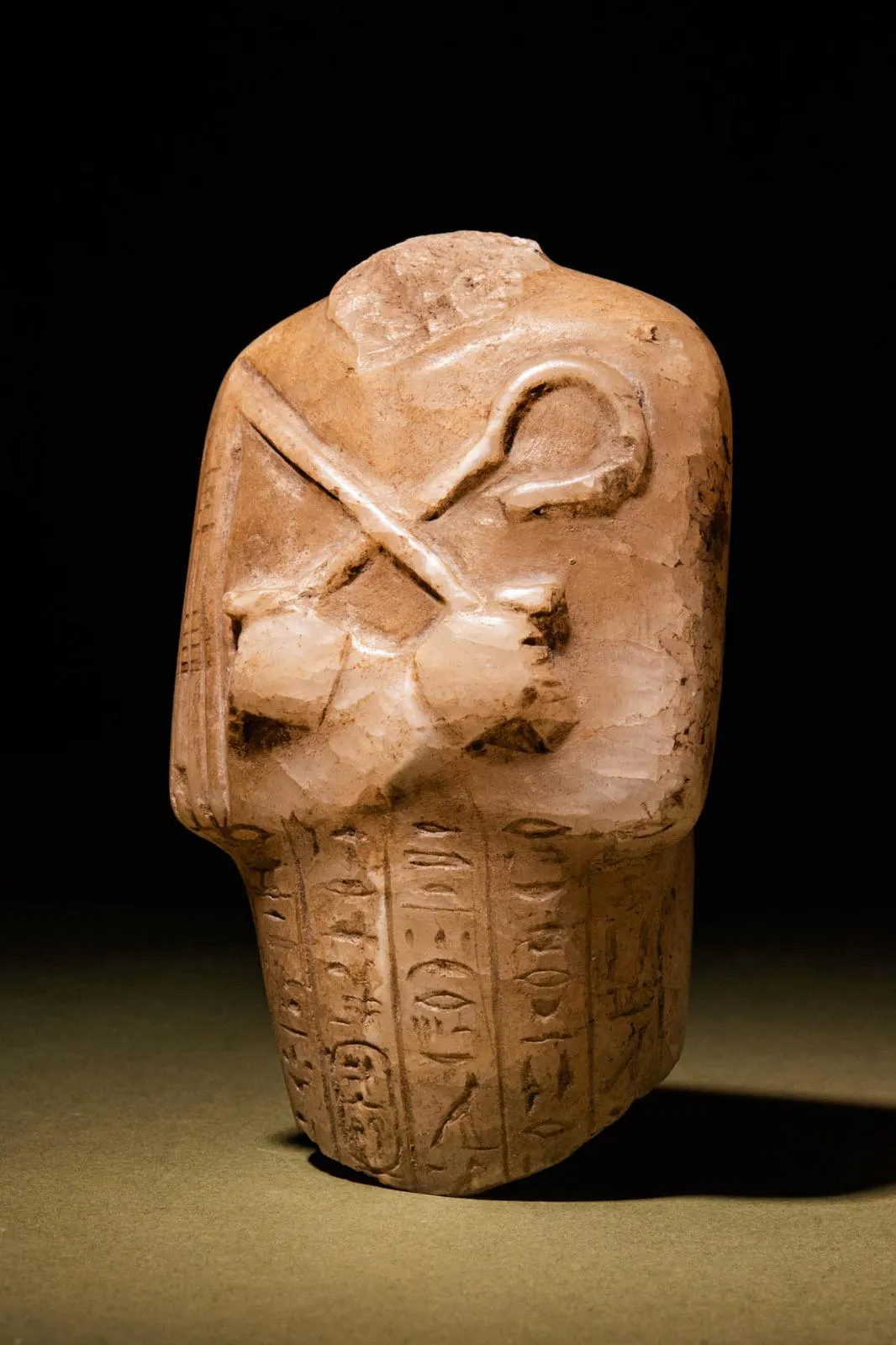
This exceptional alabaster royal shabti from the 18th Dynasty, circa 1360–1349 BC, depicts Pharaoh Amenhotep III as Osiris, the god of the afterlife, holding a crook and flail, symbols of kingship and authority. Shabtis, small funerary figurines, were placed in tombs to serve the deceased in the afterlife, performing any labor required on their behalf. Osiris, the Egyptian god of the afterlife, resurrection, and fertility, was often depicted in shabtis to signify the deceased ruler’s connection to divine authority and eternal life. The torso of this figure bears six partial columns of Chapter 6 from the Book of the Dead, an ancient Egyptian funerary text containing spells intended to guide the deceased safely through the underworld.
Originating from the pharaoh’s tomb in the Valley of the Kings (KV22), discovered in 1799 during Napoleon's expedition, this artifact offers a direct connection to one of Egypt’s most celebrated rulers. Measuring 165 mm x 65 mm and weighing 390 g, the shabti has provenance from the Prince Collection (1990s–2014). It is accompanied by a full authentication report by Simone Musso, consultant curator for Egyptian antiquities at the Stibbert Museum and member of the Nuri Archaeological Expedition.
All items will be available for in-person preview from 20th January to 24th January 2025, by appointment at Apollo’s Central London showroom. Live bidding begins on 25th January 2025 at 1 PM GMT. Registration is required to bid.
Find more information about the sales on Apollo Art Auctions!