
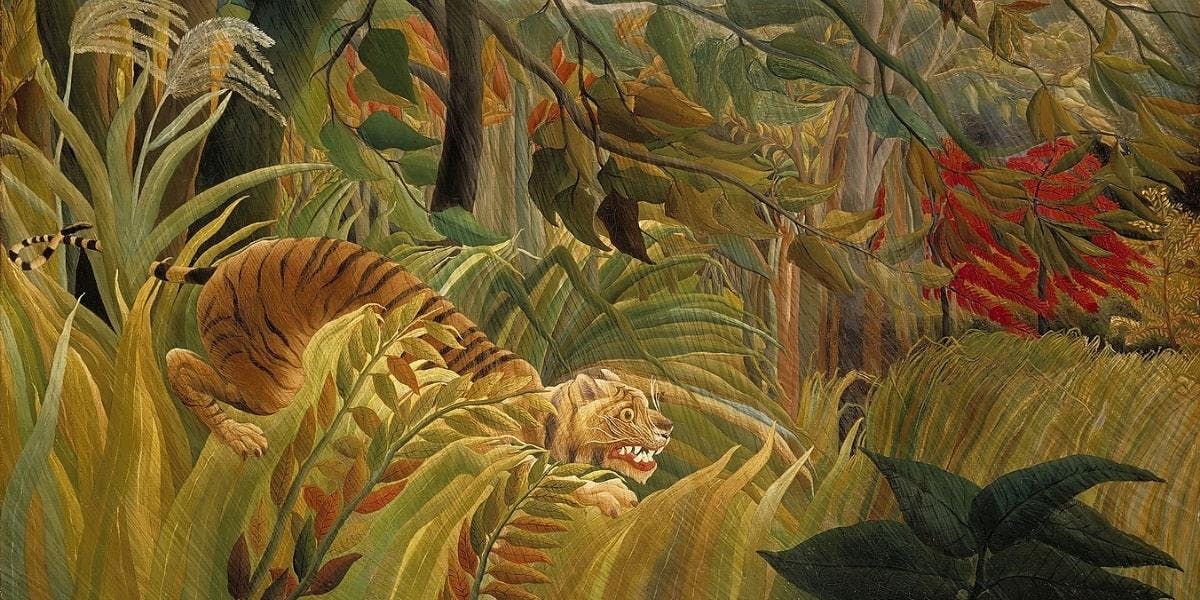
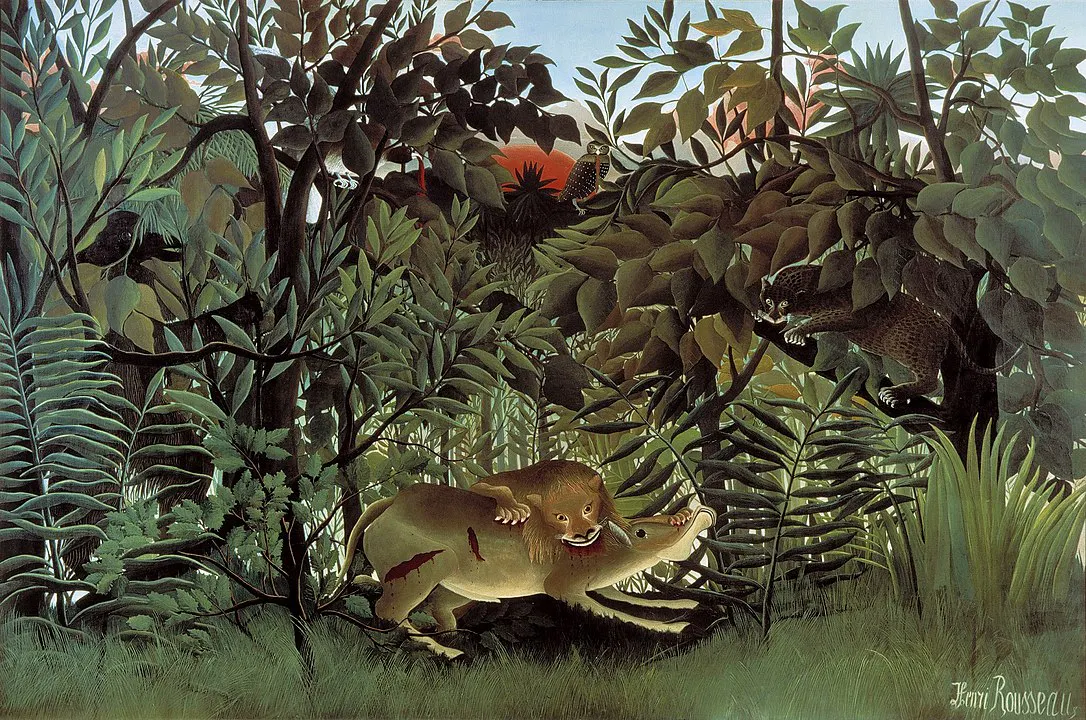
His tiger surprising its prey ought not to be missed; it's the alpha and omega of painting.
So where did this Frenchman who never left France find the inspiration to depict enigmatic jungles? Influenced by the illustrations in children's books and Paris' lush botanical gardens and taxidermy tableaus, Henri Rousseau (1844-1910) imagined his own leafy landscapes brimming with exotic plants and wild animals. While serving in the French army, Rousseau would also hear the tales of the jungle as told to him by survivors of French expeditions to Mexico. From this, he crafted fanciful scenes on canvas.
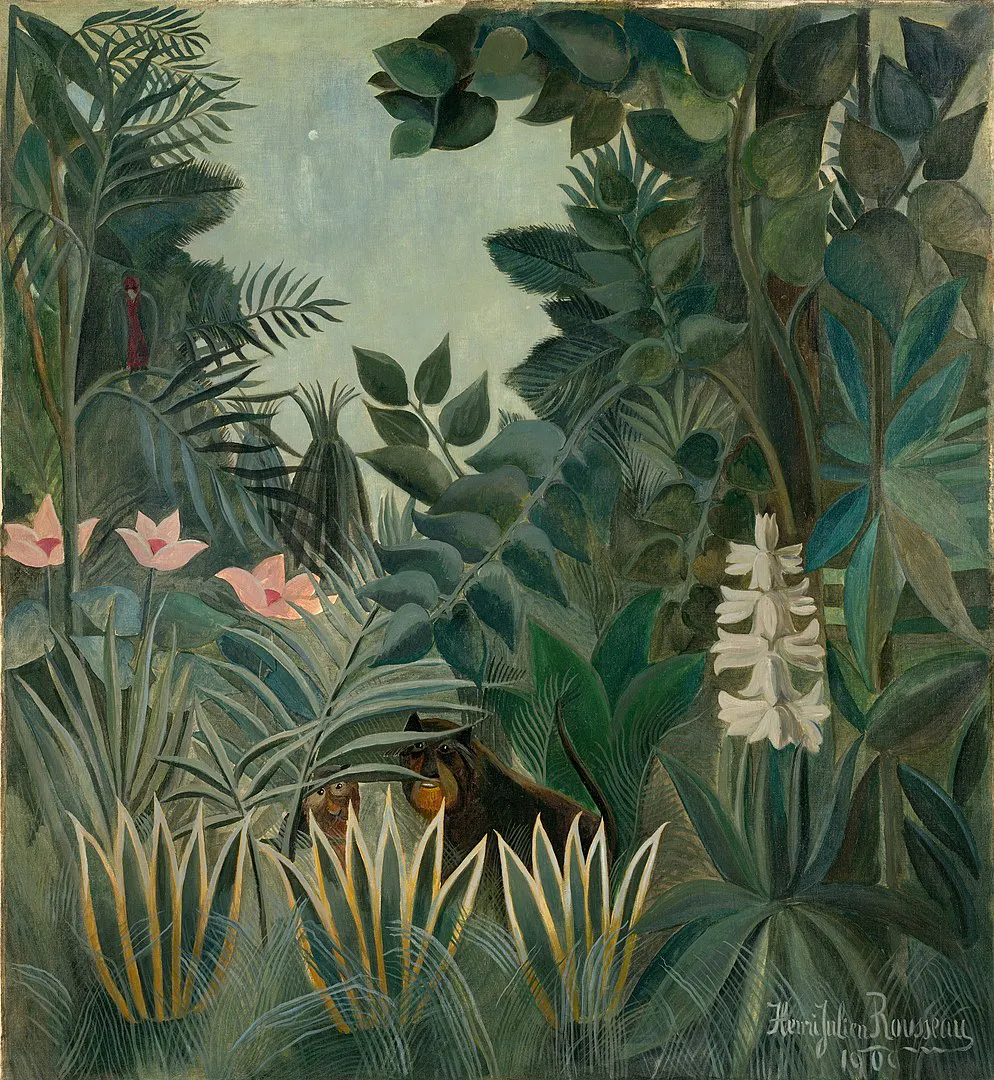
When I go into the glass houses and I see the strange plants of exotic lands, it seems to me that I enter into a dream.
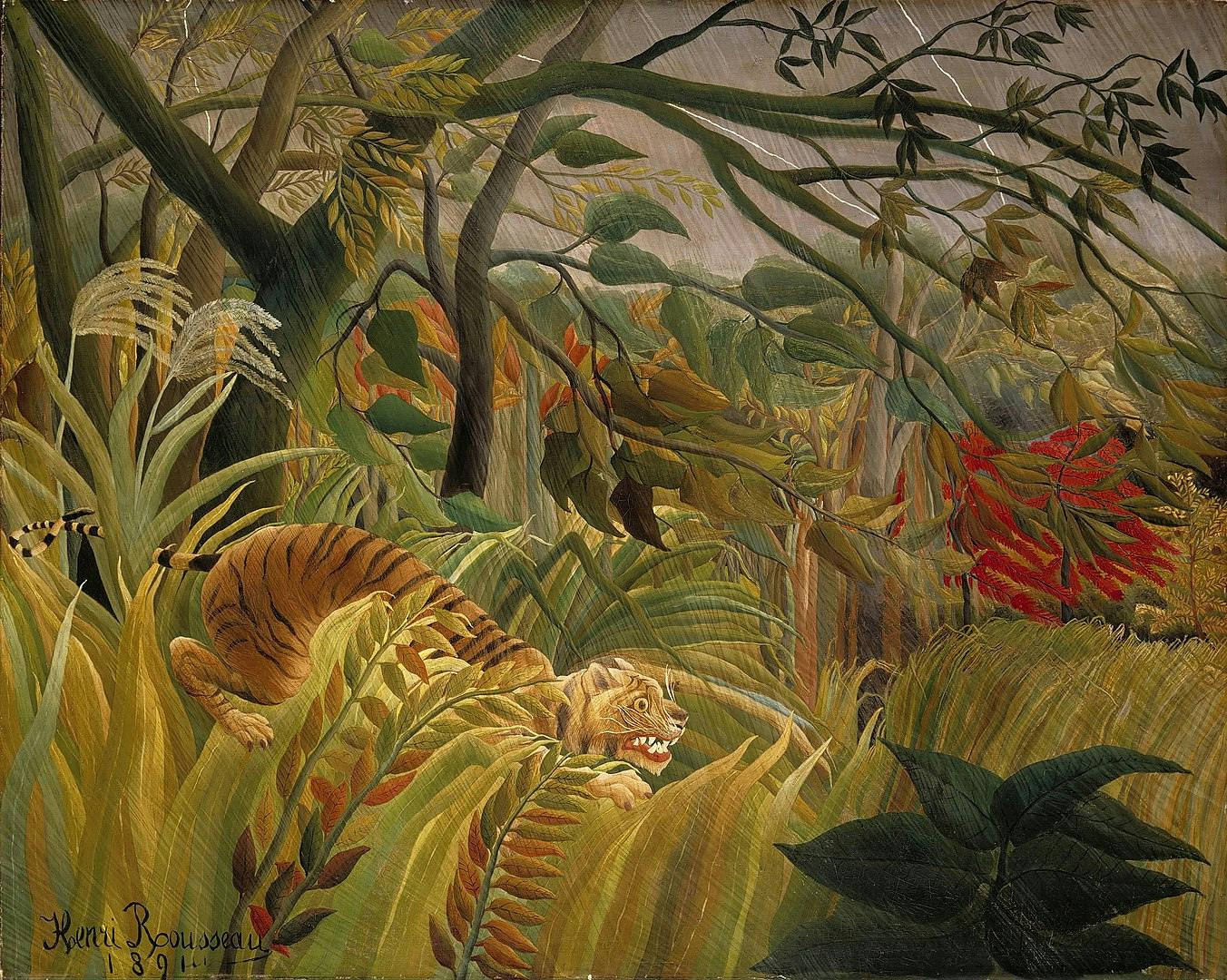
Henri Rousseau was born in 1844 in western France, and he held a variety of jobs, from a lawyer's assistant to a tax collector on the outskirts of Paris to support his family. It wasn't until he was in his 40s that he turned to art without formal training. Beginning in 1886, he started exhibiting at the Paris Salon, and in 1891 he introduced his first breakthrough jungle scene Tiger in a Tropical Storm (Surprised!), which depicts a tiger from the viewpoint of explorers. Fellow artist Felix Vallotton described it saying, "His tiger surprising its prey is a 'must-see'; it's the alpha and omega of painting and so disconcerting that, before so much competency and childish naïveté, the most deeply rooted convictions are held up and questioned."
See also: Art Brut: Art Outside the Box
In 1893, he retired from his job in the Paris Customs Office and began painting full-time. Due to his lack of formal art education, he is considered a proponent of naïve art or primitivism. He also is said to have invented the "portrait landscape," painting portraits set against extremely detailed landscapes.
Want more articles like this straight to your inbox? Subscribe to our free newsletter!

Although some of his works were regarded harshly by art critics, his modern and almost surrealist paintings were adored by his fellow artists like René Magritte, Max Ernst and Pablo Picasso. The latter was so taken by Rousseau's work that in 1908 he hosted 'Le Banquet Rousseau' at his Paris studio, a party of artists that has become legendary as one of the greatest social gatherings of the 20th century art world.
See also: Surrealism and the Subconscious
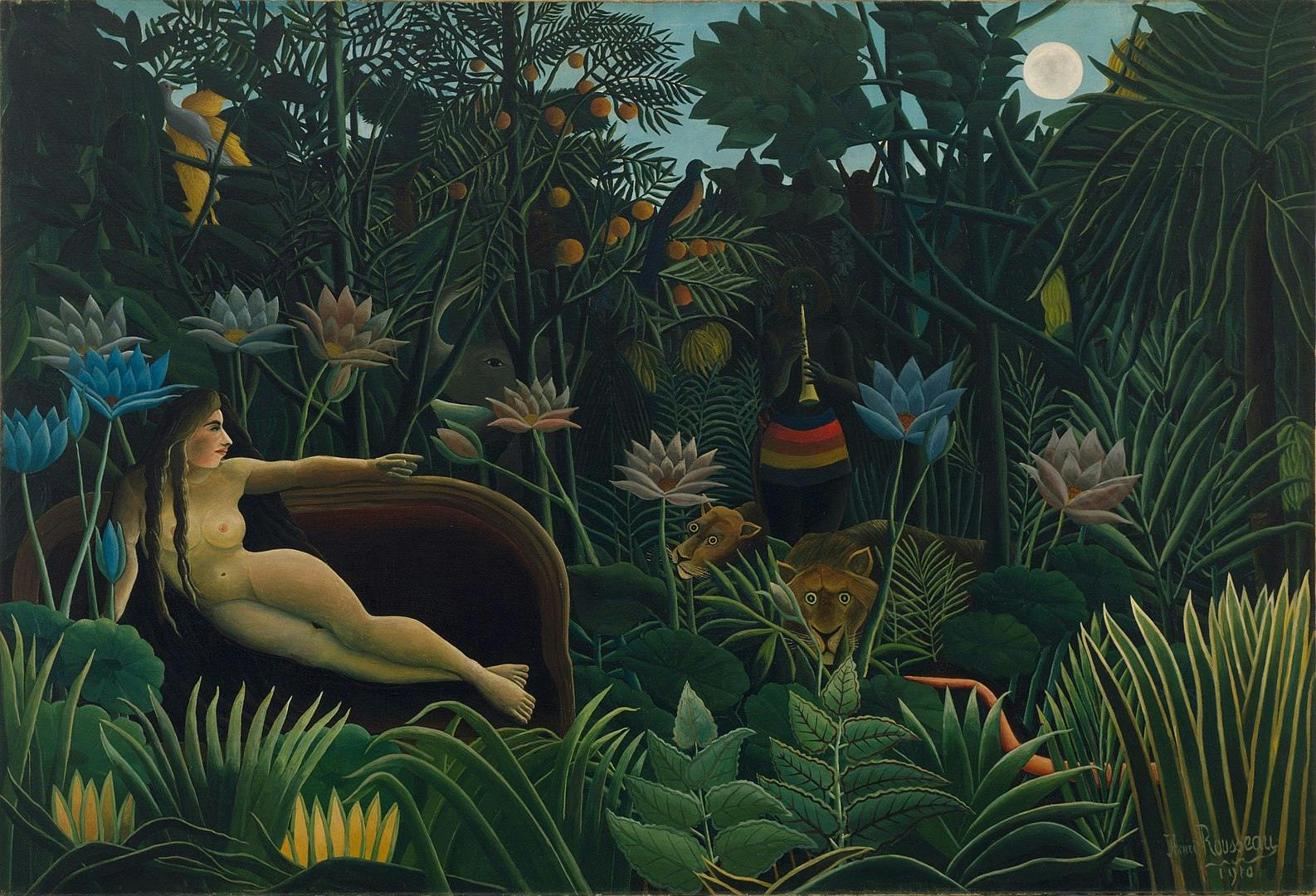
Rousseau died in 1910 at the age of 66 of a leg infection, and his funeral was attended by artists including Constantin Brancusi, Robert and Sonia Delaunay, and Paul Signac. Over a century later, his jungle scenes continue to inspire, and in 2006, Tate Modern dedicated an exhibition to the jungles of Rousseau's oeuvre entitled Henri Rousseau: Jungles in Paris, which featured 50 of his masterpieces.
See al: Peter Beard: Into the Wild
Today, most of his works can be found in the world's top museums, including the Metropolitan Museum of Art, MoMA, the Musee d'Orsay and the National Gallery in London. His paintings also fetch multi-million dollar prices at auction, with his record set for Portrait of Joseph Brummer (portrait-landscape) at £2.9 million in 1993 at Christie's.
This is an updated version of the article originally published on 1 December 2016


