
Stay up-to-date with the antiques world

By subscribing, you are agreeing to the privacy policy. Unsubscribe anytime.

Barnebys

Barnebys HQ

Brahegatan 10
BOX 5038
114 37 Stockholm

Company

  • About Us
  • Join Barnebys
  • Our Partners
  • Press
  • Career

Explore More

  • Barnepedia
  • Buying / Selling at auction
  • Auction Houses / Dealers / Galleries

Support

  • FAQ
  • Terms of Use
  • Privacy and Cookies policy
  • Contact us
  • Barnebys Group AB
  • Barnebys.se
  • Barnebys.com
  • Barnebys.co.uk
  • Barnebys.de
  • Barnebys.fr
  • Barnebys.es
  • Barnebys.it
  • Barnebys.hk
  • All auction items
  • Categories
  • Auction results
  • Magazine
  • Ancient Art
  • Arts & Graphics
  • Asian Art
  • Books, Maps & Manuscripts
  • Carpets, Rugs & Textile
  • Coins & Banknotes
  • Contemporary Art
  • Ethnographical
  • Fashion & Vintage
  • Folk Art
  • Furniture, Design & Mirrors
  • Glass
  • Jewellery & Gems
  • Lighting
  • Medals, Arms & Armour
  • Miscellaneous
  • Music & Musical Instruments
  • Nautica, Technica & Optic
  • Photographs
  • Porcelain & Pottery
  • Postcards & Stamps
  • Sculptures
  • Silver & Gold
  • Sports & Leisure
  • Tin & Metals
  • Toys & Collectables
  • Vehicles
  • Watches & Clocks
  • Wine & Spirits
  • Works of art
  • All auction items
  • Auction results
  • Magazine
  • Get a valuation
  • Auction system

Barnebys Magazine

LatestEditor's picksTopics
Magazine/Furniture/USM Haller: Timeless Design for a Changing Life

USM Haller: Timeless Design for a Changing Life

From Swiss engineering to an international design classic, USM Haller brings together functionality, durability and timeless aesthetics. It is an investment built to last for generations.

13 October 2025Ulrika Nilsson
A custom-made shelf from 1963 created in Münsingen by USM Haller. Built from chrome-plated steel tubes and perforated green-painted sheet metal, an early example of the modular design language that became a design classic. Photo © Quittenbaum (detail)

A custom-made shelf from 1963 created in Münsingen by USM Haller. Built from chrome-plated steel tubes and perforated green-painted sheet metal, an early example of the modular design language that became a design classic. Photo © Quittenbaum (detail)

Few designs have a history as closely tied to innovation as USM Haller. The system, now recognised worldwide for its adaptability and enduring style, began not as furniture but as part of a factory project. Its story starts in Münsingen, Switzerland, where the family-owned company USM was founded in 1885 by Ulrich Schärer as an iron and metal workshop.
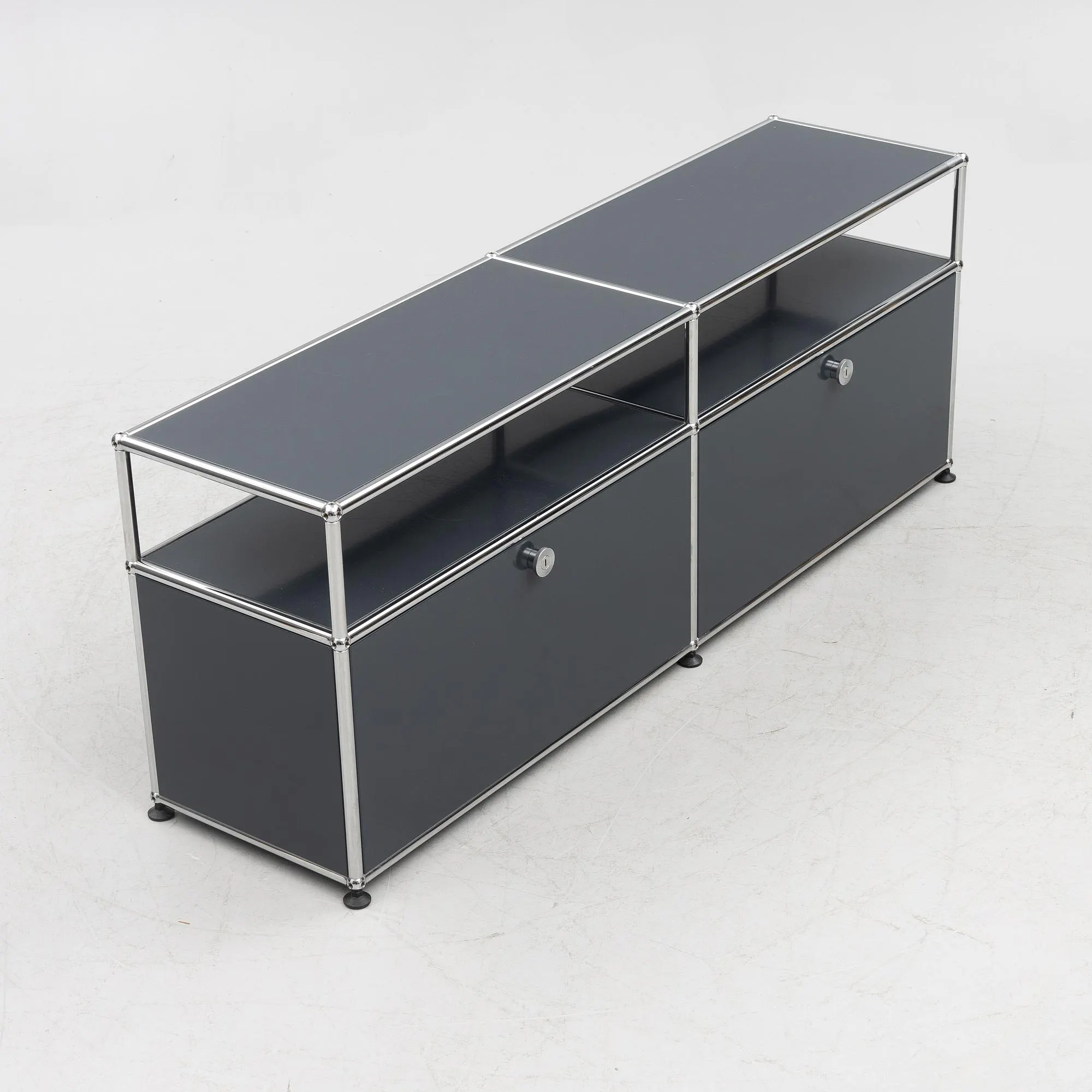
Paul Schärer & Fritz Haller, USM Haller, mediabänk, 2020. Photo © Bukowskis

For many years the company produced window fittings and metal components. Everything changed in 1961, when Paul Schärer Jr., the third generation of the family, took over with a plan to modernise the business. He commissioned architect Fritz Haller to design a flexible new factory building. Together they developed a modular steel construction system that could be adapted to different production needs. This concept later became the basis for the furniture line now known as USM Haller.
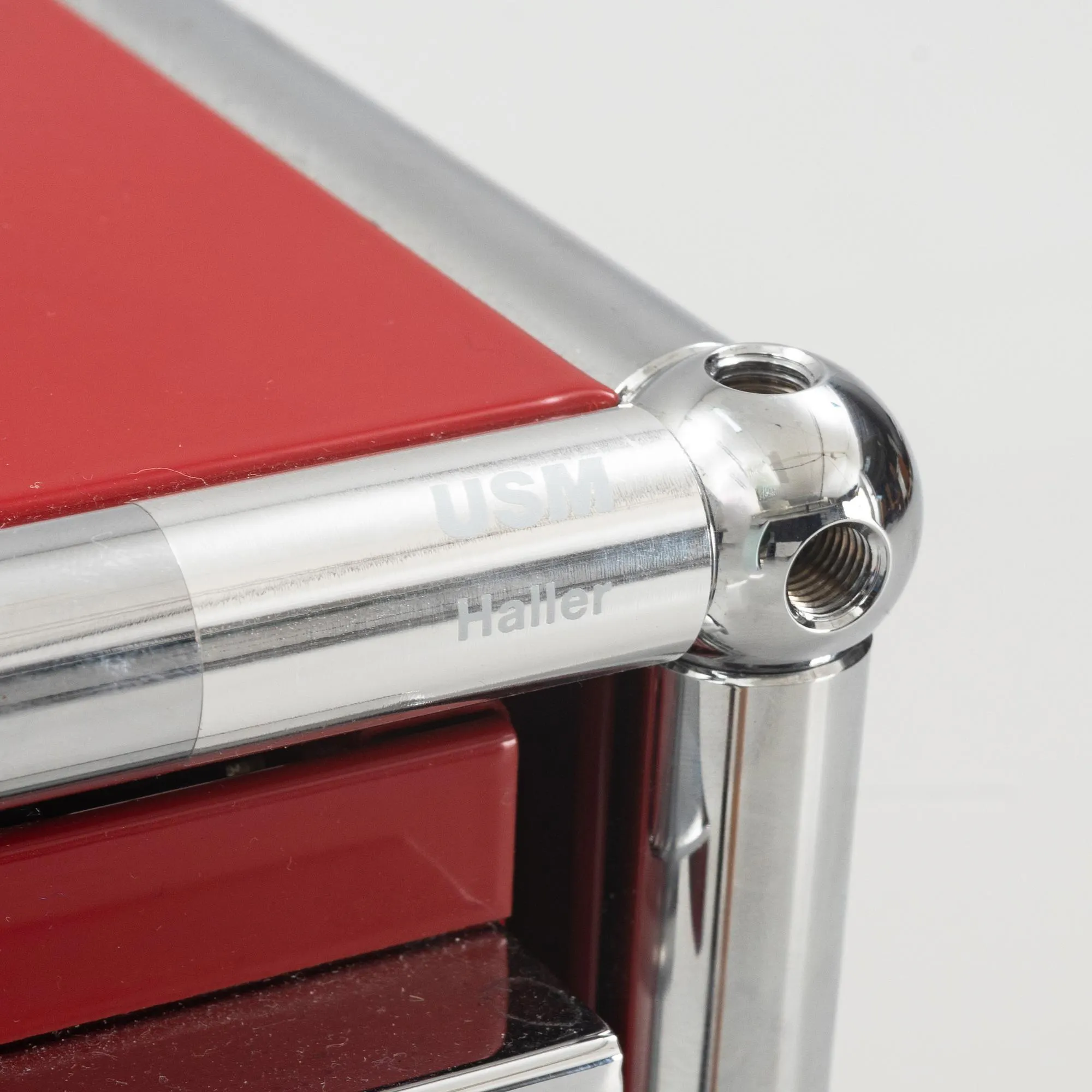
The detail image shows the characteristic coupling ball and steel tubes that form the basis of USM Haller's modular system. Photo © Bukowskis

The design rests on three core elements: a chrome-plated brass ball used as a connector, chrome-plated steel tubes and coloured metal panels. The principle is straightforward, yet the possibilities are almost limitless. With these parts, it is possible to create anything from low sideboards and bookcases to entire room dividers.

Want more articles like this straight to your inbox? Subscribe to our free newsletter!

In 1969, the system went into full production after a major order from the Rothschild Bank in Paris. Since then, its reputation as a design icon has continued to grow. In 2001, USM Haller was added to the permanent collection of the Museum of Modern Art in New York.
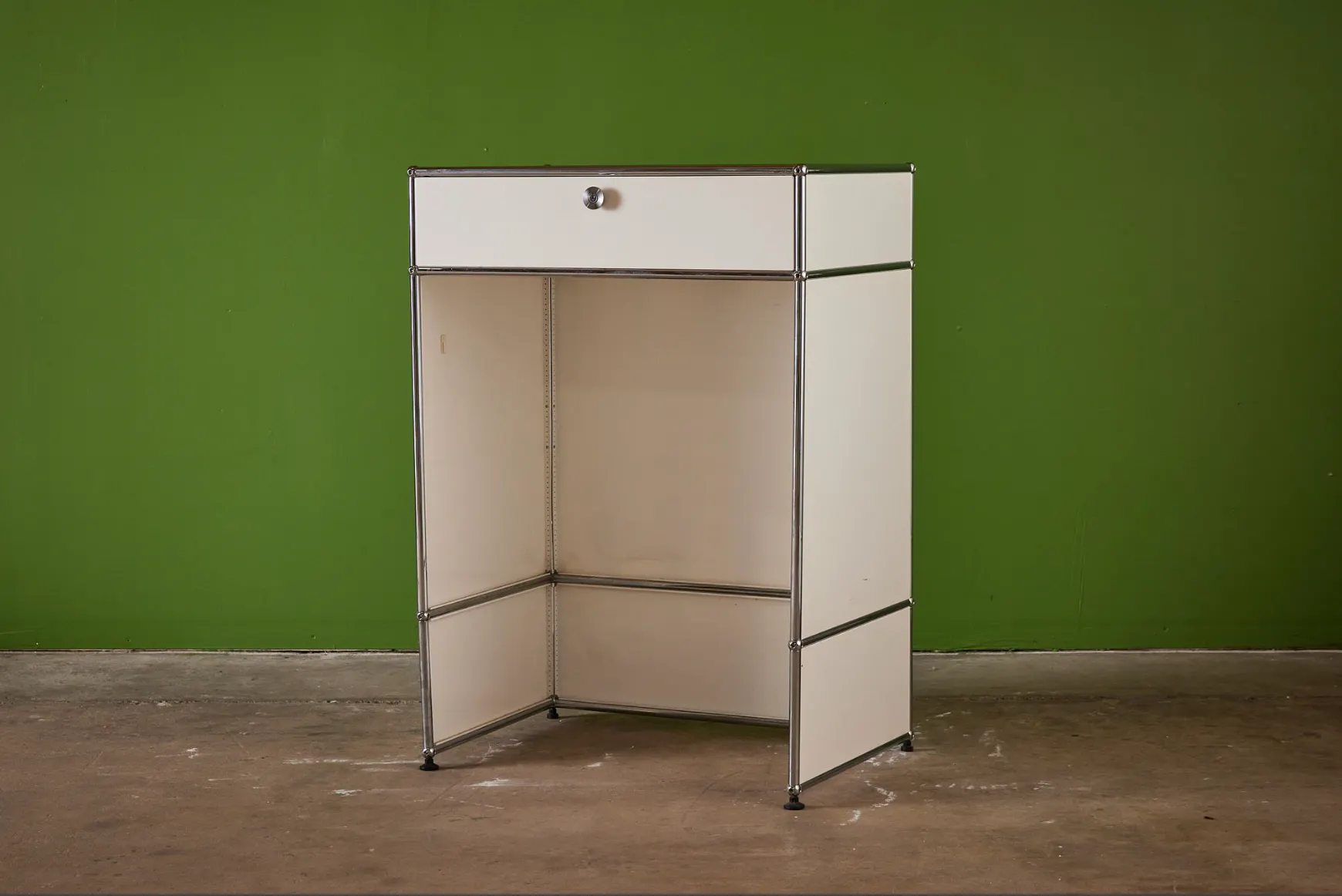
Paul Schärer & Fritz Haller, USM Haller, desk, second half of the 20th century. Photo © BILLINGS

Sustainability has always been central to the company’s philosophy. “The longer a product is used, the less impact it has on the environment” is one of its guiding ideas. The system is made to last: built from durable, recyclable materials, it can be reassembled and adapted over time. You can design a storage system that fits your home perfectly, then later add new modules, change the colour of the panels or rebuild it entirely. It is a practical investment for anyone looking for furniture that evolves with them throughout life.

See also: Barnebys' Guide to Buying Furniture
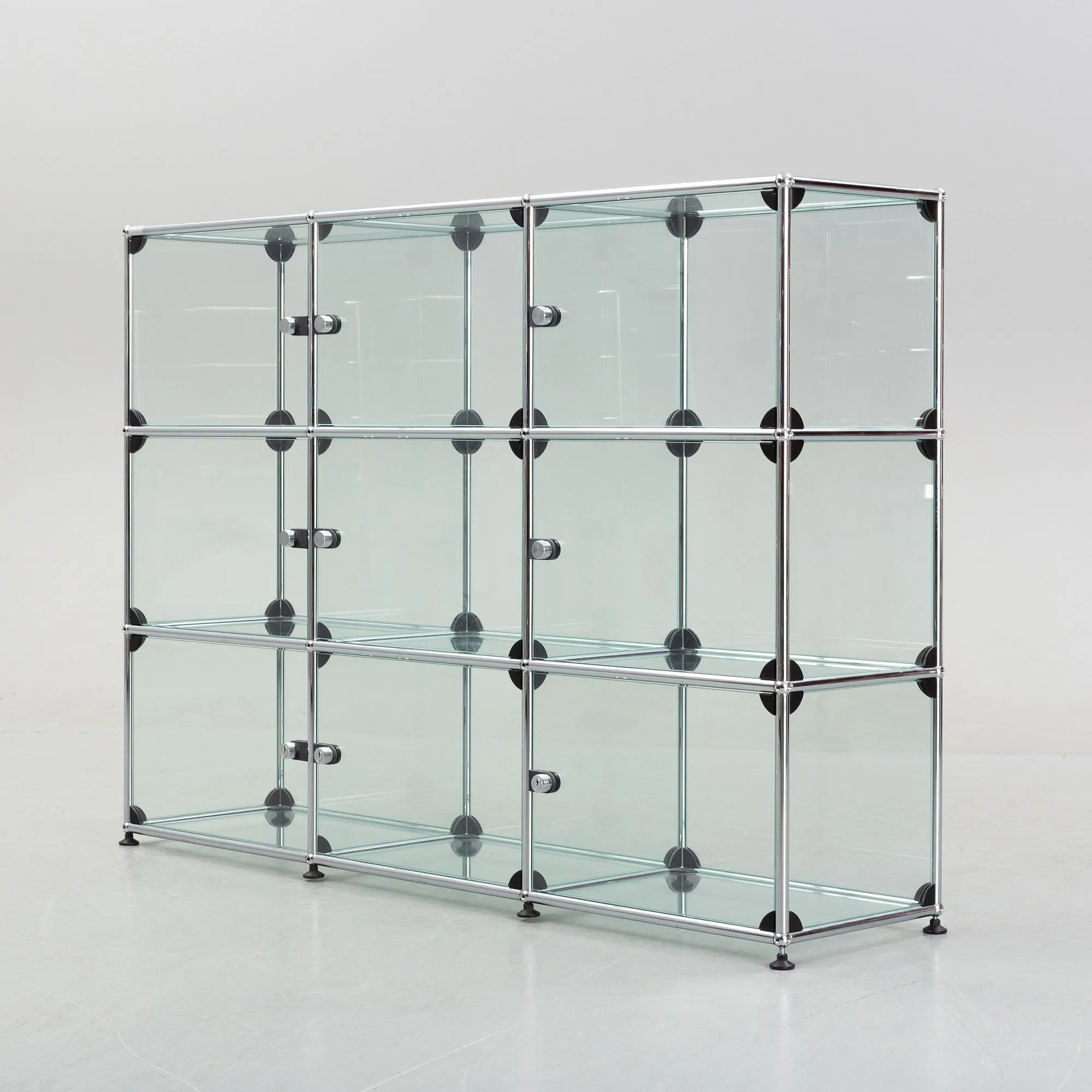
Shown here is a variant with glass instead of metal panels. Photo © Bukowskis

Thanks to its combination of functionality, longevity and restrained design, USM Haller can be found in some of the world’s most distinctive buildings, including The Gherkin in London and the Louis Vuitton Foundation in Paris.

USM Haller pieces have also become highly sought after on the second-hand market. Those looking to buy one may want to set up an alert on Barnebys, where prices range from a few hundred dollars to five-figure sums depending on size and provenance.

Find more articles in Barnebys Magazine

USM Haller20th century designmodular furniture

Subscribe to Barnebys Magazine

By subscribing, you are agreeing to the privacy policy. Unsubscribe anytime.

About the author

Ulrika Nilsson

Ulrika Nilsson is the Swedish Editor at Barnebys Magazine. She is an art historian with a bachelor's in art history and visual studies. She has a great interest in modern design and architecture, especially simple wooden furniture, colourful textile art and Swedish functionalism. At auction, she looks for Isamu Noguchi's Akari lamps, Aino Aalto's Bölgeblick glass series and Ann-Mari Forsberg's fabric Blue Crocus.

Read more from this author
Ulrika Nilsson

Bring your auction to collectors worldwide!