Stay up-to-date with the antiques world

By subscribing, you are agreeing to the privacy policy. Unsubscribe anytime.

Barnebys

Barnebys HQ

Brahegatan 10
BOX 5038
114 37 Stockholm

Company

  • About Us
  • Join Barnebys
  • Our Partners
  • Press
  • Career

Explore More

  • Barnepedia
  • Buying / Selling at auction
  • Auction Houses / Dealers / Galleries

Support

  • FAQ
  • Terms of Use
  • Privacy and Cookies policy
  • Contact us
  • Barnebys Group AB
  • Barnebys.se
  • Barnebys.com
  • Barnebys.co.uk
  • Barnebys.de
  • Barnebys.fr
  • Barnebys.es
  • Barnebys.it
  • Barnebys.hk
  • All auction items
  • Categories
  • Auction results
  • Magazine
  • Ancient Art
  • Arts & Graphics
  • Asian Art
  • Books, Maps & Manuscripts
  • Carpets, Rugs & Textile
  • Coins & Banknotes
  • Contemporary Art
  • Ethnographical
  • Fashion & Vintage
  • Folk Art
  • Furniture, Design & Mirrors
  • Glass
  • Jewellery & Gems
  • Lighting
  • Medals, Arms & Armour
  • Miscellaneous
  • Music & Musical Instruments
  • Nautica, Technica & Optic
  • Photographs
  • Porcelain & Pottery
  • Postcards & Stamps
  • Sculptures
  • Silver & Gold
  • Sports & Leisure
  • Tin & Metals
  • Toys & Collectables
  • Vehicles
  • Watches & Clocks
  • Wine & Spirits
  • Works of art
  • All auction items
  • Auction results
  • Magazine
  • Get a valuation
  • Auction system

Barnebys Magazine

LatestEditor's picksTopics
Magazine/Painting/Vermeer's Milkmaid Reveals Her Secrets

Vermeer's Milkmaid Reveals Her Secrets

Modern technology has brought to light details later discarded by Vermeer in his painting 'The Milkmaid'.

12 September 2022Gritta von Toll
Jan Vermeer (1632 Delft 1675), Servant with Milk Jug, ca. 1660, oil on canvas, 45.5 x 41 cm, Rijksmuseum Amsterdam. Photo public domain (detail)

Jan Vermeer (1632 Delft 1675), Servant with Milk Jug, ca. 1660, oil on canvas, 45.5 x 41 cm, Rijksmuseum Amsterdam. Photo public domain (detail)

With The Little Street (1658-60), Woman in Blue Reading a Letter (1662-64), The Love Letter (1669-70) and Milkmaid (circa 1660), the Rijksmuseum in Amsterdam owns four of the only 35 paintings created by Jan Vermeer (1632-1675). From February 2023, 23 more works by the Baroque painter will join the museum from many major institutions in the largest-ever exhibition of his work, in honour of Vermeer's 390th birthday.

See also: 6 Iconic Dutch Paintings

In the run-up to the exhibition, conservators and researchers at the Rijksmuseum, together with their colleagues from the Mauritshuis in The Hague, used macro XRF and RIS scanning technologies to examine Vermeer's in-house paintings. The same machinery was recently used to examine Rembrandt's Night Watch, revealing some minute details. In the process, previously unknown details in The Milkmaid first inserted by Vermeer into his composition came to light, which he later discarded and painted over.

See also: A Vermeer Painting Restored to Original Composition

"So much work had already been done on the painting hat we never anticipated something so definitive would surface thanks to modern technology. the exhibition in 2023 offers the Rijksmuseum the perfect opportunity to explore Vermeer with the latest technological advancement available to us, bringing viewers ever closer to this most mysterious and beloved artist of all time", said Taco Dibbits, General Director of the Rijksmuseum, in a press release.
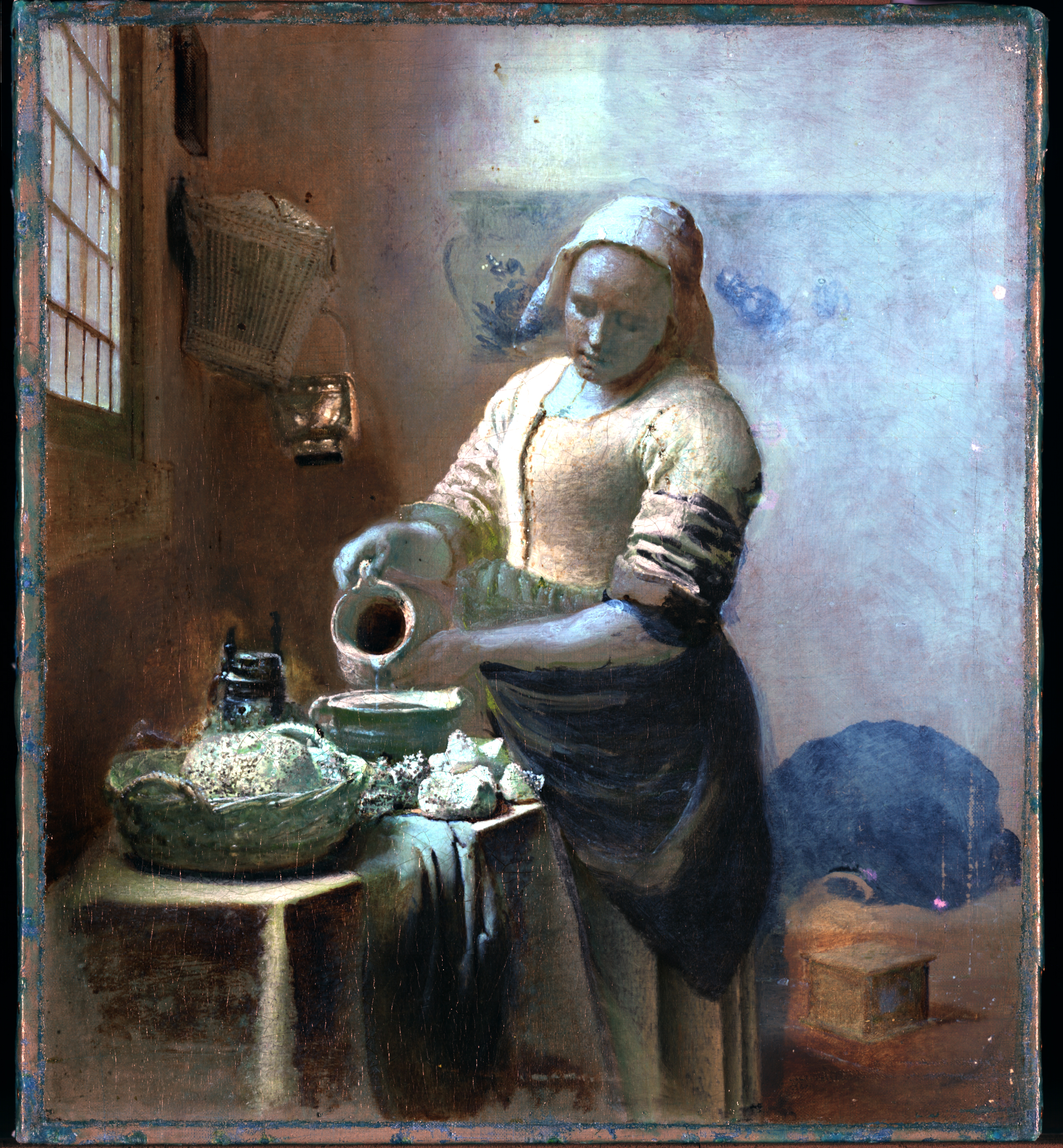
Shortwave infrared reflection image of Milkmaid (false colour). Photo © Rijksmuseum Amsterdam

So what are the layers of paint hiding in the composition of Vermeer's Milkmaid? The non-invasive examinations revealed that Vermeer first made a preliminary sketch of rough brushstrokes in light and dark colours before beginning the fine elaboration of the scene. The underpainting in black can be identified below the front arms of the maid.

See also: New Secrets Revealed About Girl with a Pearl Earring

Also in black, Vermeer first placed a jug holder on the back wall at the level of the maid's head. Underneath, on the floor, he had initially planned a fire pit before finally discarding this idea in favour of a foot-operated stove.
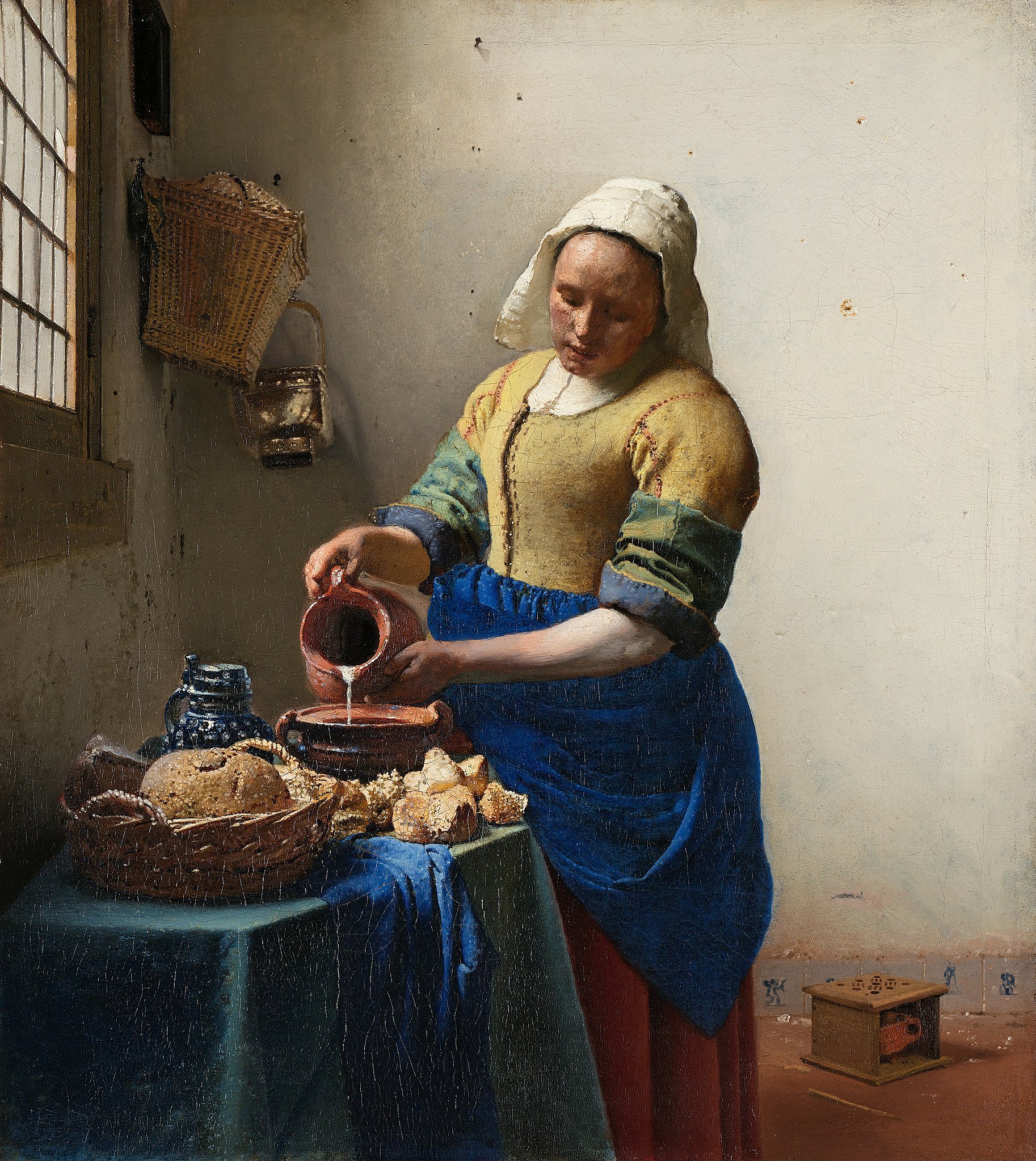
Jan Vermeer (1632 Delft 1675), Milkmaid, ca. 1660, oil on canvas, 45.5 x 41 cm, Rijksmuseum Amsterdam. Photo public domain

Want more articles like this delivered straight to your inbox? Subscribe to our free newsletter

As with his other paintings, Vermeer used objects he found in his own household for The Milkmaid – a similar jug holder was found in the pantry, and a fire basket is listed in his estate inventory. Fire baskets woven from willow branches and fitted with charcoal bowls served as heat sources for newborns and were also used to dry diapers.

See also: Jan Vermeer: The Mysterious Master of Light

The two objects that were eventually painted over would have been typical house objects of the time; with the fire basket primarily for a household with small children. As it goes, Jan Vermeer and his wife Catharina Bolnes had a total of fifteen children (four of whom died young), and definitely made use of the fire basket in their home.

The Vermeer exhibition at the Rijksmuseum Amsterdam can be visited from 10 February to 4 June 2023.

For more art world news, check out Barnebys Magazine

Jan VermeerBaroqueMilkmaidRijksmuseum

Subscribe to Barnebys Magazine

By subscribing, you are agreeing to the privacy policy. Unsubscribe anytime.

About the author

Gritta von Toll

Gritta von Toll is the German Editor at Barnebys Magazine. She completed studies in pre- and early history and archaeology, and since 2015, after a short detour into the world of advertising, she has worked at Barnebys, where she immerses herself in art history in order to bring bygone epochs closer to today's readers.

Read more from this author
Gritta von Toll

Explore related articles

Jan Vermeer, Street in Delft, ca. 1658-1659, gift of HWA Deterding, London. Photo courtesy of the Rijksmuseum (detail)
Painting

Hidden Secrets in Vermeer Masterpiece Revealed

Jan Vermeer, The Geographer, 1668/69, Städel, Frankfurt am Main. Public domain image (detail)
Painting

Did Vermeer Use a Camera Obscura?

Did Jan Vermeer portray himself at work in "Die Malkunst" from 1666/68 (Kunsthistorisches Museum, Vienna)? | Photo via Wikimedia Commons
Painting

Jan Vermeer: The Mysterious Master of Light

Discover similar items at auction

Jan Vermeer van Haarlem

Jan Vermeer van Haarlem

DE
Lempertz

20.000€

Details
9.00 x 1.40 meters Panama fabric in cotton-blend with a...

9.00 x 1.40 meters Panama fabric in cotton-blend with a...

IT
Catawiki

150€

Details
5.00 x 1.40 metres cotton pinstripe fabric – soft

5.00 x 1.40 metres cotton pinstripe fabric – soft

IT
Catawiki

150€

Details
Elegant milk-white velvet fabric - 3.50 x 1.40 meters!!!...

Elegant milk-white velvet fabric - 3.50 x 1.40 meters!!!...

IT
Catawiki

150€

Details
4.00 x 1.40 METERS !!!! Luxurious hand-velvet fabric with...

4.00 x 1.40 METERS !!!! Luxurious hand-velvet fabric with...

IT
Catawiki

150€

Details
4.00 x 1.40 meters!!! Selected only for Catawiki Elegant...

4.00 x 1.40 meters!!! Selected only for Catawiki Elegant...

IT
Catawiki

150€

Details

Bring your auction to collectors worldwide!