

Bukowskis' CEO Louise Arén has given few interviews after taking office four years ago. And now a lot has happened with the traditional 150-year-old company. When she took over, she had already been head of the company's digital development and e-commerce. Her new role at the helm was a signal to how Bukowskis' owners perceived the future of the company.
This year, Barnebys' founder, Pontus Silfverstolpe, is meeting with several representatives from the auction industry to talk about the future. Louise Arén is our inaugural interview, and here she talks about her experience with strategic business development, competition and how the focus on data and quality has improved the company.
Pontus Silfverstolpe: It has been a different spring to say the least. How has COVID-19 affected the first half of 2020? Louise Arén: We have been very humble in the face of the situation this spring, but business has been able to continue. Online has gone better than ever, even though we were cautiously positive before the auction season. We have delivered a better result than budgeted in the first half of the year, which we are proud of in light of the fact that we, like everyone else, have obviously been affected by the ongoing pandemic.
Bukowskis turns 150 this year. What does this mean? We get to celebrate with our clients! COVID has changed our approach, and we have invested more in strengthening our relationships with clients and are making new collaborations to reach new target groups. After the summer, we are releasing an anniversary book that details our story and the spectacular sales that have shaped Bukowski's fantastic brand and journey. We also want to draw everyone's attention internally to the fine work that is being done to ensure that the company continues to be the market leader.
What does history mean for your business? Through the rearview mirror, we understand how well we have succeeded with our adjustment to handle both traditional auctions in parallel with a modern e-commerce platform.
How important is the Bukowskis brand to your business?
Incredibly important. Bukowskis is an extremely strong brand, which we always make sure to have in motion. The brand has changed over time, which means that it is also perceived in different ways depending on who you are and where you come from. The younger generation is not as interested in which works have sold at Bukowskis, how many million listings we have or how we stand compared to other auction houses. They want to be inspired, shop sustainably and find a unique style where different objects are highly valued. The challenge is to preserve the traditional and emotional in Bukowski's brand but constantly move it forward.

You have managed to turn Bukowski's figures from red to black into four years. How?
It's about hard work from everyone. For me, it has been important to run Bukowskis as a modern company and create a fine balance between art and business. We let the knowledge and passion about the objects be the starting point for everything we do, but we have also built an organisation that consists of specialist knowledge throughout the company, even if in the end it is data and numbers that determine what we prioritise and how we interact. It is fundamental that everyone, both internally and externally, understands that we are commercially driven and that we safeguard our clients' business.
How have the changes been received internally?
Bukowskis is a well-established and modern company and our culture is characterised, in addition to knowledge and passion, by transformation. I feel that there has been and is a great understanding internally that we must change and constantly move forward. I have also tried to be clear about why we make changes and where they lead us. A company that stands still today automatically goes backwards.
Check out the latest auction news on Barnebys Magazine
There is a lot of talk about the importance of data in our industry. How critical is data for Bukowskis journey going forward?
It has been absolutely crucial for the results we have achieved in recent years and a natural part of everything we do every day. Data helps us to constantly improve the client journey and is the basis for us to be able to deliver visually to our target groups. The companies that manage to analyse data proactively and in real time and then translate it into business decisions, win.

Initially, it was mostly about online auctions and volume, but lately it feels like you have invested more and more in quality. Is that true?
To a large extent, that is true. It is a significant part of our business and our offer. Last year, we changed our strategy and scaled down about 50 percent of online volume segments to ensure higher quality, without reducing sales. On the contrary, we increased sales and raised average prices significantly. We also have more Fine Art auctions online than before, which has been a success factor as we see that they attract a completely new and sometimes younger target group.
The most difficult thing has been to maintain profitability and drive major and strategic changes. With that come some sad decisions
You originally come from the Kinnevik sphere. What was the biggest difference between the companies? My background is in large international companies where the toolbox and the commercial aspects are the same, but in smaller companies the decision-making processes are shorter. At Bukowskis, I work closely with owners, the board and a management team with experience from various industries, and together with the fantastic and extensive object expertise available at Bukowskis, it is a dynamic and important foundation for the company.

What are the biggest benefits of digitising auctions?
The international reach. The exposure is much larger all over the world, which means that you get more buyers and sellers. We see daily that art and design furniture continue to be popular online, which both sales and increased traffic prove. This in turn is a consequence of the fact that we have raised the quality online and that we are successfully reaching out to our channels with curated and unique theme auctions.
Are there any risks with digitising auctions?
There are risks because of the global and digital vulnerability that our industry shares with other industries. Most recently the EU directives on money laundering were updated. We are in constant dialogue with the relevant authorities and both follow the authorities' requirements and help them in their preparatory work. Do you think the risk of counterfeiting is increasing?
As an auction house, you practice even greater caution. Today, technology, information and knowledge are available to ensure authenticity, and we work with the best in each industry, also internationally, to ensure security for both buyers and sellers.

You have been CEO of Bukowskis for four years. What has been the most fun and the most difficult part of the job?
Undoubtedly, the most fun has been to see how our focus on Fine Art and the progressive digital strategy has borne fruit in a changing industry. We have managed to balance business and art and at the same time improve results year after year. The most difficult has been the challenge of maintaining profitability while driving major and strategic changes within the company. With that comes some sad decisions.
Have you had to lay off staff?
We work in a personnel-intensive industry and thus personnel make up a large part of our cost base. We are constantly reviewing how we should work and in recent years have significantly reduced our cost. There have been reorganisations that included laying off staff.
How do you view the competition in Sweden? We do not usually comment on individual competitors. Our focus is to be the market leader. Our auction turnover was just over SEK 850 million (£74.3 million) in 2019, which is SEK 590 million (£51.6 million) more than number two auction house in Sweden. The Nordic auction market has changed over the past two years due to the fact that Stockholms Auktionsverk is a weaker player. The competition is about supply, brand, expertise, and a strong digital presence and based on that we are well positioned.
What are Bukowski's biggest challenges?
The whole business model is based on us being brokers, which is an art in itself. We have auctions 365 days a year and all the operational control that comes with them. That is the big challenge to win every day. Otherwise, it is about introducing our business model to a broader target group that is already in a secondary market driven by digital behaviours.
Some people think that the physical customer meeting will be less important, but it is rather that the expectations around the personal meeting will be higher!
What do you see as the industry's biggest challenges?
The industry will develop more this year than it has in the past ten years, which is interesting. The challenges for the industry are otherwise the ones I mentioned for Bukowskis: to introduce and communicate our business model. Other challenges are about counteracting challenges that exist in the digital landscape.

Which are your most important target groups? How do you reach them?
It is quite unique for a company and an industry to work so broadly and attract so many different target groups. One of the success factors is our strong brand is loaded with rational and emotional values. Some believe that the physical customer meeting becomes less important, but it is rather that the expectation around the personal meeting becomes higher and thus more important to handle successfully. If you work with data successfully, these meetings can be prepared in a way that benefits both the customer and the business, which is something we work actively with every day.
Bukowskis is today one of the world's leading auction houses when it comes to the online experience. Are you investing in an international expansion?
The market shares in the Nordic region can grow a few more percentages, but we are constantly looking at strategic opportunities.
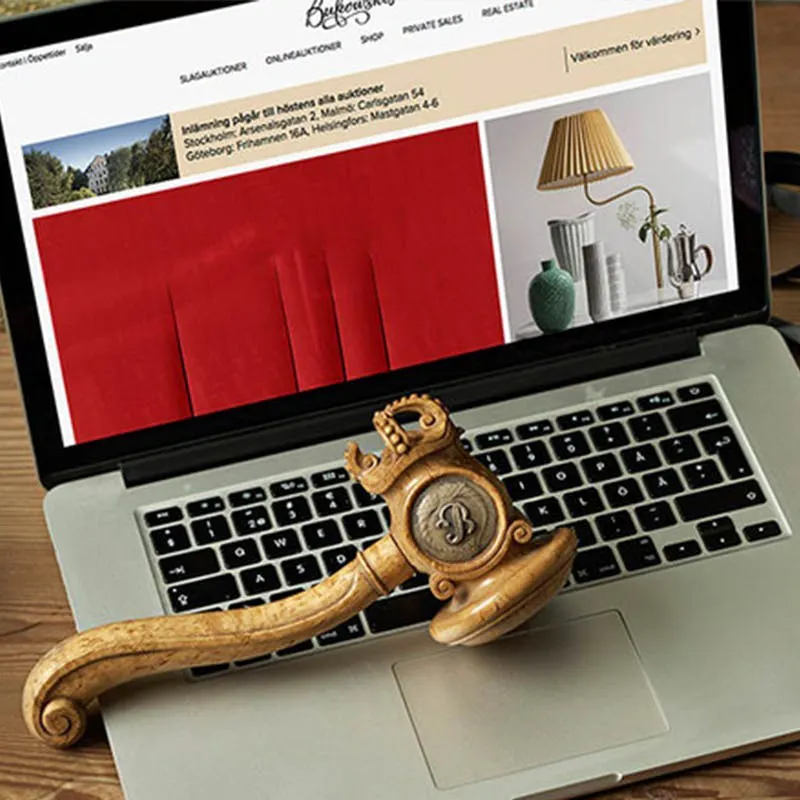
Will you continue with your printed catalogues? Yes, for the time being, but we follow the development of the global industry.
What is your working style? I'm a task-oriented person with a constant need to develop and be challenged in the professional sphere. On a private level, I basically strive for the same thing, but the tasks must then include my family and close friends. My personal time is preferably used to listen to as many podcasts in as many different genres as possible.
Your first encounter with art? In the early 2000s, I lived in New York, London and the Baltics and went to museums a lot. The strongest memories of seeing art and artistry during this time period I have from my years in the Baltics where guided tours of art in stairwells, parks and other unexpected places could be enjoyed.
Are you collecting anything? I do not collect anything specific in art or design, but rather fall in love with individual objects.
What was your first purchase at auction? Champagne glasses by Simon Gate, designed around the 1920s at Orrefors-Sandvik. I hope I have reason to use them a lot.
Discover latest news from the auction industry on Barnebys Magazine

![Medals and diary from James Lawence-Smith [detail]. Image © Dawsons](https://images.prismic.io/barnebys/003b4ddb-44b9-432a-ac2a-b773fea116cf_Medals_Diary_Surgeon+James+Lawre.jpg?auto=format,compress)
![David Douglas, in charge of the new Militaria Department at Elstob & Elstob, is pictured holding the boxed Queen’s Gallantry Medal and the RAF Long Service & Good Conduct Medal presented to Flight Sergeant William Barker Oldroyd. Also in the photograph are items from a single-owner collection of Gordon Highlanders’ militaria [cropped]. Photo: Elstob & Elstob](https://images.prismic.io/barnebys/6a990cde-5f13-4a2c-9903-9d24584b8170_Cover.jpg?auto=format,compress)