Audemars Piguet, the watchmaker still run by its founding families and based in Le Brassus—where it was established—will celebrate its 150th anniversary in 2025. To mark the occasion, we’re taking a closer look at the company’s flagship model, the Royal Oak, and have compiled five key facts that chart the story of this coveted timepiece.
1. Designed Overnight
On the afternoon of 10 April 1970, Gérald Genta—the first designer to specialise exclusively in watches—was in his hotel room in Basel, where the Swiss Watch Fair (later known as Baselworld) was due to open the following day. Around 4pm, he received an unexpected call from Georges Golay, the managing director of Audemars Piguet, with an unusual brief: Genta, who had designed several watches for the brand since the 1950s, was asked to create a men’s wristwatch that was both elegant and sporty—something that could be worn just as easily with an evening suit as in everyday life. Crucially, it was to be made of stainless steel—an unusual choice for a luxury timepiece at the time. And the design had to be ready by the very next day.
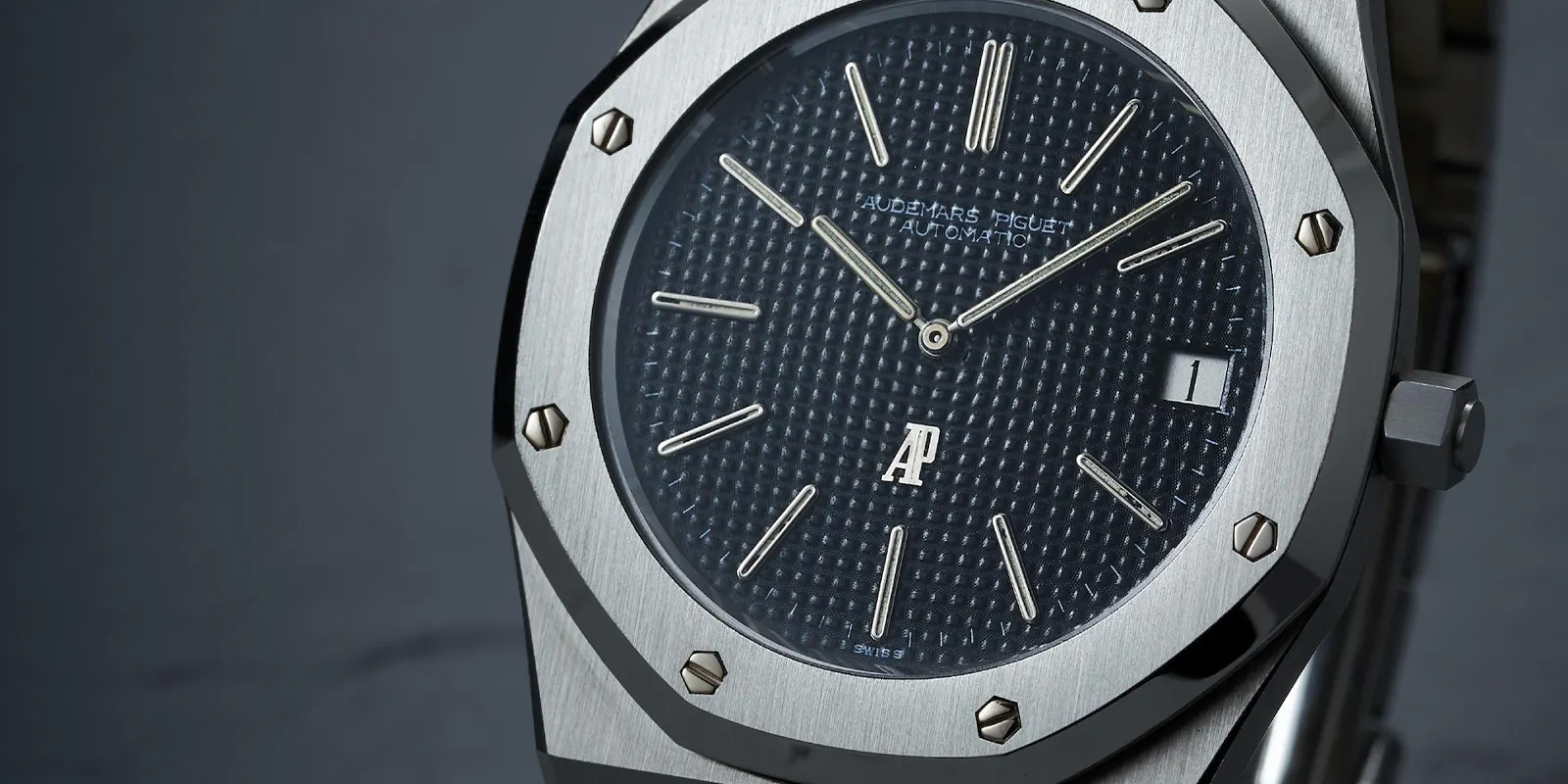
Remarkably, Genta managed the task overnight. Within a few hours, he had produced a fully realised design featuring what would become the Royal Oak’s signature elements: an octagonal bezel secured with eight visible screws, a monocoque case, and an integrated bracelet.
See also: Buying Luxury Watches: In Conversation with a CEO
The inspiration for this extraordinary design partly stemmed from a misunderstanding. During the phone call, Genta had assumed the watch needed to be water-resistant. This reminded him of a childhood memory—watching a diver emerge from Lake Geneva. He was particularly taken with the diver’s helmet, especially its round viewing window, and used it as the basis for a new generation of wristwatches.
2. A Collaborative Effort
By the time development of what would become the Royal Oak got underway, Audemars Piguet had enjoyed two strong decades of growth. Staff numbers had increased from 35 to 84, and the Le Brassus workshop was producing 5,500 watches a year, both in small series and as unique pieces.
For this new model, however, the plan was to produce 1,000 stainless steel and 100 white gold units in order to offset the high labour costs.

Audemars Piguet enlisted various specialists for production: the monocoque case was manufactured by Favre & Perret in La Chaux-de-Fonds; the iconic ‘Bleu Nuit 1’ tapestry dial with protective ‘Nuage 50’ lacquer came from Stern Frères in Geneva; and the integrated bracelet, comprising 154 individual parts, was made by Gay Frères, also in Geneva. The movement chosen was calibre 2121, an evolution of calibre 2120, jointly developed in 1967 by Audemars Piguet, LeCoultre & Cie, and Vacheron Constantin. At just 3.05 mm high and 28 mm in diameter, it was the world’s thinnest automatic movement with a date function, making it ideal for the Royal Oak’s then-generous dial dimensions—hence the early nickname ‘Jumbo’. Until 2021, all Royal Oak models used the calibre 2121.
See also: Jaeger-LeCoultre: 5 Things to Know
3. What's in a Name?
The Royal Oak was the first Audemars Piguet watch produced in series to be given an actual name—previously, models were identified only by reference numbers. Early contenders included Safari, Grand Prix, Ascot and Kilimanjaro, but the name ‘Royal Oak’ first appeared in the company’s records in December 1971. So what’s the story behind it?
The original Royal Oak was an actual oak tree in England, remembered for its role in 1651 when, following the Royalist defeat at the Battle of Worcester, the future King Charles II hid in its branches to escape Parliamentarian forces. Though the tree itself was destroyed by souvenir hunters in the 18th century, a surviving branch still stands in Shropshire.
This event immortalised the tree as a national symbol, and eight Royal Navy ships bore the name Royal Oak between 1664 and 1916. The nautical reference aligned perfectly with the Royal Oak’s water-resistant design and Genta’s inspiration. Just as the design elevated stainless steel to the status of a luxury material, so too was an ordinary oak elevated into a royal icon.

4. Was It Worth the Risk?
Almost two years to the day after Genta sketched the design, the Royal Oak was unveiled to the public on 15 April 1972, the opening day of the Swiss Watch Fair. With the quartz crisis threatening the traditional watch industry, launching such a radical design was a bold move. The greatest concern was the price: at CHF 3,300—equivalent to nearly CHF 10,000 today—it was extremely expensive for a stainless steel watch. Comparable models like the Rolex Submariner and IWC Ingenieur were far more affordable. The Royal Oak was priced more like a gold watch.
To justify this, Audemars Piguet focused on craftsmanship and innovation in its marketing.
See also: 8 Little Known Rolex Facts
Initial reception was lukewarm. While many acknowledged that something groundbreaking was being attempted, criticism outweighed praise. But sales quickly silenced the doubters. The Royal Oak became a hit, first in Switzerland, Germany, and Asia, then in France and Italy. Demand grew so rapidly that the initial production run was increased from 1,000 to 2,000 units.
5. Adapting Through the Decades
In 1976/77, the Royal Oak collection expanded to include models in yellow gold, as well as two-tone versions combining yellow gold and stainless steel. The original model, reference 5402, was produced in four series—A, B, C, and D—up to 1978. By 1994, a total of 6,050 had been sold, over 4,000 of them in stainless steel.
A ladies’ version, reference 8638, was introduced in 1976, followed in 1977 by reference 4100 (also known as Royal Oak III), which featured a central seconds hand and a smaller case diameter. Genta’s inspired design proved incredibly versatile, spawning more than 500 different variations to date, many featuring complications such as calendar displays and moon phases. In 1993, the more technical Royal Oak Offshore was introduced, followed in 2002 by the avant-garde Royal Oak Concept line.

Want more articles like this straight to your inbox? Subscribe to our free newsletter!
With the Royal Oak, Audemars Piguet demonstrated bold vision, unveiling a wristwatch unlike anything the world had seen. The gamble paid off—spectacularly. Other brands soon followed, most notably Patek Philippe with the Nautilus in 1976—another Genta masterpiece.
Today, vintage Royal Oak models command high prices at auction. In 2022, a stainless steel Royal Oak “Jumbo” Ref. 5402 from 1978—once owned by Genta himself—fetched CHF 2,107,000 at Sotheby’s in Geneva.