Since 1948, the New York collectibles company Topps identified popular cultural phenomena that could be transformed into collectors cards. This had been done since Bazooka Joe was launched in the mid-20th century and was followed by, among other things, the Wild West character and TV star Hopalong Cassidy, President John F. Kennedy, the Beatles and Batman.
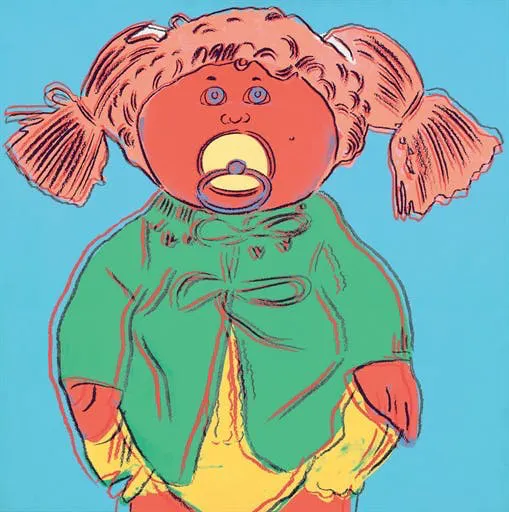
The big collecting phenomenon of the 1980s and the ultimate dream for Topps, was the Cabbage Patch Kids dolls. However, the company behind these dolls, Original Appalachian Artworks, was not interested in a collaboration because they did not want their product to be associated with the cheap cards and chewing gum that Topps manufactured.
However, Topps CEO Arthur Shorin did not want to give up the idea, so the company came up with the solution: they decided to parody the dolls and create as Shorin would've called it a 'f*** you' version.
But before we go into the history of the Garbage Pail Kids, here's a brief background of Topps. The predecessor to Topps was the import and distribution company American Leaf Tobacco, founded in 1908 by Morris Shorin. In the late 1930s, the family hired a market analyst who advised Morris and his four sons to invest in chewing gum.
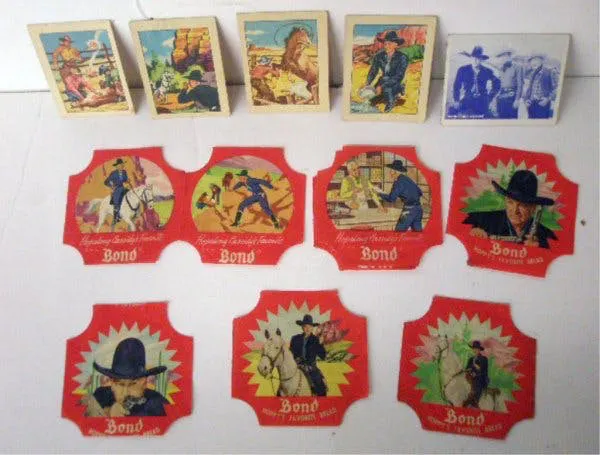
In 1938 the name Topps Chewing Gum was registered and in December of the same year four flavours were launched. By the time the United States entered World War II, chewing gum was available via vending machines throughout the country.
About 10 years later, the bubble gum Atom Bazooka was launched. In the patriotic post-war spirit, the package was created in the colours of the American flag. There was also a comic strip card about the character Bazooka Joe in the package. Soon Bazooka Joe was super popular and became the generation's biggest collector's card.
Next, a card was made with cowboy Hopalong Cassidy (William Boyd) and what would become the company's golden calf, the baseball card (1952). Sy Berger's original design of the baseball cards has basically been maintained ever since.
Berger worked for the company for 50 years. He negotiated contracts with baseball players every year and even went to London and negotiated with The Beatles to make Topps the market leader in collectors cards.
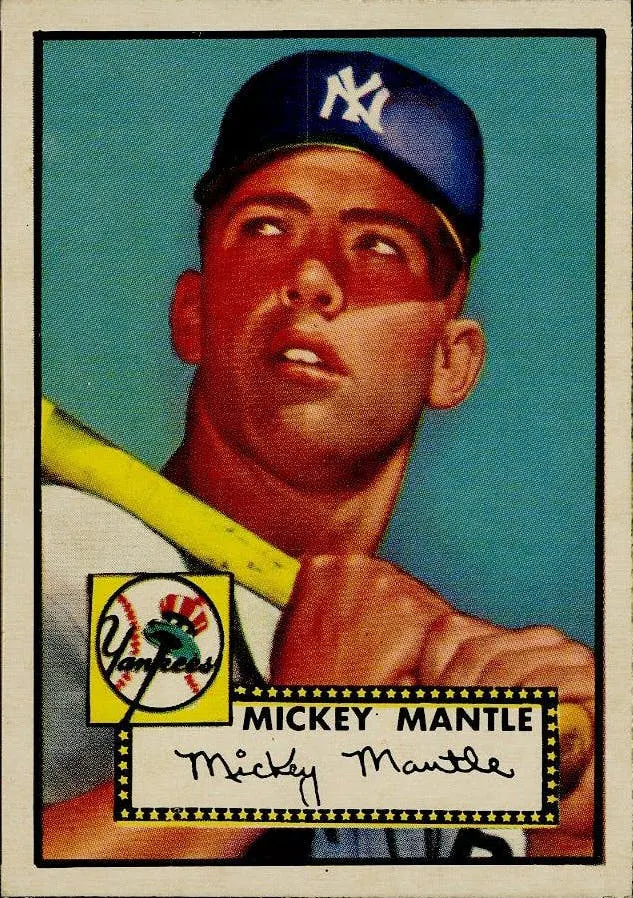
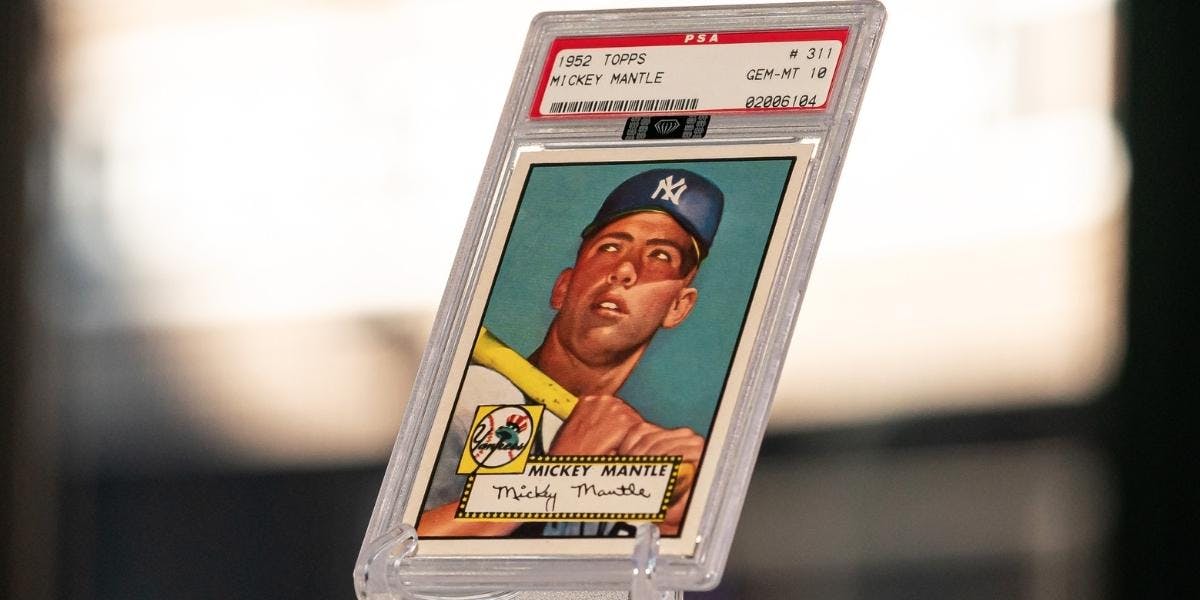
In 1952, Berger rented a garbage barge and had the remaining baseball cards dumped from the first series, as he couldn't even give them away. Of the 407 variants of player cards drowned, there were several Mickey Mantle's: a card that is today one of the most in demand and in 2015 sold for US$330,000 (£254,000). Appraiser Matthew Chilton works for Value My Stuff and specialises in memorobilia. "Topps and Panini are the two main card companies. Topps is the only card manufacturing company who holds a baseball license, which allows the company to use team names/logos on their products. However, Panini holds exclusive licenses for the NFL and NBA," says Chilton.
Sports cards soon became the foundation of Topp's business. Today, there are almost 500 people in the company and Topps has the only company contract with Major League Baseball. They are also big among many sports such as Premier League football in England.
"Collect what you love and enjoy. Collectors often change their interests over time either focusing on cards from a specific time period or a favourite player. Some collect cards due to their rarity and value. Educate yourself as much as possible before heavily collecting. For anyone interested in collecting cards, I recommend that they buy a price guide. Price guides are helpful in identifying, pricing and learning about cards," says Chilton.
The cartoon series, like Bazooka Joe, were alternatives that did not require photography. The connection to popular culture, however, made the popularity of the cards linked with the fickleness of trends.
Len Brown, creative director at Topps from 1959 to 2000, told Mental Floss magazine in 2016, "Topps had always done real well with baseball. Non-sports cards, I called them novelty cards, those came and went. It was just added business."
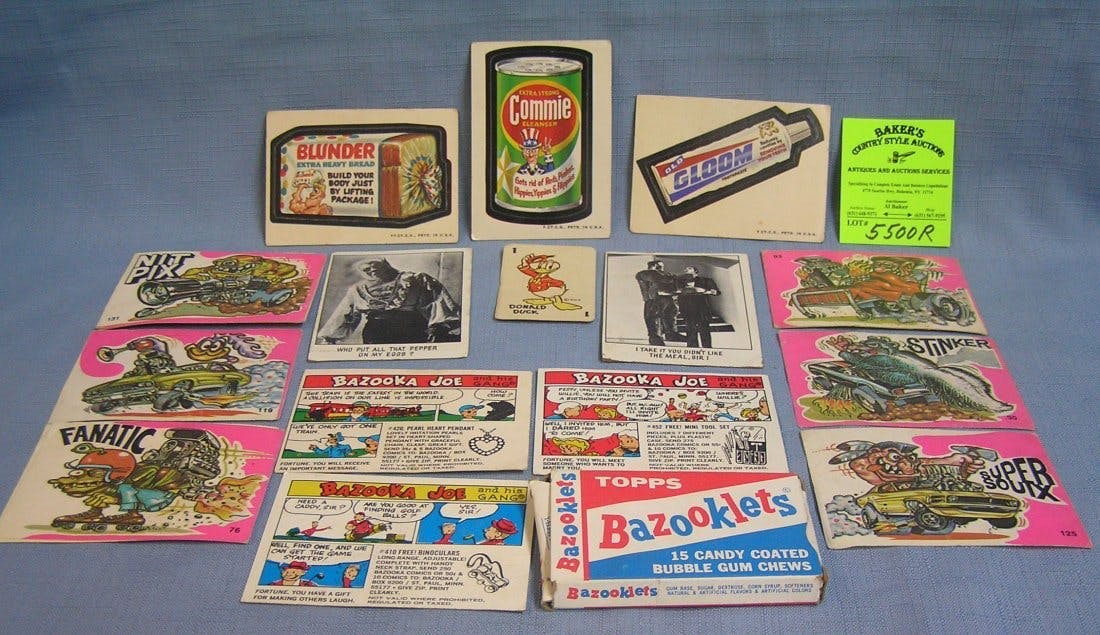
Bazooka Joe, a so-called 'novelty card' was released in a series of 1,535 and was first discontinued in 2012 (in Argentina, the series still continues to be released). But of course smaller series were also made. In the early 1960s, illustrators borrowed from the magazine MAD, who was the leader when it came to satire. In 1959 Norman Saunders created the series Funny Monsters, in 1962 came Mars Attacks, later Rejected Aliens.
The target audience for the cards was young men – just like the baseball versions. The groups designing the series were also most often men. Topps' 'new products development department' was an incubator for the underground comics scene. For example, there was a variant of a Batman card internally at Topps where the star sits on the toilet.
The Pulitzer Prize winner Art Spiegelman more or less grew up in the company and kept track of new talents to take to the company's development department. The new talents were called to Brooklyn, where Topps' windowless office was located in a rough area near the harbour. All the houses looked the same so visitors would follow the smell of chewing gum to find the right one.
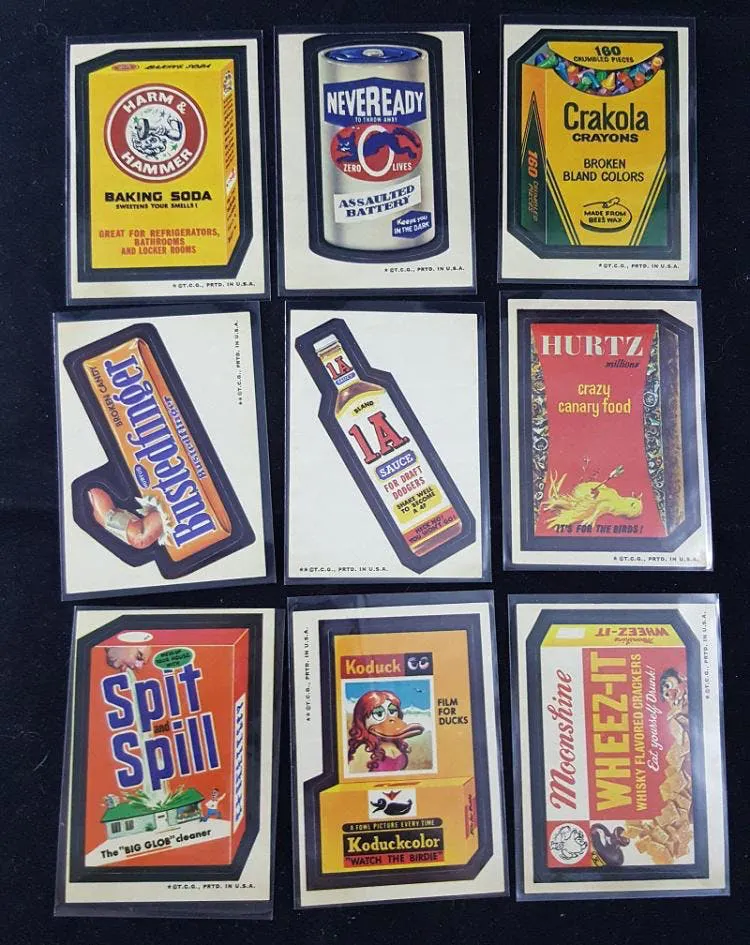
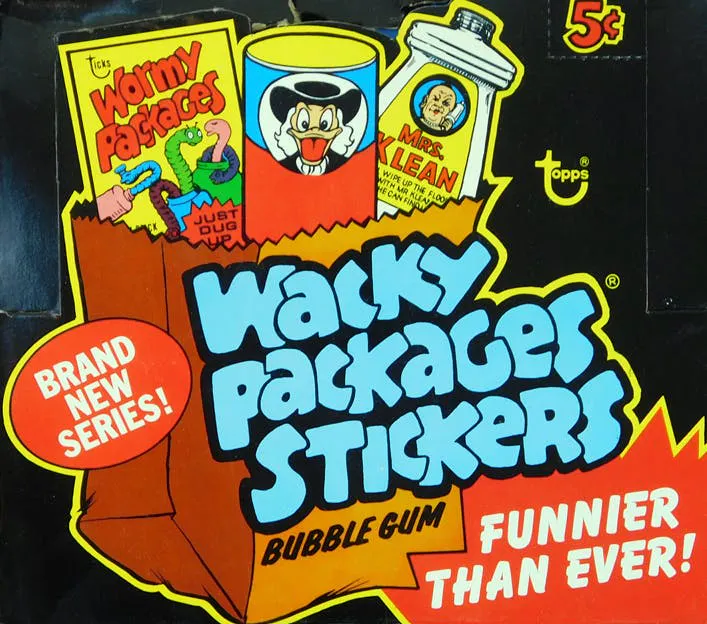
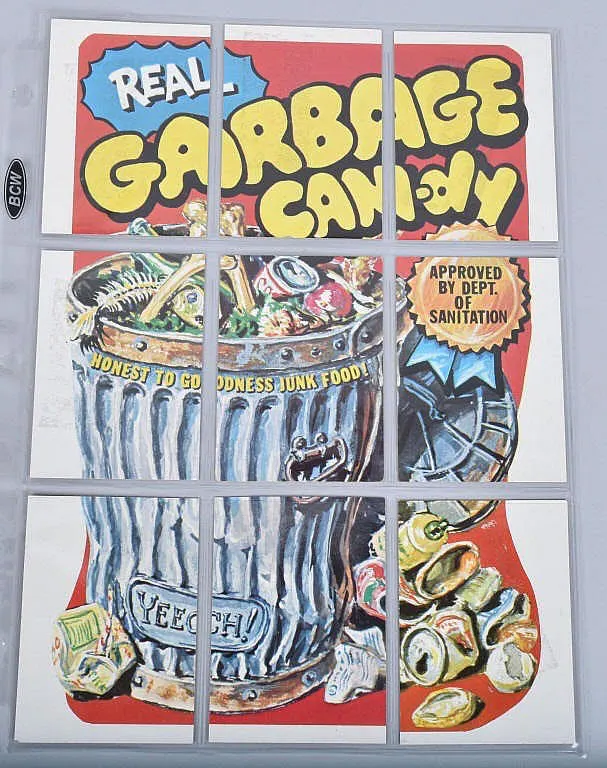
In 1967 Topps started producing the Wacky Packages series. The series was a riff on ordinary household products: the recognisable brands were forged and given crazy names like Gulp Oil, Koduck and Muleburro, and the illustrations underlined the alternative business. Art Spiegelman was one of the people behind it. In addition to Wacky Packages, he also created Garbage Candy – candy with filthy names (think old gym passes or fish legs) that came in mini variants of plastic trash cans. When the candy was finished, the garbage basket took on a different function as a toy. Wacky Packages were made for two years in the late 1960s and for five years in the 1970s. One of the years they sold more of these than the baseball cards. In 1985, it was time for a relaunch of the cards. One day, Art Spiegelman called the underground comic illustrator John Pound and asked if he wanted to make any suggestions.
Pound told the Gpkworld fan site in 2007 that one of the ideas was a picture called Garbage Pail Kids and was a parody of the popular Cabbage Patch Kids dolls. But none of Pound's proposals were printed in the issue that came out. However, the card with Garbage Pail Kids would not be forgotten...
At about the same time as his proposal was rejected, CEO Arthur Shorin's negotiations with Cabbage Patch Kids dolls had failed. When discussing the possibility of parodying the dolls during a meeting, the card was quickly retrieved from John Pound. Arthur Shorin is said to have called Garbage Pail Kids the "craziest thing that ever happened at Topps" but he let Spiegelman find a place for the garbage kids.
Spiegelman returned to John Pound and asked if he could do more variants. Pound submitted about 30 to 50 sketch suggestions, colour studies and logo variations.
At first Pound stated that he would make the children somewhat disturbing, but he realised that he wanted to make them more elaborate. If they were both cute and horrible he thought they would be more interesting.
Topps selected him from among three candidates to make the first series. Pound told Gpkworld, "Spiegelman said he wanted the same artist to do all 44 cards, to maintain style and feel .. Topps had a two-month deadline... I basically needed to make a new one a day."
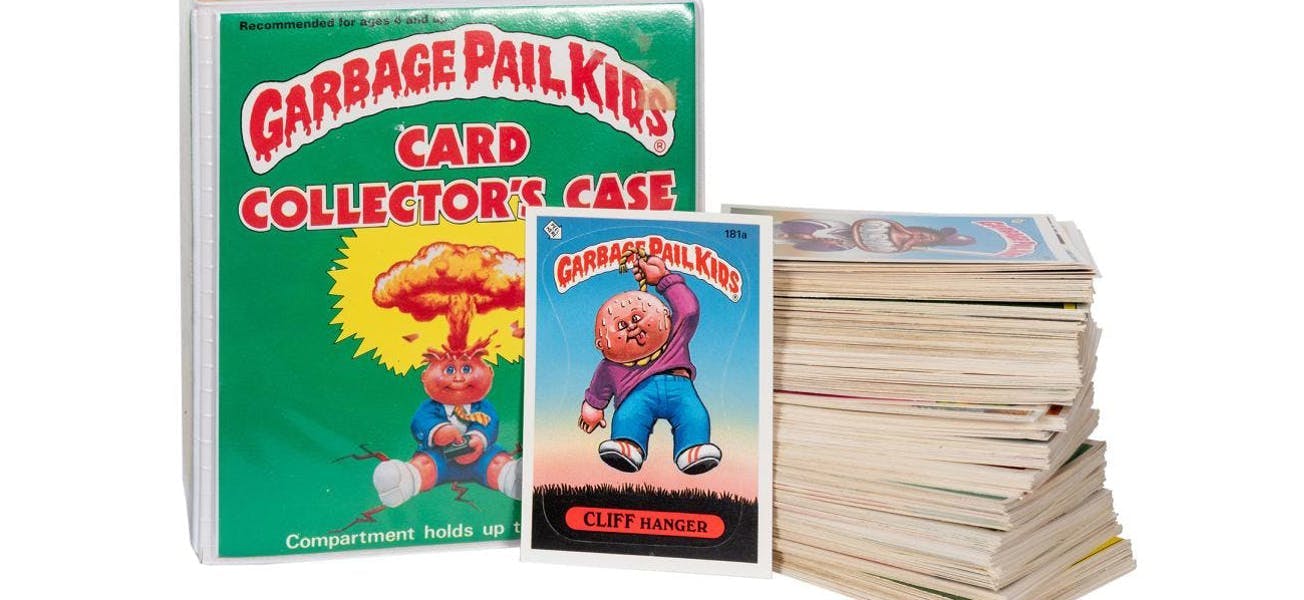
Spiegelman had figured out how to find variety for an entire series. The children who were abnormal, deformed or had met a cruel fate would look like siblings – so it was logical that the same cartoonist did all of them. They were presented one by one. The Garbage Pail Kids' names always had word play where the first and last name together formed a funny combination, like Schizo Fran, or it was linked to the fate that played out in the illustration, like Cliff Hanger.
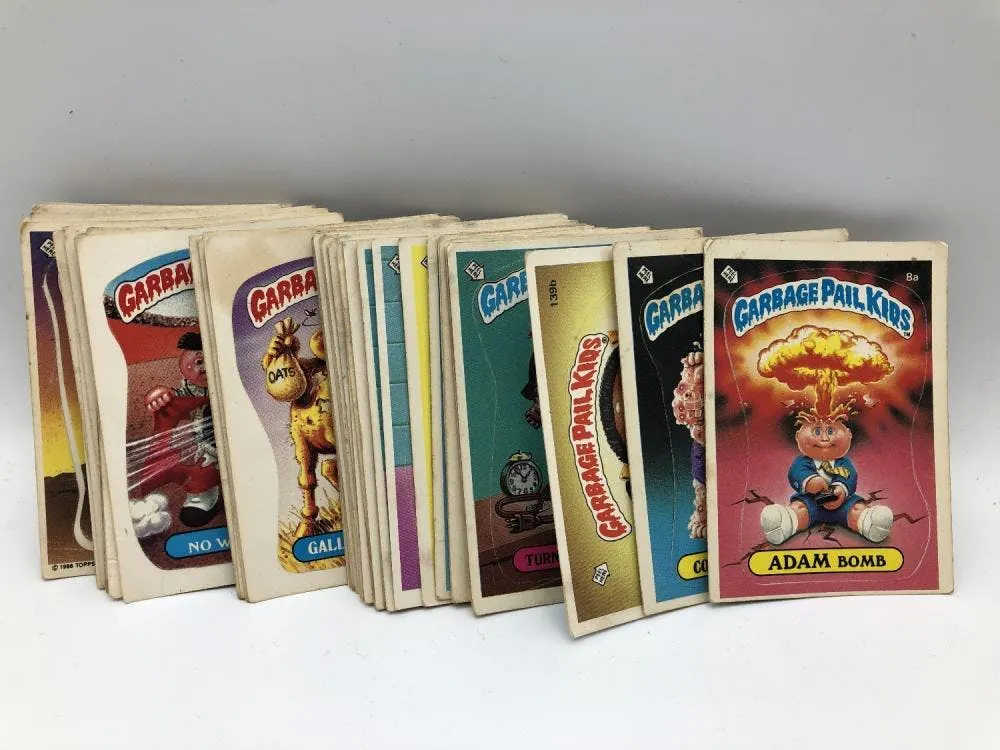
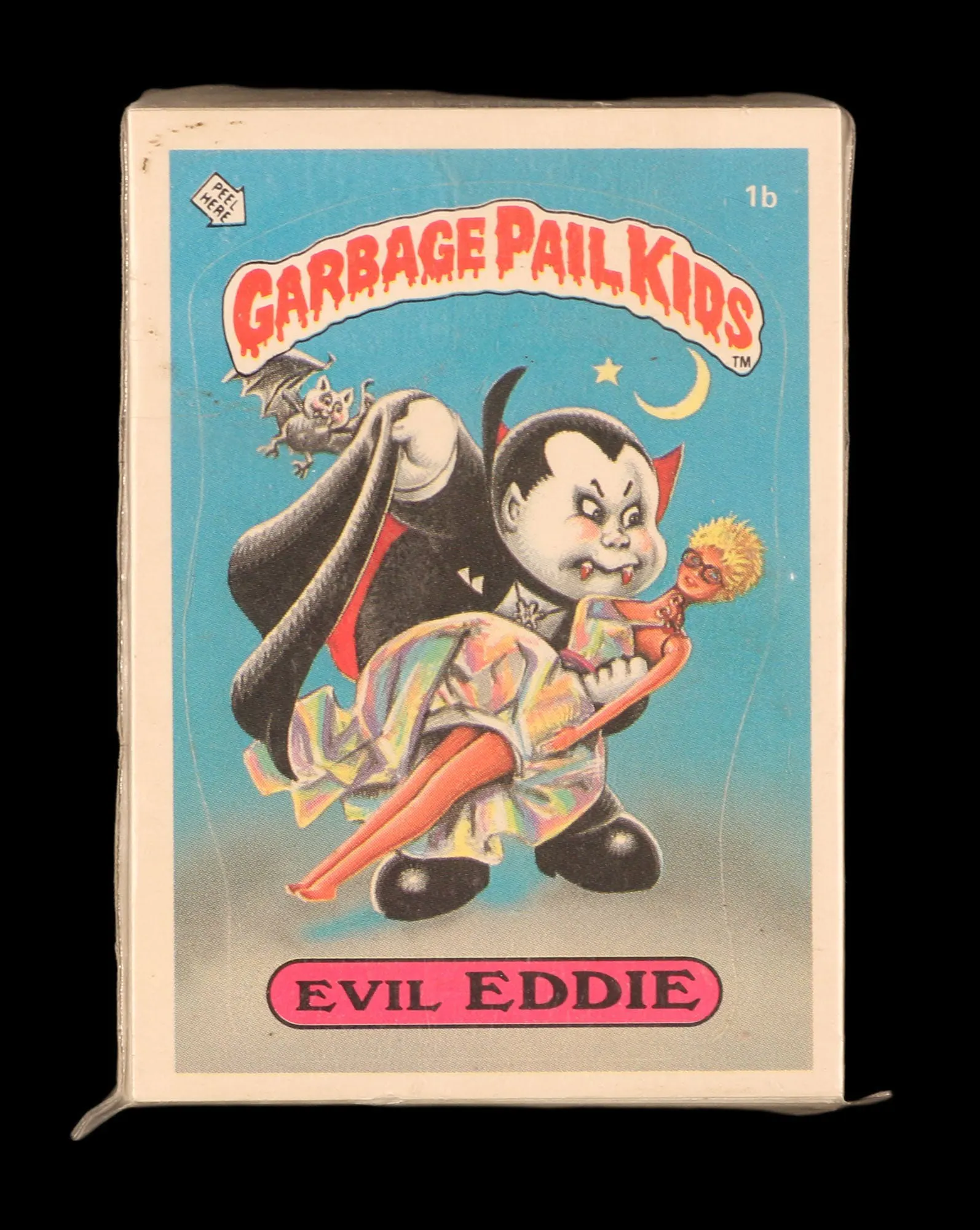
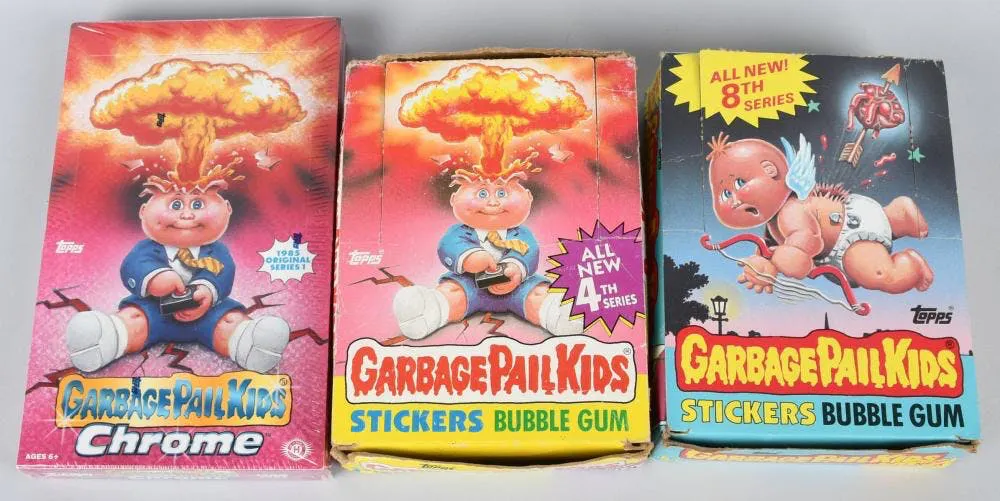
In May 1985 the first test round was released and in July the first 88 cards were launched. One package cost 25 cents and in each package there were five cards and one pink elongated chewing gum. Each figure came in two variants with different names. The cards with serial numbers 1a and 1b were a Dracula type of guy by the name of Evil Eddie/ Nasty Nick, but by far the best known was Adam Bomb/ Blasted Billy with numbers 8a and 8b – a poor man who presses a red bomb button and out of his head forms a sponge-shaped smoke cloud. Soon he was on posters, on the packaging and on boxes. Today, Adam Bomb has become the symbol of Garbage Pail Kids.
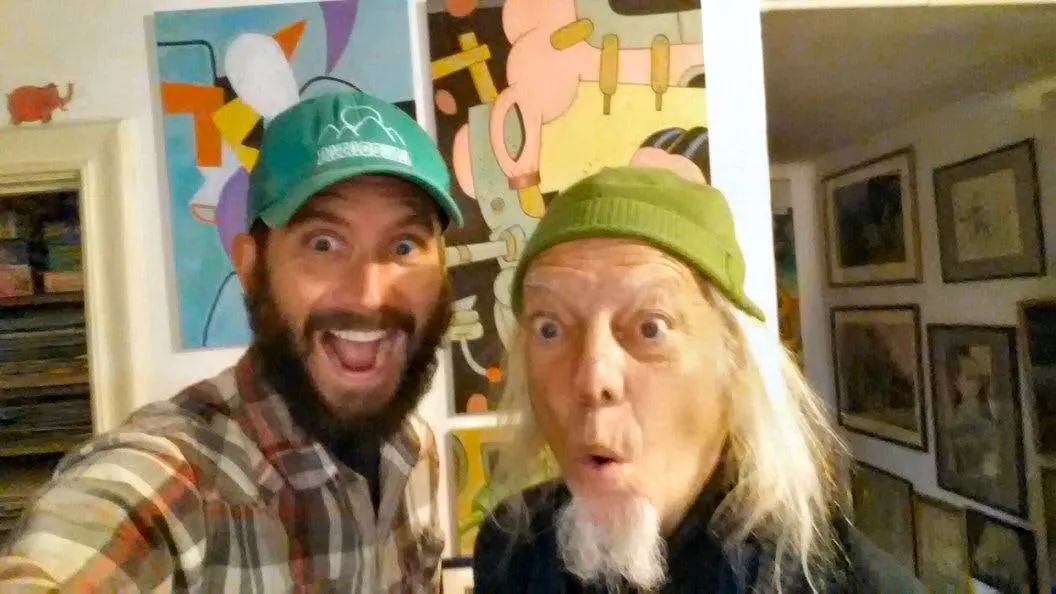
"My infatuation with Garbage Pail Kids started at the beginning of junior high school, during seventh grade, in the autumn of 1985 – I must’ve been around 12," said collector and expert Aaron Booton. "One day, heading home from school I noticed two kids really into some trading cards in the seat in front of me on the bus, I leaned forward to get a better look and I was blown away by what I saw; they turned out to be 2nd Series GPK cards. I was instantly wowed and won over; that obsession has lasted 35 years!"
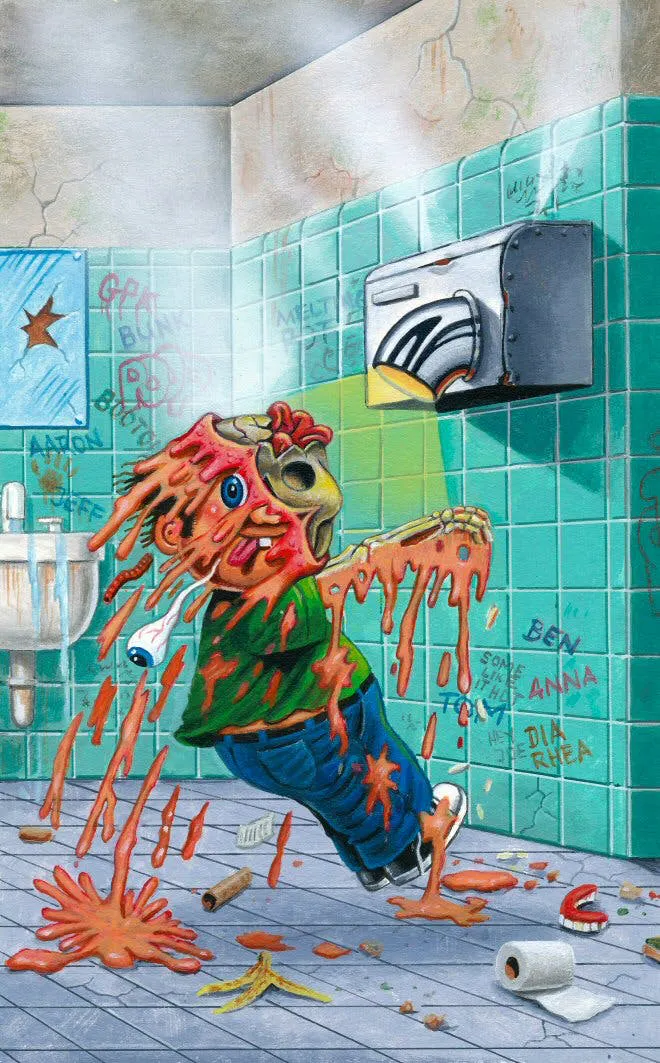
Booton has been a Garbage Pail Kids collector since autumn 1985 and runs one of the world's largest fan sites, Gpkworld.com, alongside his telecommunications profession. Thanks to the site and through the documentary 30 Years of Garbage: The Garbage Pail Kids Story, where he was an executive producer, he has talked to the series creators and become friends with a couple of them. In one of the modern releases, his name is even inscribed in the wall of a card depicting Pete Heat and the hair dryer that blows everything except Pete's skull.
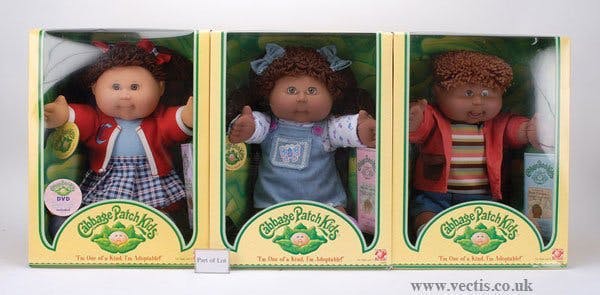
"It was that perfect period between prepubescence and adolescence, where you didn’t know the meaning of counterculture, but enjoyed the idea of coolness (GPK) up against, and at odds with, cuteness (CPK), and your parents and teachers not liking the material," says Booton. "The cards were everywhere; on the bus, on the schoolyard playground, in piles on lunch tables for trading or inspection – every kid wanted the cards, even if only collecting them briefly; for a name, character, card back, etc."
The cards spread throughout the US and later the world. It is said 500 boxes were sold a day and stores limited how many packages each customer could buy in order not to sell out immediately. In Germany they were called 'Die total kaputs kids' and are probably the most talked about non-sports cards in history. Garbage Pail Kids was the largest collector product in the United States throughout the 1980s. Beginning with the second series, the back of the cards became part of a larger puzzle, built with 17 other cards, to maintain the collecting frenzy.
Children loved them as much as parents hated them. In the American 'Bible Belt' they were banned; in Sweden, a member of Parliament tried to ban them. Psychiatrists believed that the cards "would teach innocent minds to laugh at violence, deformity and pain". In France, the well-known underwater explorer Jacques Cousteau warned parents that if children had these, they would "sink into ruin and begin with cocaine".
Soon, the cards were banned at many schools in the United States, not actually for their 'offensive' content but rather because children couldn't concentrate on their lessons. CBS and several other TV channels featured the hype.
In Sweden, Garbage Pail Kids were introduced in 1987 and already the year before, the international journalist Erika Bjernström had written about them Dagens Nyheter: “From the candy stand, the dolls glance at us standing in the food queue. For a moment it fades. They constitute relentless proof that the concept of nuclear war and death is part of the children's reality in 1986. Unscrupulous businessmen are not late to exploit their fears and fantasies for the future for profit."
Topps is said to have believed all publicity is good. No criticism ever reached those who worked with the series, even though they obviously saw articles in newspapers and TV shows. The working group referred all the media to the company's public relations department. In addition, they were in such a bubble job-wise that they almost didn't know how big the cards had become.
John Pound had worked hard on the first series. Then, a phone call came from the company. They wanted to come out with a second series as soon as possible; so it continued until they decided to shut down.
The creative group was constantly thinking that the next series would be the last. Up until 1989, 15 series were created with cards, for a total of 660 cards. In addition, lots of other merchandise was produced, such as t-shirts, buttons, albums, bags and hats. A 16th series was created but never left the company.
Before the third series, several illustrators were employed who drew in John Pound's manner, including Tom Bunk and James Warhola who painted his figures in oil (his uncle was Andy Warhol and according to the illustrator, the pop artist thought the cards were both disgusting and fascinating).

The jokes in the Garbage Pail Kids images are cheeky and deal with everything from taking pills to poor hygiene.
There was a dictionary with popular names because it was known that the children loved to find their own names on cards. In previous projects, Topps had sold cards where disgusting monsters were given common names – and the kids had bought the cards.
However, this was a criticism too. If a character had the same name as someone who was bullied, the cards could be used combatively.
However, every card ended up on the CEO's table before the printing press – he had the final vote. If you flip through the cards, they do not actually seem very nasty; they are fictional characters and are so abnormal that they don't seem real.
Rather, Garbage Pail Kids was an art collection for kids.
Aaron Booton says, "Even as a youngster, you could tell the quality of the artwork was topnotch. As a youngster, you didn’t know major underground comix artists had a hand in creating these masterpieces, but you knew the 25-cent-pack and five sticker cards in your hand was well worth the money and value. The subject matter on the cards really did expand your knowledge, made you want to draw and create, broadened your imagination. Every form of entertainment, be it artwork media, music, video, etc., questions peoples’ morals and values – which is a good thing. However, as a kid, there is a level of innocence and the cards felt like a language only you and your friends could understand. The artwork spoke to you; like a secret from adults."
In 1987, Topps was sued by the owner of Cabbage Patch Kids Dolls. Overnight, many original drawings disappeared from the Brooklyn office. The companies settled and Topps was forced to change the appearance of the characters and the logo in addition to US$7 million (£5.4 mil) in royalties for previous series.
At about the same time, Topps also decided to make a feature film called the Garbage Pail Kids movie. It premiered in August 1987 and was a major wreck. The movie was not cartoon and the script had been written by an outsider with no understanding of the characters because those who worked with the cards did not have time.
CBS planned a series about them, but this was stopped when the advertisers became nervous. According to the 2015 movie 30 Years of Garbage Pail Kids, it was the first time in CBS history that a finished series was stopped due to complaints.
Mark Newgarden of Topps told Mentalfloss, "The film was much worse than I could've imagined and I'm pretty sure it helped lower the perception of Garbage Pail Kids."
In 1988, sales of Garbage Pail Kids had dropped so much that Topps stopped the already finished 16th series.
"It’s hard for me to let go of obsessions and possessions, so when the 16th Series GPK set wasn’t released in early 1989, it took a while to grasp that GPK was no longer going to be hitting store shelves, or rather, store counters," said Booton. "If I could change anything during the history of GPK, minus the movie (UGH!), it would be to have seen the official release of the 16th Series GPK set that was shelved and still remains unreleased in it’s original format. I remember writing to Topps in 1989 asking whether the set would be released… no response. I was well into high school at the time and most of the collectors around me had stopped collecting GPK during the 4th and 5th series sets. Even though the card artwork was eventually released in different ways (All-New Series 1, bonus cards, etc.), I still feel unsettled as a collector knowing that the old reverse card material was never printed and that the original set was never released."
The fact that the images were controversial also persisted. Art Spiegelman was eventually awarded the Pulitzer Prize for the cartoon series Maus, which was about the Holocaust. When it was released in book form at Pantheon Book in 1991, the book publisher was terrified that it would spread that he was associated with Garbage Pail Kids.
Today, Garbage Pail Kids collector cards are all the more popular with adults. However, collectors of objects related to childhood often have breaks from their hobbies. For Booton, basically the whole 1990s was such a period. However, during college, he was on the Internet and one of his first searches happened to be Garbage Pail Kids. That same year, in 1998, he started his site to tell more about the creation of the cards and also found eBay, so it wasn't long before he was obsessed again.
"My dream was always to find an Indiana Jones-like hidden tomb of 1st Series GPK boxes since I never owned the complete 1st Series set as a kid, but that dream was answered via eBay in 1998 when I was able to hold a 1st Series box, open 1st Series packs, and collate a 1st Series set!" said Booton.
Booton describes himself as an addict and today he is more active with other collections. Nevertheless, he spends about ten hours a week on the site that has been active for 22 years. It is one of several fan sites in the subject and focuses on the creators; another has a community of collectors who focus on the cards, series or surrounding products. Aaron does not make any money on his site and therefore does not know the exact number of readers, but is aware he is getting more and more. Nowadays, the site is also on social media and has a few thousand followers.
"The visitors in general range from die-hard collectors to easy-going perusers who remember who are fond of the nostalgic characters," he said. "There is definitely a large GPK community that runs a plethora of different websites and social media pages for all aspects of the cards, be it for international releases, Cheap Toys figures, sketch cards, sell and trade, et cetera. Some gather for the ‘GPK’ conventions and trading card shows throughout the year. The website and community has led to some amazing friendships, some I know will be lifelong – with many collectors and also several artists, from the original series and from the new releases."
American appraiser Simeon Lipman, known from PBS's Antiques Roadshow has valued cultural phenomena and collections for more than twenty years. In the film 30 Years of Garbage Pail Kids, he calls Adam Bomb the comic book Mona Lisa and says he would never insure the original for less than a quarter of a million dollars. He also estimates that the first series cards in top condition would go for about $3,000-5,000 (£3,200-3,900).
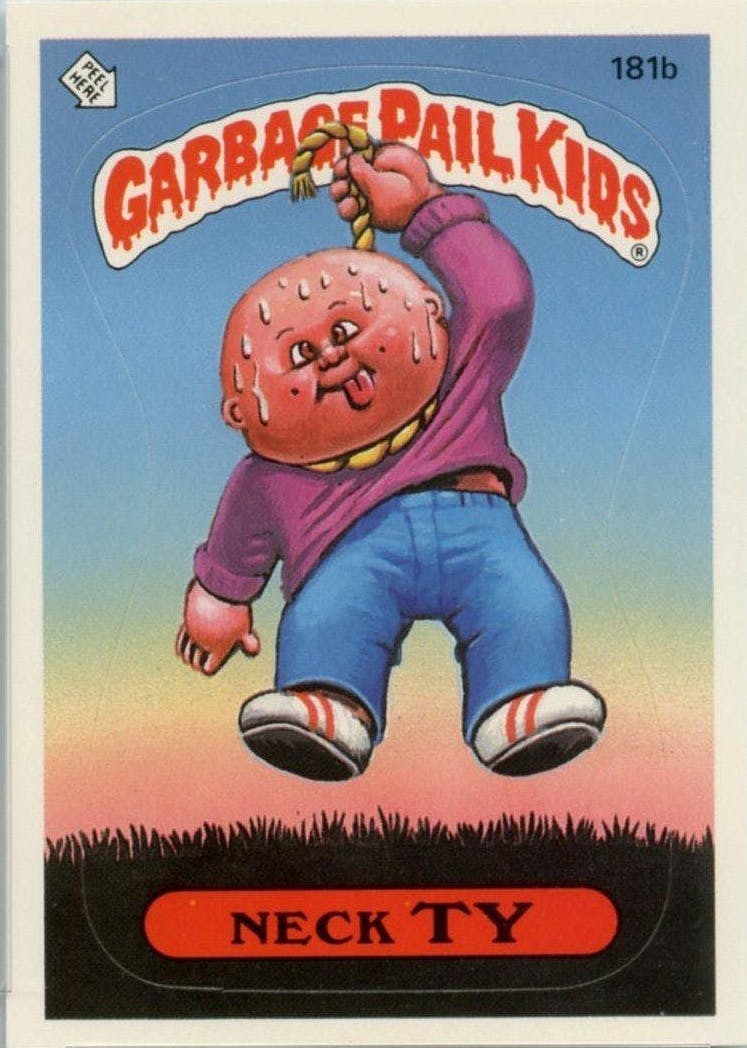
"Topps originally printed Garbage Pail Kids with a matte finish but it is thought they eventually ran out of that card stock and had to switch to a glossy paper instead", said Chilton from Value My Stuff. "Those glossy versions are very rare and therefore carry a premium to them versus their matte counterparts. Most valuable is Nasty Nick and Adam Bomb from the first series."
Historically, eBay has been the major marketplace for Garbage Pail Kids. As of this writing, a search for them results in approximately 30,000 hits on the site. Around 350 auction results linked to the subject are also registered on Barnebys. The most expensive item is an original comic art from 2006 by Will Elder and Harvey Kurtsman, an adult version created for MAD with celebrities such as Prince, and Yassar Arafat, that sold for $2,868 (£2,200).
Garbage Pail Kids lay dormant until 2003 when the series was brought back to life by Topps and has since then returned periodically. The new series was called the All New Series and was made until 2007. Since 2016 it has also been possible to buy digital variants of the cards. However, the hype from the mid-1980s has not been revived.
"My most unique item is a green-ink sketch card by John Pound from the All-New Series 4 release that never found its way into the boxes but was purchased directly from the artist (the first iteration of a ‘Return’ sketch card); only three known to exist," said Booton. "But, from the Original Series, my favourite items would have to be the original tight pencil and colour rough artwork, also by artist John Pound, for the 3rd Series #104 character which is the mascot for my website and the first ‘Aaron’ card within the GPK realm. From the middle releases, my buddy Tom Bunk has placed my name within the artwork for several pieces, so those cards and some of the final artwork are my most prized possessions. For some later releases, Brent Engstrom and Joe Simko have also given myself and website some shout-outs on card. It’s wonderful to be recognised and acknowledged by these brilliant artists."
The artists themselves gave all their original material to Topps during the 1980s. What did not disappear in 1987 was retained by the company. Around 1990 an auction was held in which Topps sold a number of original items from its history – but not from Garbage Pail Kids. Several of the illustrators even had to buy back things they themselves created. In the early 2000s, Topps sold many of the originals from Garbage Pail Kids on eBay. The originals of the 16th un-produced series are still missing.
"Valuations can increase dramatically if cards are professionally graded by a third-party. I highly recommend getting rare/vintage collectible cards graded by either PSA or Beckett," says Chilton.
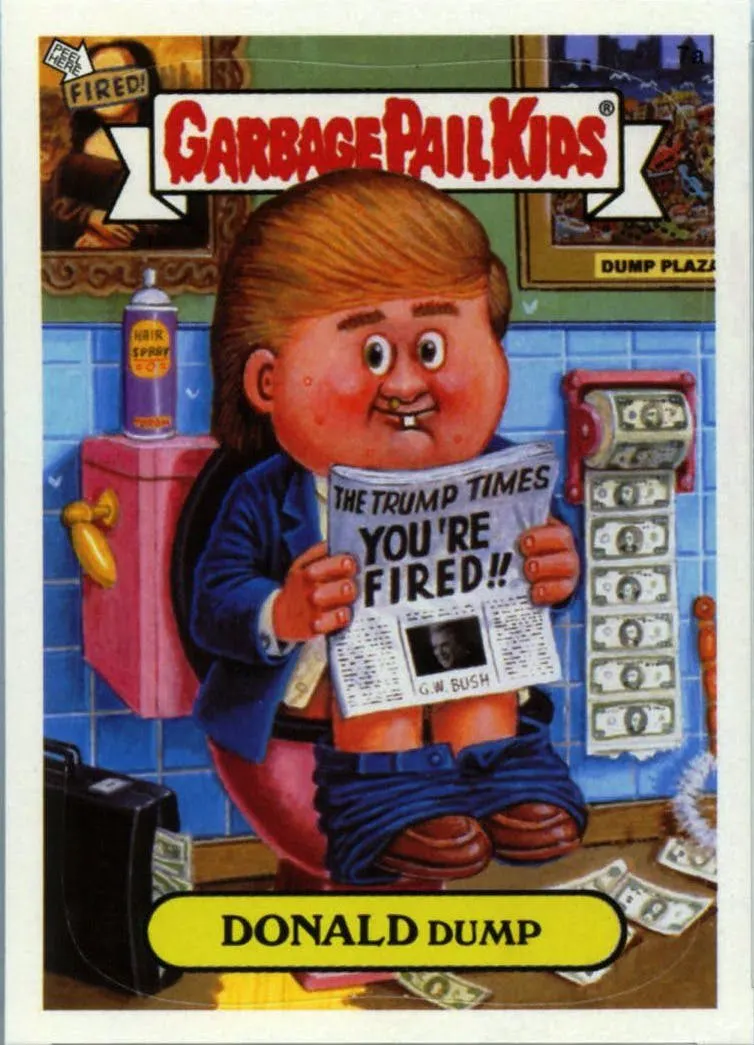
This year marks 35 years since Garbage Pail Kids was first released, and it is important to remember that 10 to 12 year olds laugh at the same things now as they did then. For example, do you remember how Batman was caught in the 1960s while sitting in the toilet? In 2004, Harry Potty and Donald Dump were released as remakes of popular figures. Guess where they both were sitting?
Find more Garbage Pail Kids on Barnebys
Garbage Pail kids series
1985-1989 Original series
2003-2007 All new series
2011 Flashback series
2012-2013 Brand new series
2013-214 Chrome
2014 – 2019 Yearly series
Since 2016 you can find digital versions
Appraisal Matthew Chilton: Top 4 most valuable Garbage Pail Kids cards (2020)
1. 1985 Garbage Pail Kids #1a Nasty Nick---Estimated PSA 10 Gem Mint Value: $7,500 (£5,800)
2. 1985 Garbage Pail Kids #6a Adam Bomb----Estimated PSA 10 Gem Mint Value: $4,000 (£3,080)
3. 1985 Garbage Pail Kids #49b Schizo Fran---Estimated PSA 10 Gem Mint Value: $1,000 (£770)
4. 1985 Garbage Pail Kids #5b Jay Decay---Estimated (Checklist Back) PSA 10 Gem Mint Value: $900 (£690)
Sources:
The modern Hobby Guide to Topps Chewing Gum 1938-1956, David Hornish
Gpkworld.com
Mentalfloss, 2016, Jake Rossen
Topps.com
30 Years of Garbage: The Garbage Pail Kids Story