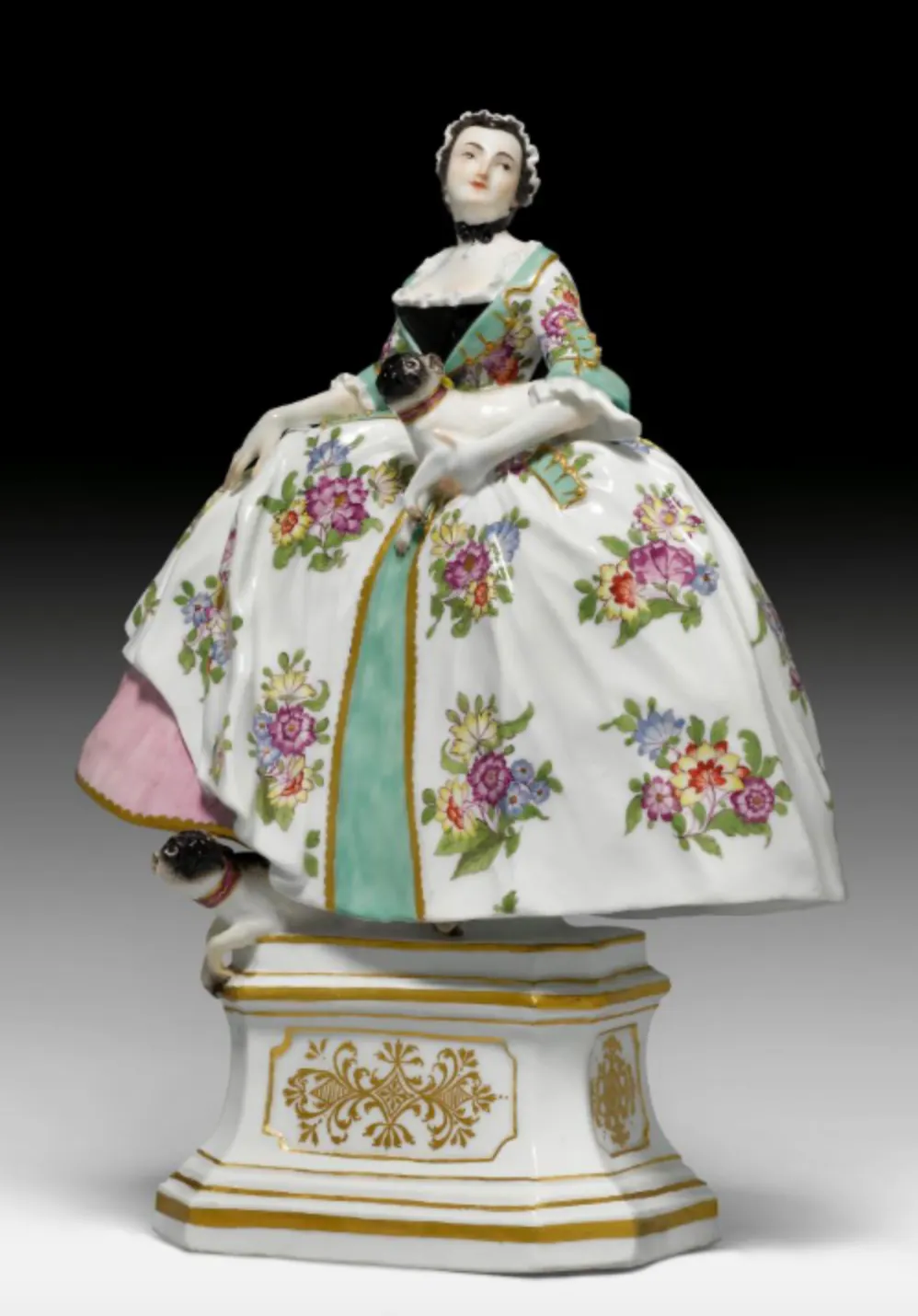
If you stroll through a museum or leaf through an auction catalogue, you will occasionally notice objects whose names or descriptions raise a question mark. The figure of The Lady of the Order of the Pug falls into this category, a delicate porcelain figure designed at the Meissen factory in the mid-18th century.
The figure depicts a noble lady in a typical floral patterned gown of the era. She hides her pinned-up hair under a lace bonnet and a ribbon decorated with a bow nestles around her neck. But the lady is not alone: she is holding a pug dog in her arms. Another representative of the breed rests at the feet of his mistress and looks up at her with wide eyes. The figure could have simply been called Lady with Two Pug Dogs, so how did the name The Lady of the Order of the Pug come about?
See also: The Art of Fashion: Fashion in Art
In order to uncover this secret, one must first turn to the legendary Freemasons. Originating in England, this secret society, transcending social and religious boundaries, disseminated across Enlightenment-era Europe in the 18th century. Secrecy was paramount, so it is not surprising that the Freemasons soon encountered suspicion from the Catholic Church, which sensed that heretical actions were taking place during the secret meetings. In 1738, Pope Clement XII forbade every Catholic from joining the Freemasons and threatened them with excommunication if they disobeyed.
See also: The Story of the Staffordshire Dog Figurines
In order to avoid this risk, but not forego the advantages of membership in a secret society, an alternative was found: the Pug Order in 1740, whose founder is said to have been Bavaria's ruling Duke Clemens August (1700-1761). Unlike the Freemasons, women were also admitted to the Pug Order, aligning with the contemporary trend wherein women's societies, inspired by the Freemasons, were emerging in France and elsewhere.
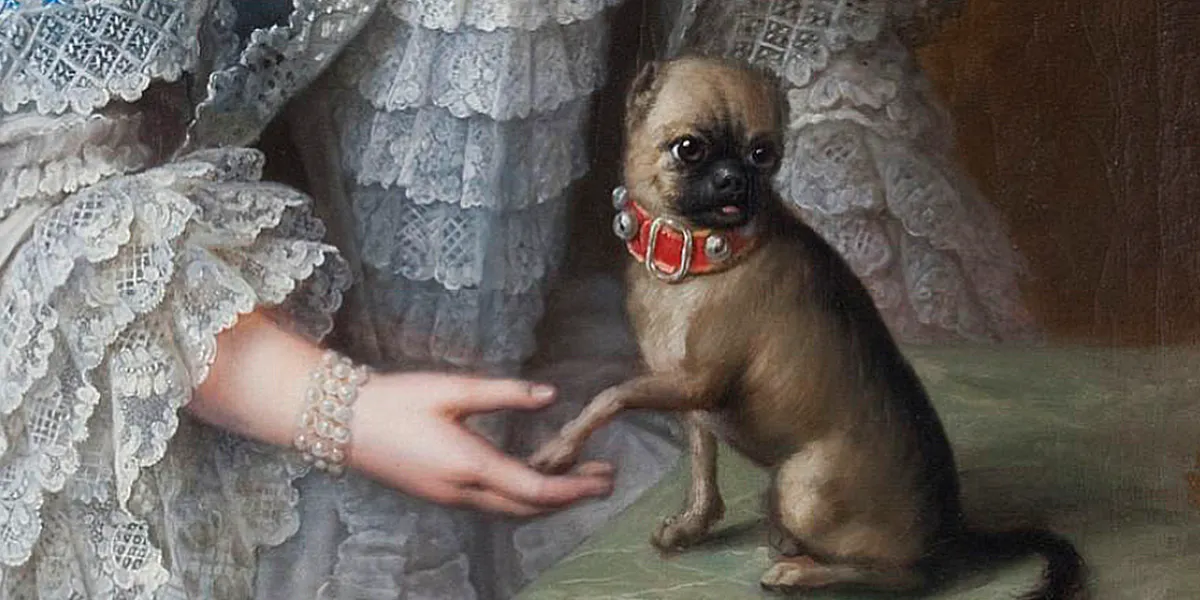
But why was the pug chosen as its namesake and symbol? The pug dog originally comes from China, where it was reserved for the imperial family. In the 16th century, the first pugs arrived in Europe on the ships of the Dutch East India Company and the cute little dogs quickly became popular companions among high society ladies, who appreciated them for their special loyalty – a trait that was expected to be shared by the members of the order. The members of the order owned real pugs and secretly wore a silver medallion decorated with a pug as a sign of their membership.
See also: An Artist's Best Friend: 8 Painters and Their Pets
On the whole, the Pug Order was based on the rituals of the Freemasons, but did so in an amusing, even parodying way. The members of the various lodges (there seem to have been ones in many courts and places, including Berlin, Bayreuth and Weimar) called themselves Möpse (meaning "pug" in German). The respective lodge masters, each with a male and a female member, were known as Großmöpse ("Big Pugs"). Only the all-important position of Grand Master remained in male hands, such as August III/II, King of Poland, and Elector of Saxony (1696-1763).
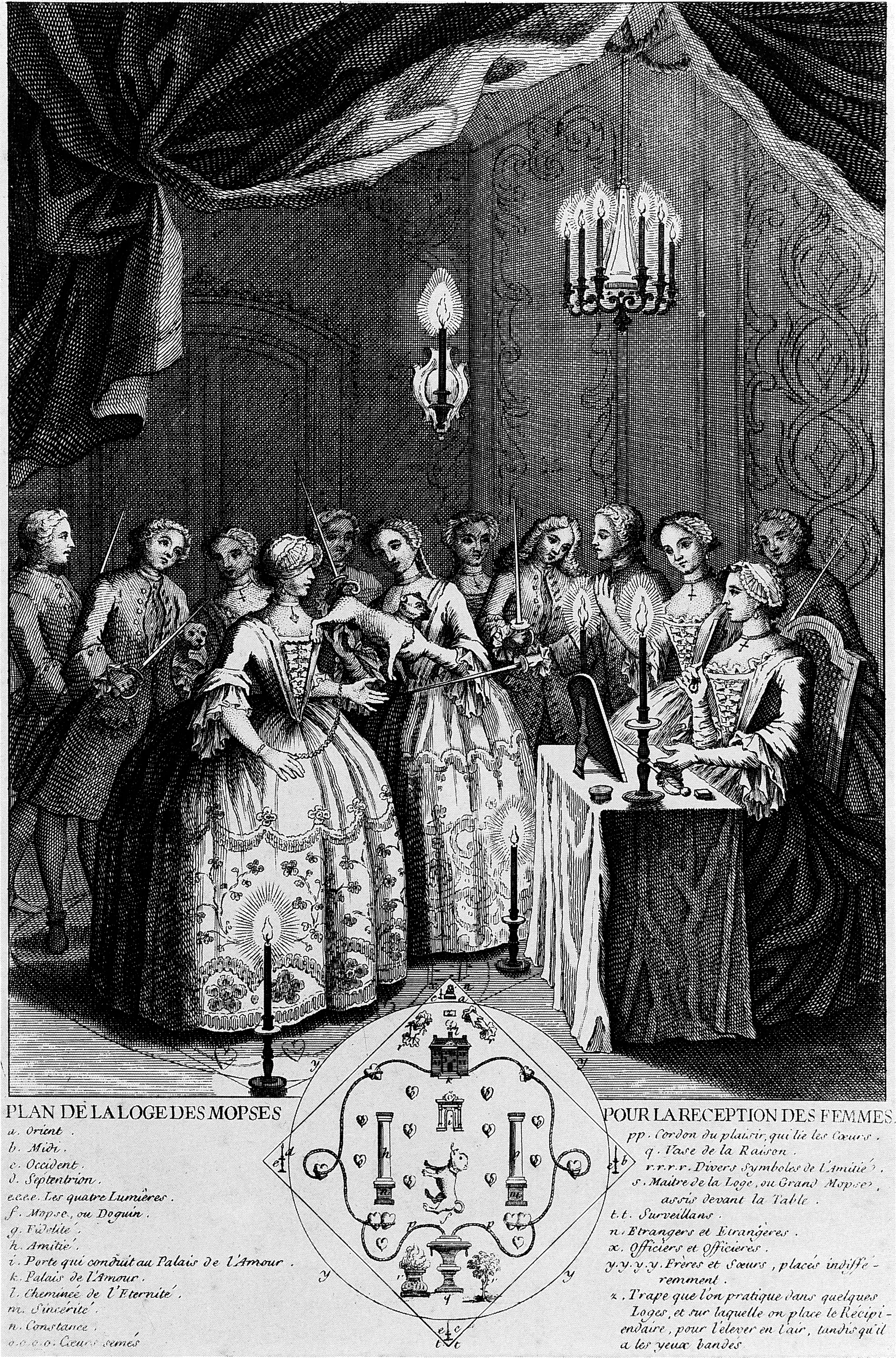
The admission ritual of a novice must have been particularly fun for everyone involved: blindfolded, the candidate had to scratch on the door on all fours, like a pug. After entry, he was led around a special carpet nine times, followed by symbolic kissing of the backside of a pug (usually made of porcelain), various oaths and obediences, and the removal of the blindfold.
See also: Collecting Like a King: Meissen Porcelain 101
The production of the pug figurines required for the initiation were commissioned from the porcelain manufactories, which had been producing the finest figures for several decades. For example, pug figures can be found repeatedly in the order books of the great Meissen designer Johann Joachim Kändler (1706-1775), as well as individual human figures and groups of people associated with the Pug Order.
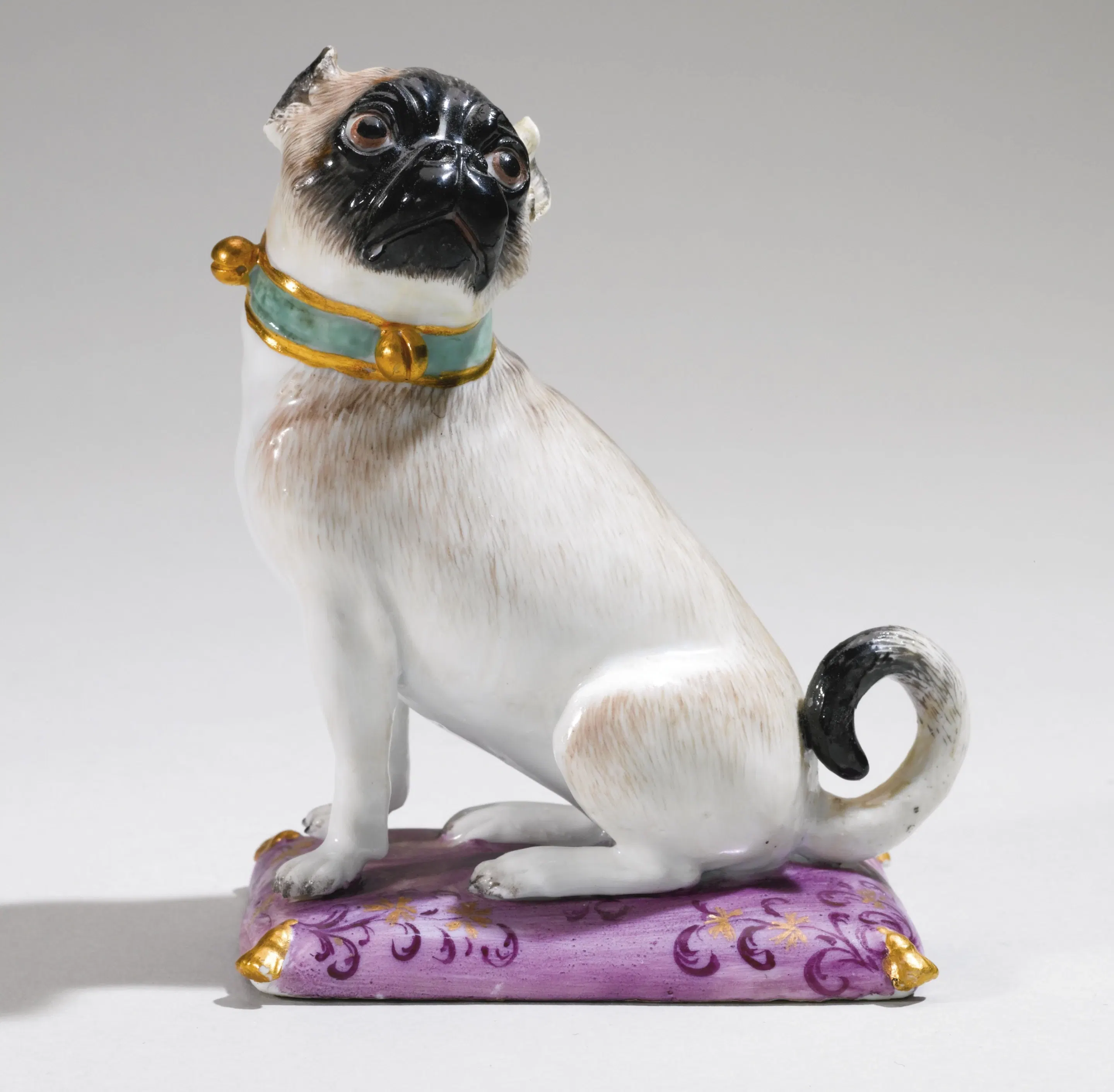
Kändler wrote about the figure that inspired this model in 1744: "1. Lady of the Pug Order, standing on a pedestal, holding a pug dog in her left hand, also one lying at her feet, in front of the Princess of Herfordt ...10 Thlr." The Princess of Herfordt was probably Princess Johanna Charlotte of Anhalt-Dessau, the widowed Margravine of Brandenburg-Schwedt (1682-1750), who held the position of princess abbess of the secular women's monastery of Herford from 1729 to 1750. Other sources name Henriette Amalie Princess of Anhalt-Dessau (1720-1793) as the client. Henriette, who remained unmarried, was banished to Herford Abbey for eleven years by her father, Prince Leopold I of Anhalt-Dessau, after she gave birth to an illegitimate son in 1741.
Want to discover articles like this straight to your inbox? Then sign up for our free newsletter today!
The Pug Order had to end its status as a secret society as early as 1742, when a so-called "traitor pamphlet" (L'ordre des Franc-Maçons trahi et le Secret des Mopses révélé) was published in Amsterdam, which contained the symbols and practices of the Freemasons as well of the Pug Order. It was an important source on the beginnings of the Freemasons in France and especially on the Pug Order. The author, Gabriel-Louis Calabre Perau (1700-1767), assured that he did not intend his work to expose the orders, but rather to protect them from slander and evil suspicions.
Nobody knows how long the Pug Order existed. While some believe it existed into the 20th century, others believe it did not make it past the beginning of the 19th century.
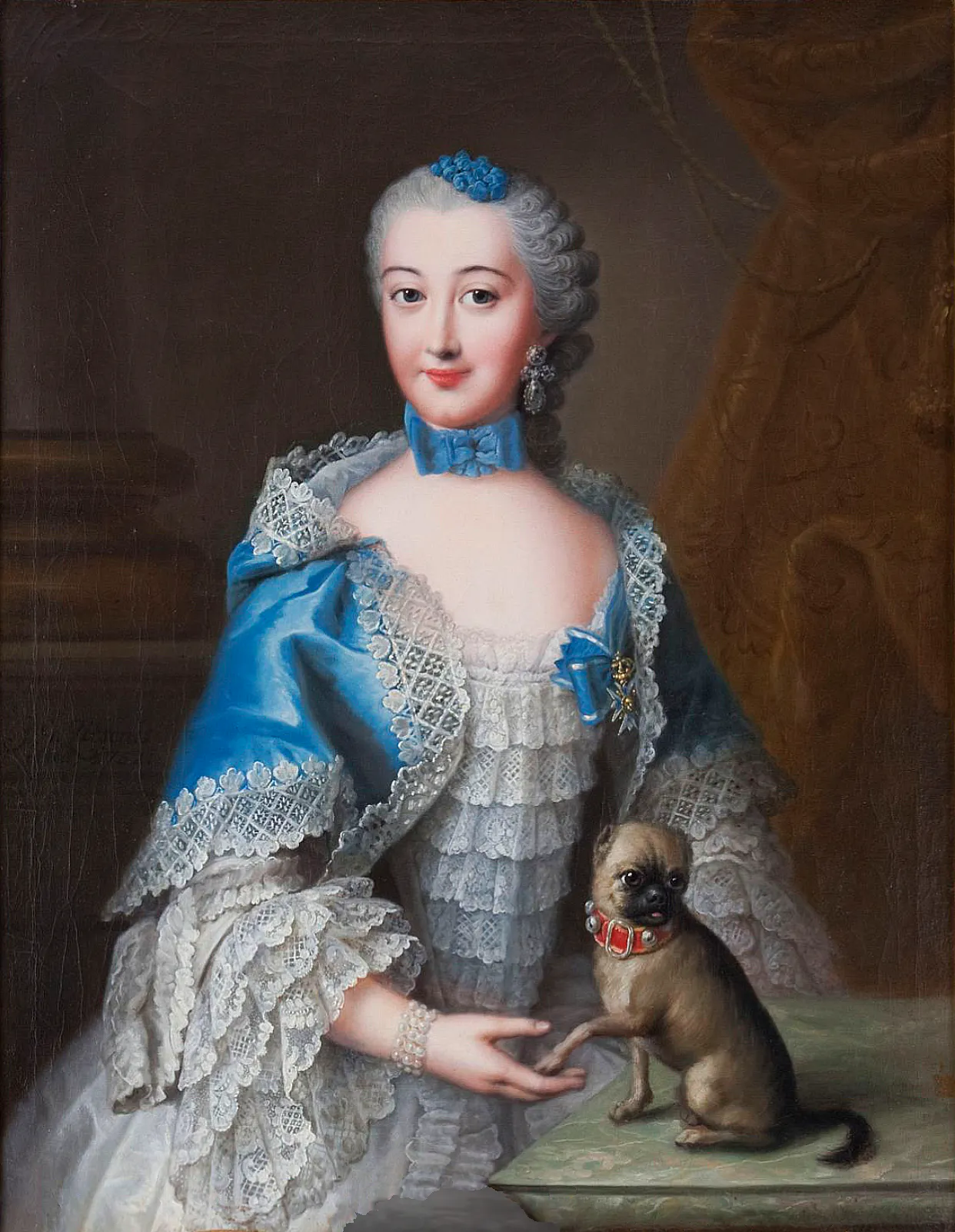
One thing is certain: 18th-century portraits of distinguished ladies with their pet dogs abound. But with each of these portraits in which a pug dog is present, one inevitably has to ask oneself, was this lady also a "pug"?