
![Annie Leibovitz, ‘David Hockney, Los Angeles’ [detail], 1983, 44.5 cm x 45.7 cm. Photo: Phillips](https://images.prismic.io/barnebys/7e2b6e27-abdd-4b3b-a80f-ca944efe2158_Hockney.jpg?auto=compress,format)
David Hockney was born in 1937 in Bradford, England. His first works, for example Nude (1957), were inspired by social realism and the Kitchen Sink movement, a British cultural movement that developed in the late 1950s, whose protagonists, often ‘angry young men’, were disillusioned with modern society. In 1959, he joined the Royal College of Art in London; there he discovered Alan Davie, Jean Dubuffet and Francis Bacon. From that time on, he relied on two major sources: Henri Matisse for colour and Pablo Picasso for experience.
In his propaganda and love painting, he was an activist for homosexual and vegetarian causes. At the exhibition Young Contemporaries in 1961, he presented four paintings inspired by Pop Art and Abstract Expressionism, and also influenced by the classical masters.

But the real turning point for Hockney came in 1964. Attracted by the American dream, Hockney moved to California: the shock from the industrial greyness of Yorkshire was brutal. Here, acrylic paint started to invade the surface of his canvases as a reflection of the blinding mirages of the American way of life (body worship, money, moral liberalisation). Hockney painted swimming pools in Hourloupian shapes that unfolded in the style of Mark Rothko’s colour field paintings, as with Bigger Splash (1967).
See also: John Baldessari: The Irony of Conceptual Art
His painting was then divided into two tendencies: the experimental ‘Technical Pictures’ and the narrative ‘Extremely Dramatic Pictures’. Colour dilution sometimes reached extreme levels, while building façades and cut grass surrounded the contours of a minimalist lifestyle, for example A Lawn Being Sprinkled (1967).

In 1968, Hockney embarked on a series of large double portraits recognised as masterpieces of modernity, take Christopher Isherwood and Don Bachardy (1968). In Mr and Mrs Clark and Percy (1971), he was inspired by Jan van Eyck’s Arnolfini Portrait (1434). Hockney then designed sets and opera costumes for Igor Stravinsky’s plays. This adventure led to the revival of a famous print by William Hogarth: Kerby (After Hogarth) Useful Knowledge (1975).
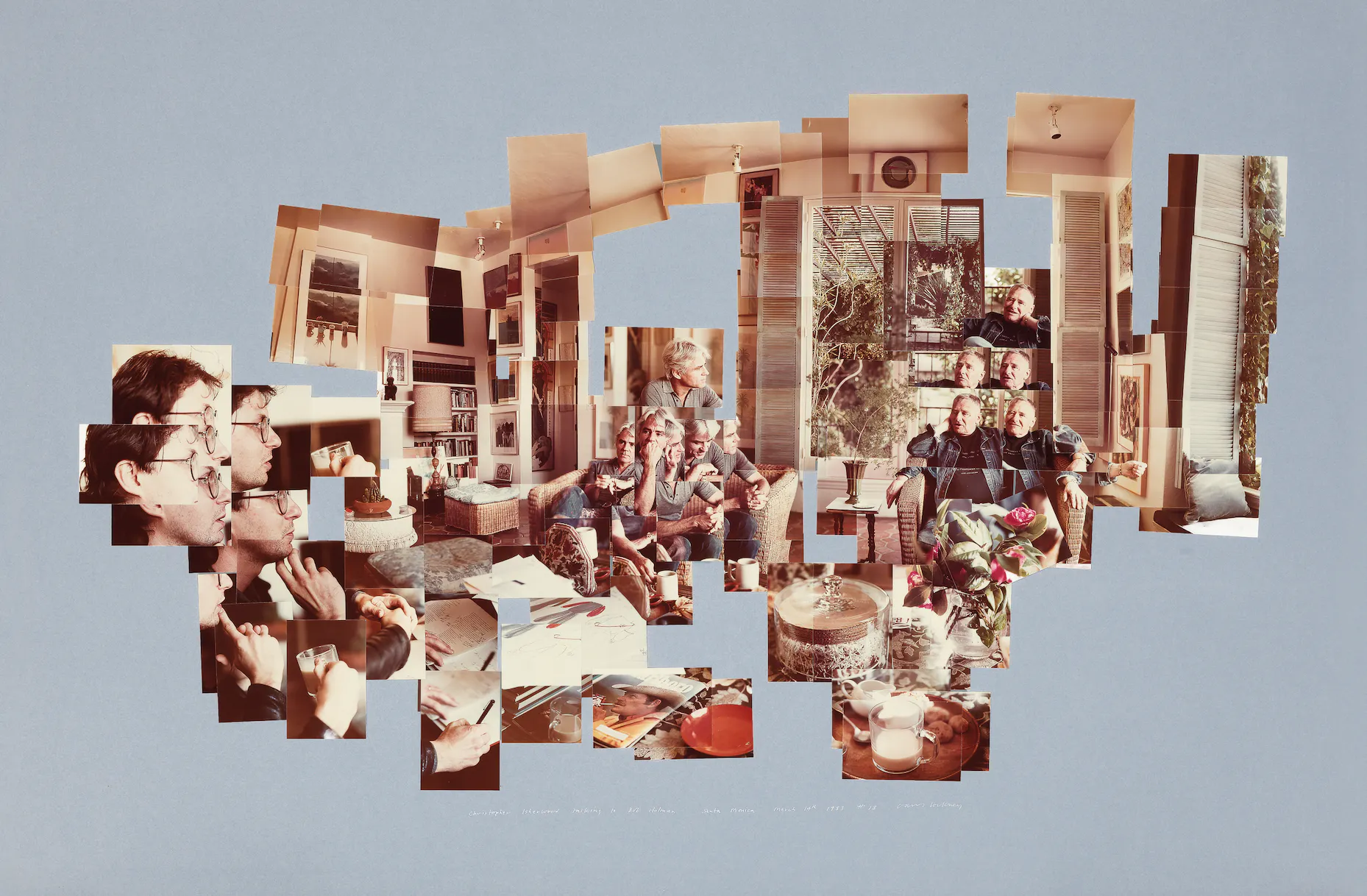
In the early 1980s, Hockney explored photography, conducted research on Picasso and Asian art, and pursued metaphysical readings. In order to go beyond photographic realism, the painter developed his own techniques. He assembled joints and recomposed figures from multiple images, as with Pearblossom Highway (1986). “If a painting is really beautiful”, said the artist, “a reproduction, even of poor quality, restores much of its magic. It is difficult to define what it is, and that is why the word magic is appropriate.”
In the 1990s, Hockney returned to the North of England. He painted the countrysides of his childhood, for example Garrowby Hill (1998), and composed photographs on the theme of the four seasons. In one of his best late paintings, Birth, Copulation and Death (1997), he illustrated a poem by T. S. Eliot. The trapezoidal format is reminiscent of the altarpiece panels painted by the Old Masters.
See also: Josef Albers: Thinking Outside the Box
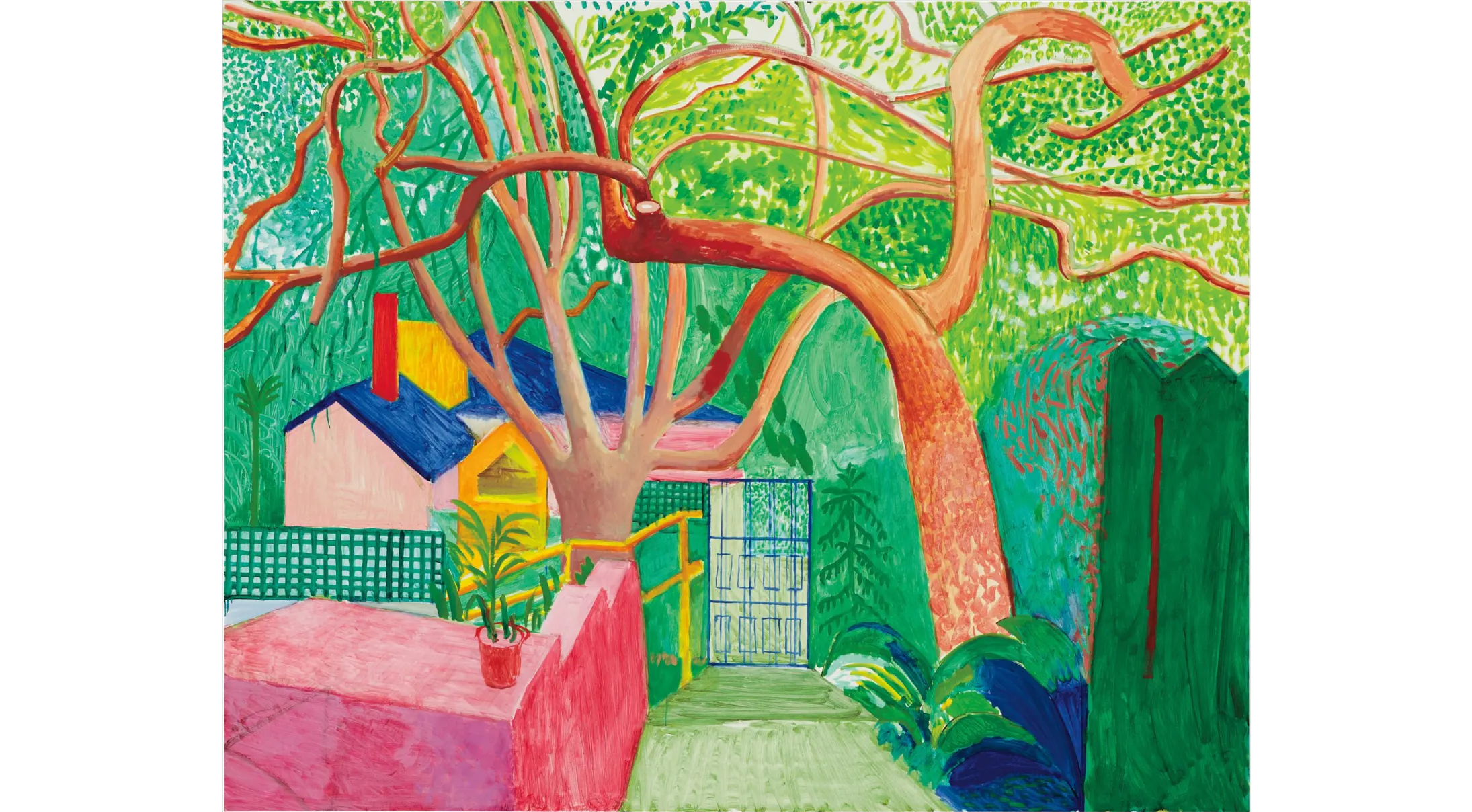
His artistic vision soon exploded into monumental formats as an ode to nature – Bigger Trees Near Water (2007) measures a massive 4.57 × 12.19 metres. In reality, it is an assembly of several canvases, designed again using computer technology. Fascinated by new technologies, in 2009 Hockney exhibited creations made on the iPhone. Hundreds of images were made available in portraits or still lifes reminiscent of Vincent van Gogh’s sunflowers and William Turner’s dying suns.
A reproduction, even of poor quality, restores much of its magic. It is difficult to define what it is, and that is why the word magic is appropriate.
Hockney’s artistic success has also equaled a financial one. His recent work signals how he is one of the most prominent painters today. A retrospective organised in 2017 by the Centre Pompidou, the Tate Gallery and the Metropolitan Museum brought together 160 works by the artist. That same year, Hockney offered his Arrival of Spring in Woldgate (2011) to the Centre Pompidou.
See also: Jenny Saville: The Art of the Sculpted Nude on Canvas

Finally, on the auction side, Hockney stands as one of the most expensive living artists. For a short period, he dethroned Jeff Koons as the most expensive living artist in the world when, on 15 November 2018, his 1972 work Portrait of An Artist (Pool with Two Figures) sold for £70.71 million at Christie’s New York. However, Koons claimed back the title in May 2019 when his Rabbit sold for £71.75. Who knows though, Hockney could take back the title at any point.