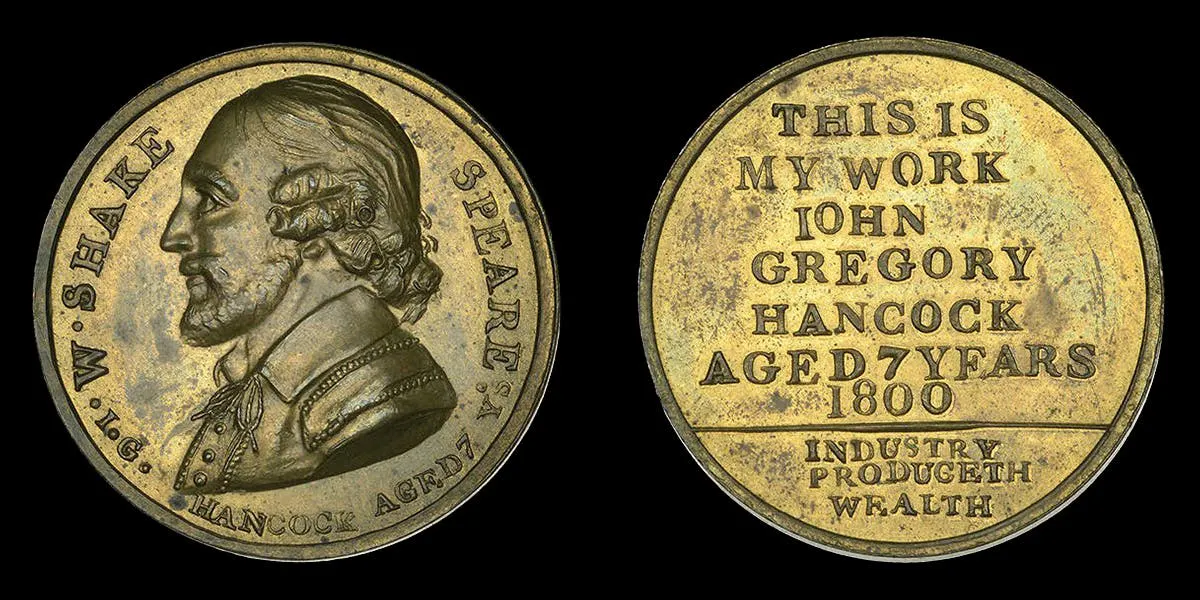
“This is my job, John Gregory Hancock, age 7, 1800, Industry produceth wealth."
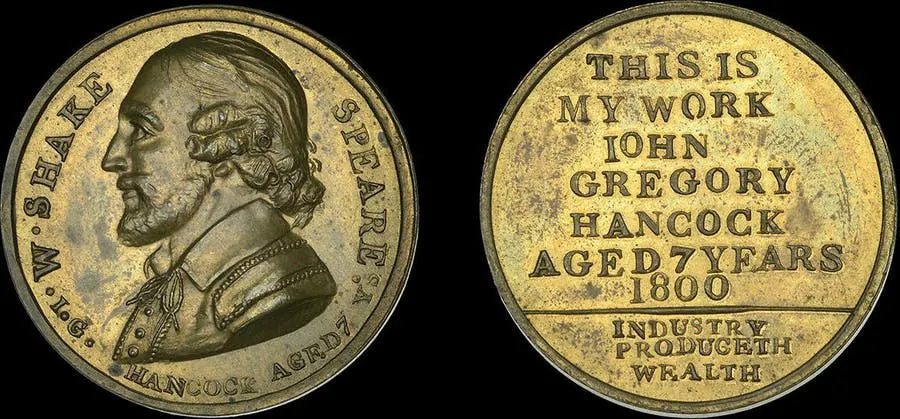
So reads the inscription on this half-penny made at the turn of the 19th century by a (very) young British engraver and medalist. The brass medal is adorned with the profile portrait of William Shakespeare on one side and the annotation on the other.
The child prodigy John Gregory Hancock Jr of Birmingham was the son of die engraver John Gregory Hancock (active c. 1775-1815), employed by the coin maker Obadiah Westwood. Hancock senior, himself described as a "genius of engraving" and "one of the best artists in the history of 18th-century British mint", made several George Washington coins mentioned in the Complete Encyclopedia of Walter Breen (a controversial numismatist and author).
Hancock had been commissioned to make moulds for two types of pennies representing Washington as samples for a federal currency project. Deemed “too monarchical”, his two moulds were rejected by Washington and it is said that in revenge, Hancock (with his accomplice Westwood) would have struck medals illustrating the American president as a effeminate Roman emperor. These satirical medals were reportedly distributed privately and their existence kept secret for over 40 years to avoid an 'international incident'.
See also: Angelica Kauffmann: The Child Prodigy
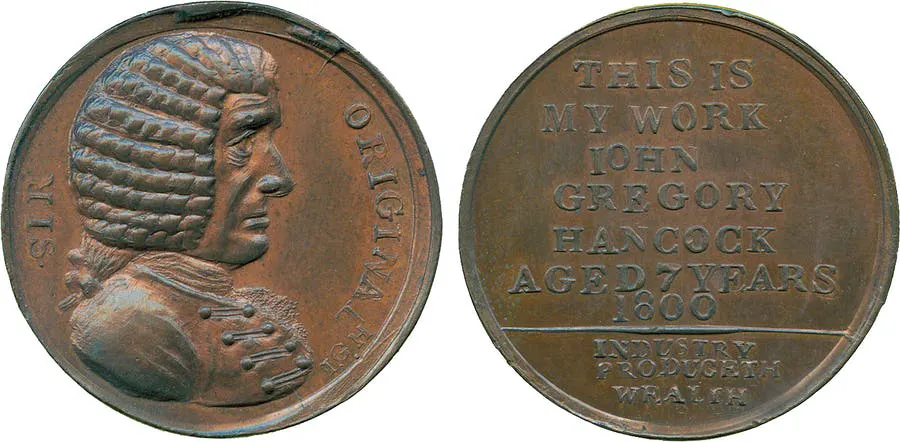
Unfortunately, very little information remains on his son, John Hancock junior, and it would even seem that the latter did not survive him because no document remains to trace his existence (or any activity of the engraver) after the early 1800s. We know of other rare half-pennies showing bust portraits made, according to the inscriptions, when he was 7 and 9 years old.
The medal depicting the famous Shakespeare will be sold at British auction house Dix Noonan Webb on 27 August with an estimate between £500-700.