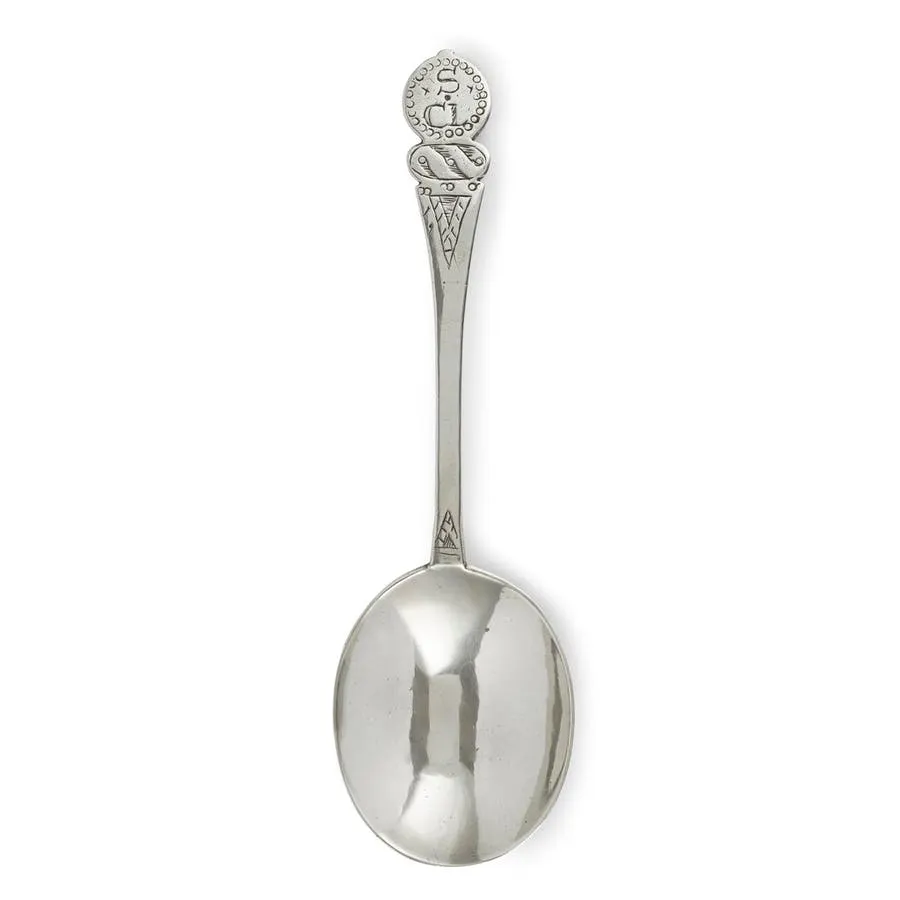
While the earliest Scottish spoons are similar to models known from England or continental Europe, this ‘disc’ copy seems to be an exception in the country's production. Experts place the creation of this silver spoon around 1580 and qualify its shape as “unique”.
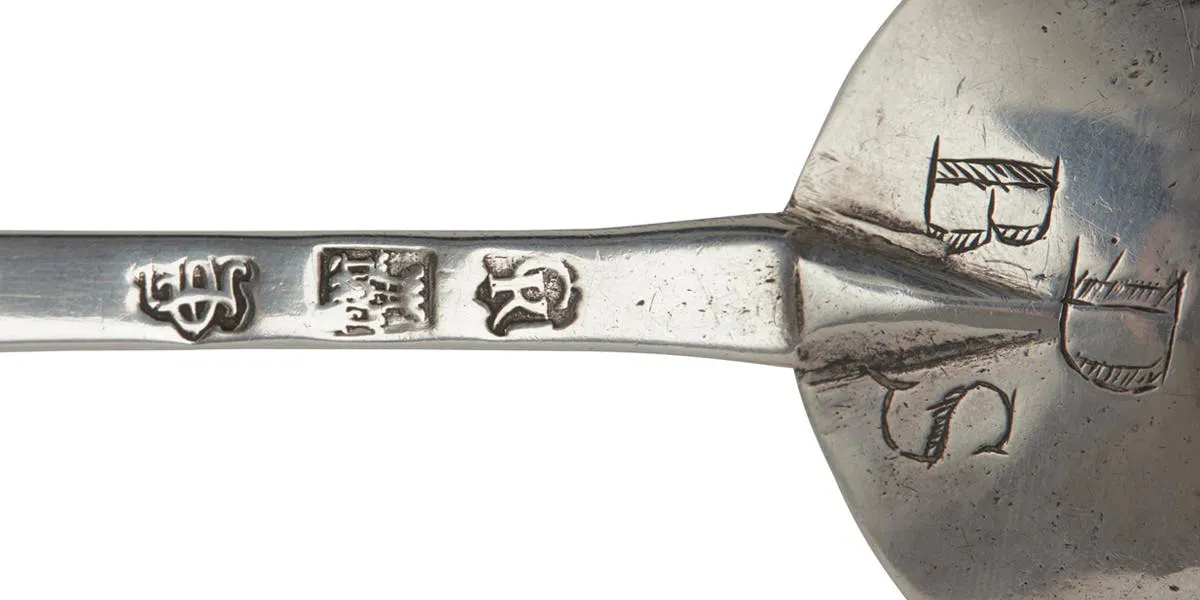
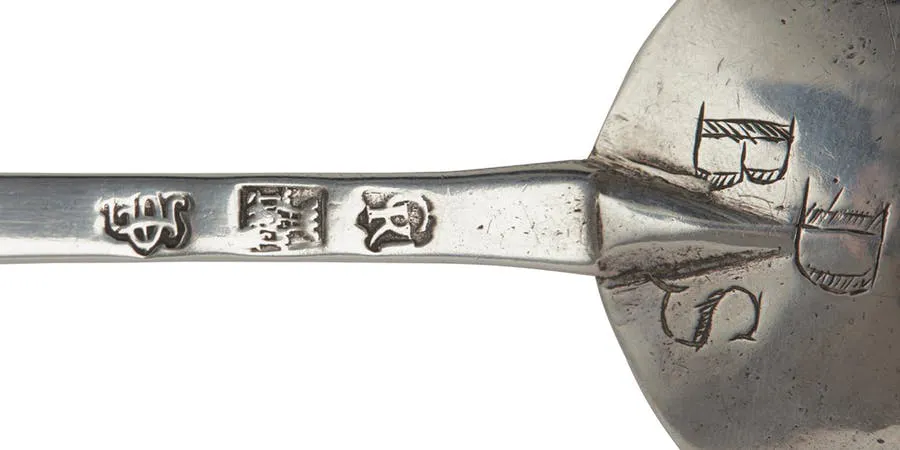
The spoon bears the hallmarks of the maker Gilbert Kirkwood and of James Denniestoun, a deacon active in the 1610s and ‘20s. It is the latter which allows the spoon’s hallmarks to be dated a little more precisely: before 1681, Scottish silver was not not stamped with a dated letter (also called jurande, this allows you to find the date of manufacture of a metal work.; each year corresponds to a letter of the alphabet).
Kirkwood's activity is first documented in the records of the City of Edinburgh Goldsmith's Corporation, when he entered as an apprentice in 1598 and released himself in 1609. His career was, apparently, rather successful: he was appointed deacon in 1624 and was well off enough to acquire Pilrig Estate (a house he built in 1638 and still found in the suburbs of Edinburgh today).
See also: 19th-century Half Penny by 7-year-old at Auction
His hallmark is listed on communion cups and various unique works, as well as the earliest known Scottish spoon from 1608. The National Museum of Scotland keeps a rare Kirkwood disc spoon dated to around 1611.
In Scotland, the religious organisation of trades was very important. In Edinburgh, each trade had its altar at St Giles Church to honour its holy guardian, and the master of this fraternity was interchangeably called Kirkmaster, Godman or Deacon. This not only because he looked after the altar of the trade but also because he helped the chaplain in the celebration of certain offices.
See also: A Japanese Ninja Museum is Victim of a Heist
The trade guilds are therefore the direct result of religious fraternities, which by necessity became professional fraternities. The fraternal dimension of the trades was predominant through its religious function. Over time, many corporations continued as only a charitable function, such as the Goldsmith Corporation of the City of Edinburgh, which is still in operation today.
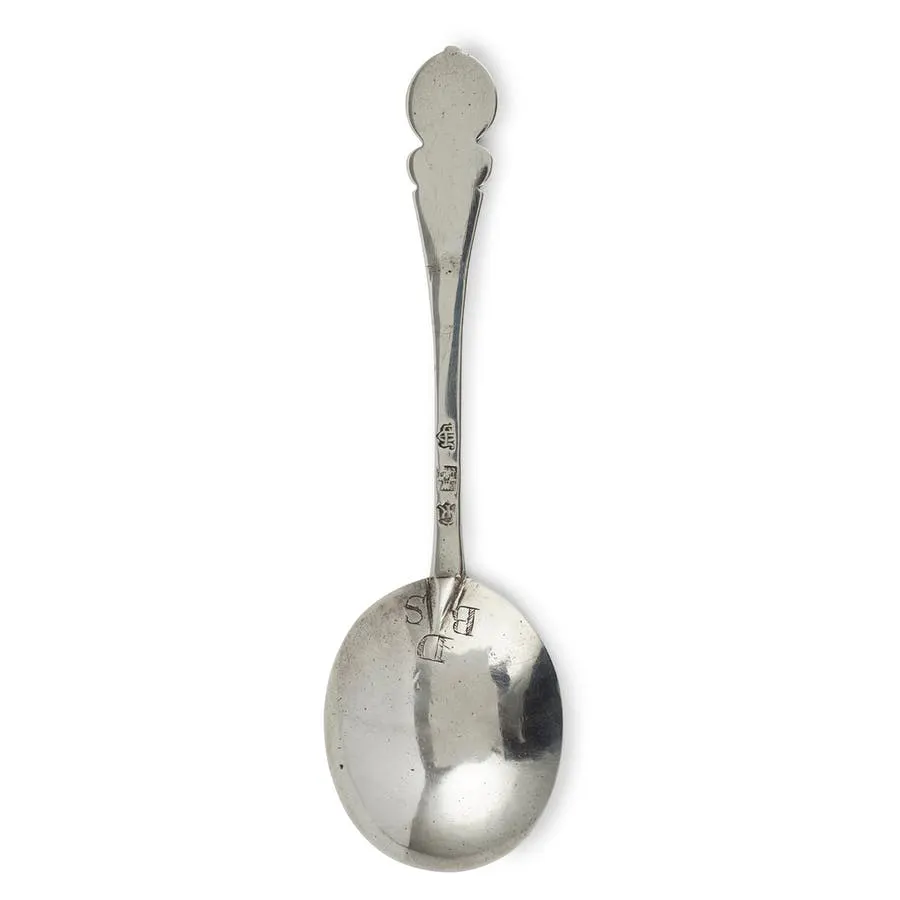
This spoon, designed a little later than the copy kept at the National Museum, is engraved with the initials ‘SCI’ on the disc and ‘D BS’ on the back, just at the edge of the collar. Presented at a sale in Edinburgh last month with an estimate of £3,000-5,000, the spoon sold for £21,000 pounds to an anonymous collector.
In 2012, a disc spoon from around 1650, marked for Peter Neilson and engraved with the initials of the original owner, Bessy Boyd, the daughter of the Archbishop of Glasgow James Boyd, sold for a similar amount of £22,000.