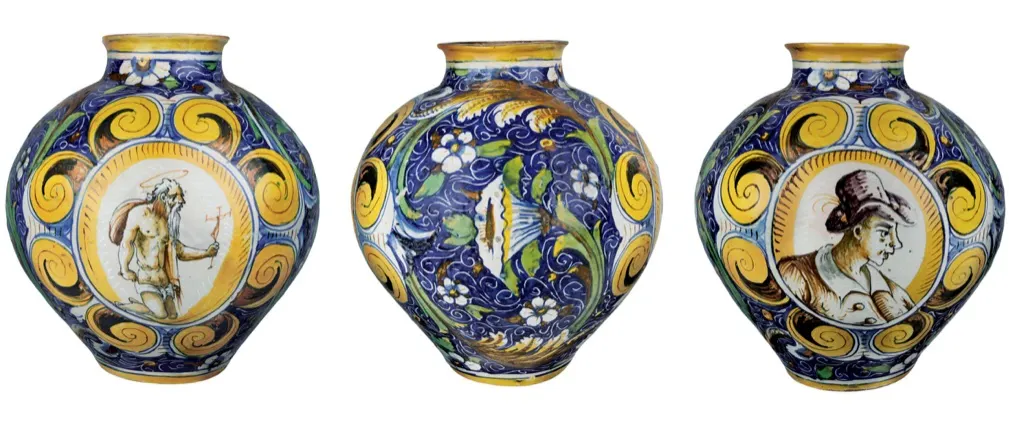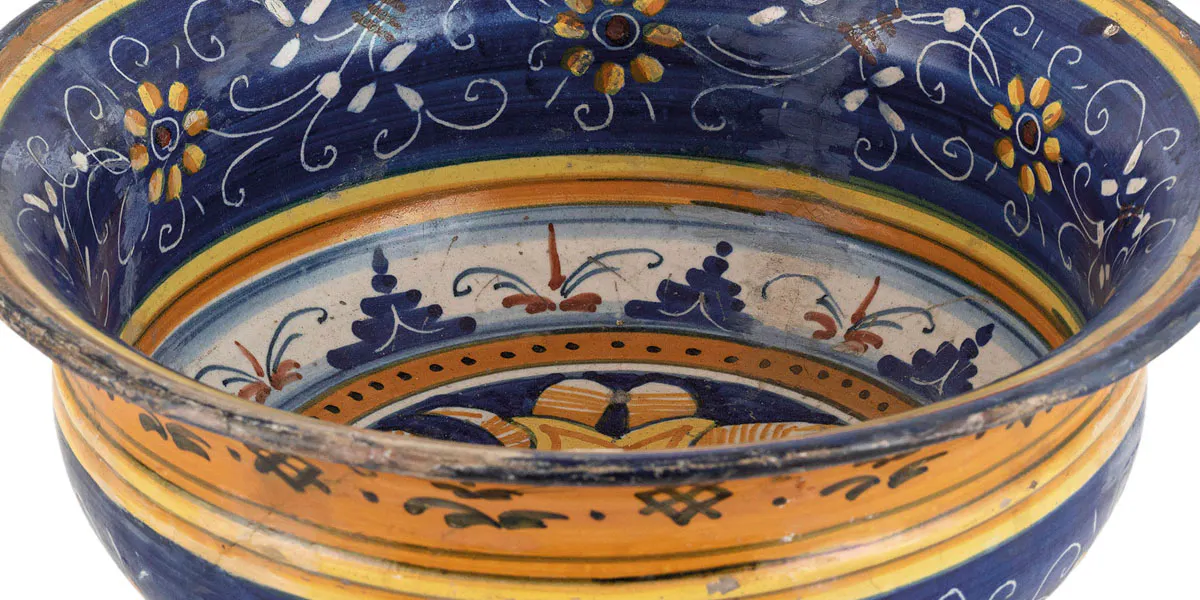
The Italian auction house Wannenes has announced an exciting sale dedicated to Italian majolica, testifying to the passion of a great collector, Umberto Gori. The catalogue includes more than 200 lots ranging from the 14th to the 19th centuries and is a body of great interest, especially from an art-historical point of view. Some of the majolica presented, in addition to the characteristic examples of the various Italian ceramic centres, were purchased by Umberto Gori out of a documentary interest. In some cases, these unique ceramics represent a real challenge to the knowledge and research of specialists.
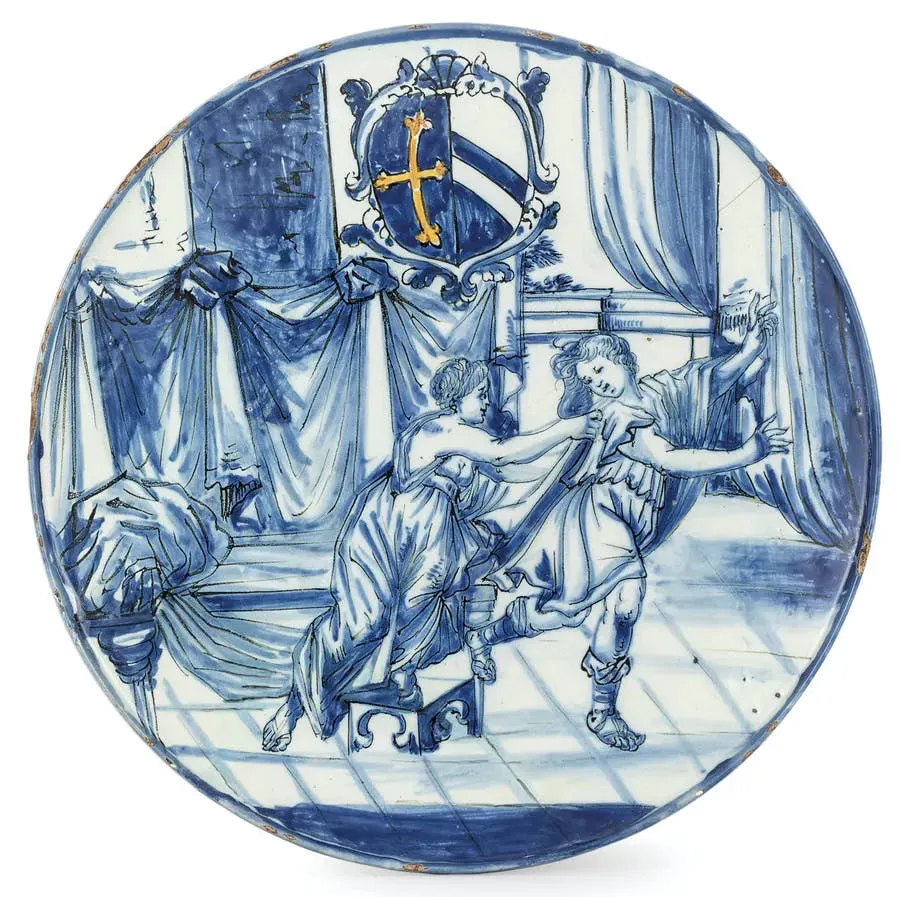
The works in the collection have been produced in Venice, Pesaro and Urbino, Deruta, up to Casteldurante, Rimini and Rome. Ligurian production is also present, and here it is worth mentioning a tazza (a wide but shallow saucer dish mounted on a stand) from the Guidobono ovens of Savona, dated 1690 and probably made for the wedding between Pier Antonio Filippo Franceschi and Maria Maddalena Alamanni in 1688. The scene which adorns this tazza represents the well-known episode of Joseph and Potiphar's wife (Genesis 39, 7-20), considered as an allegory of chastity.
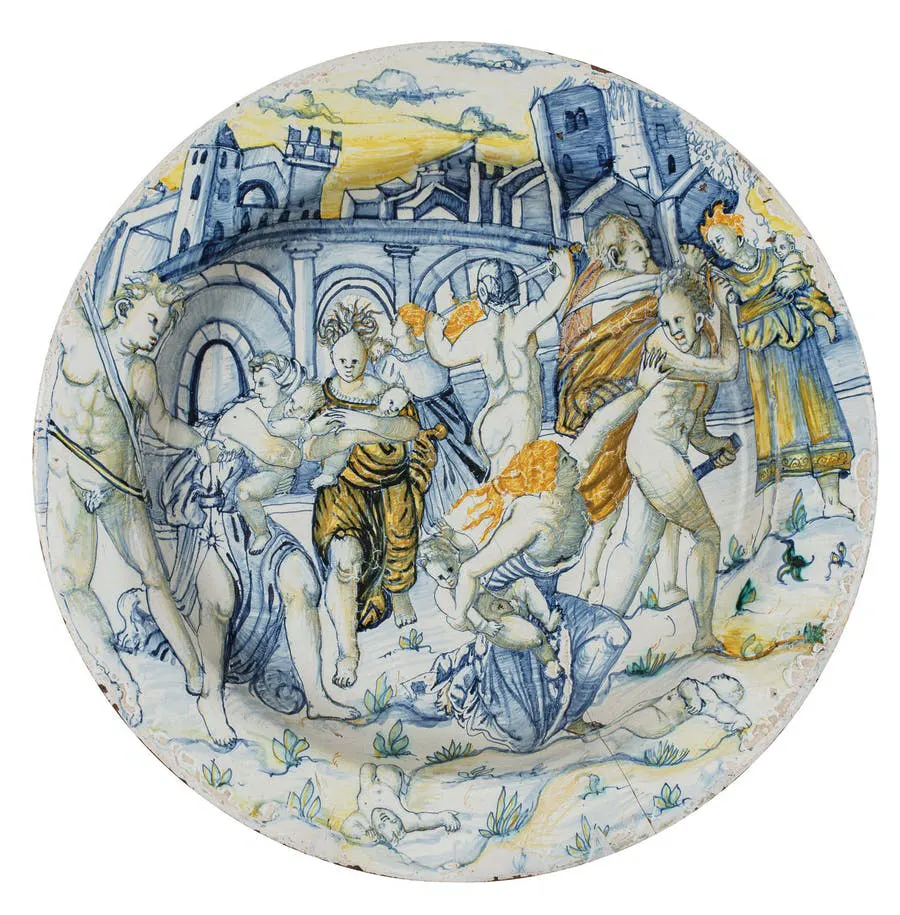
Note also this plate, decorated with the scene of the Massacre of the Innocents by Raffaello Sanzio through Marcantonio Raimondi. Dating from around 1561-65, this piece is an important testimony to the birth of the majolica style of the ovens at Castelli, Abruzzo. The living scene loses neither its immediacy nor its expressiveness, even moving away from a vivid palette of colours in favour of a two-colour scheme (characteristic of the new style).
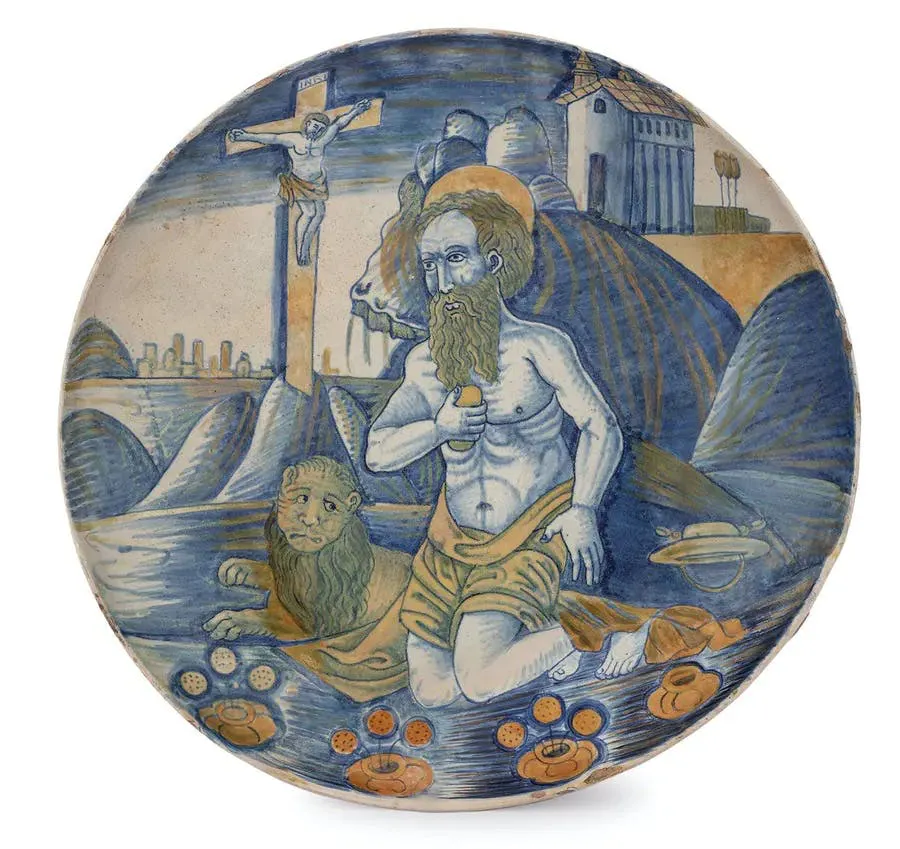
The figure of Saint Jerome, which decorates this cup, is taken from a painting by Pinturicchio (kept at the Walters Art Gallery in Baltimore), painted in shades of cobalt blue and abundantly illuminated with gold. It is a subject that has been treated on several occasions, often with the same two-tone technique, in the ovens of Deruta. This version, which has been attributed to Giacomo Mancini, presents an unusual and realistic rawness in the man's face and body, accentuating the expressiveness of the scene.
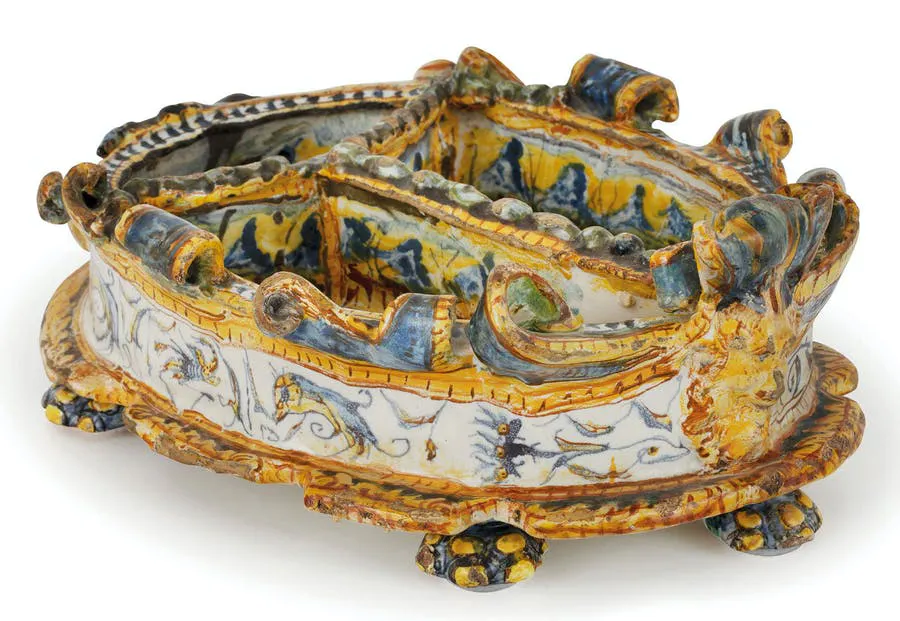
Inkwells are certainly one of the most intriguing types of production in Renaissance majolica, and Urbino ones in particular: the models are numerous and imaginative, such as those in the shape of a temple or others accompanied by figures in the round-bump. Among the many variants, the compartmentalised model remains one of the most successful. In the present case, the elegant structure is decorated with Raphaelesque motifs and has, inside, a whimsical motif of mountain waves accompanied by a tiny trompe-l'oeil of writing instruments.
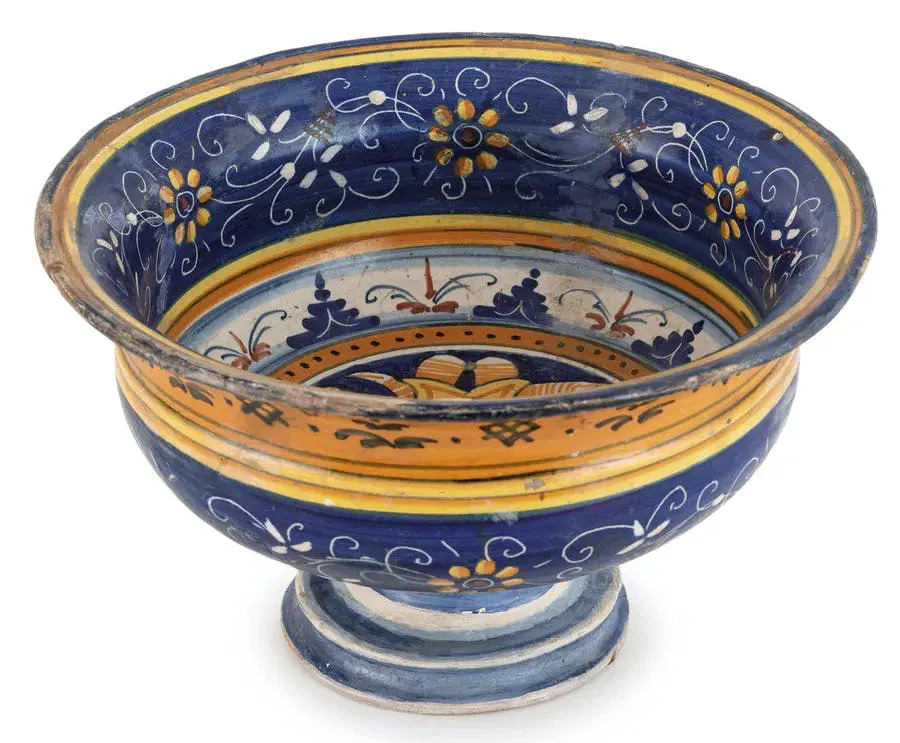
The kilns of Montelupo produced decorative heraldic cups in the middle of the sixteenth century and throughout the following century, varying the decorations and always with successful results. This is the case with this polychrome majolica cup, where the Heraldic coat of arms is that of the Medici of Florence.
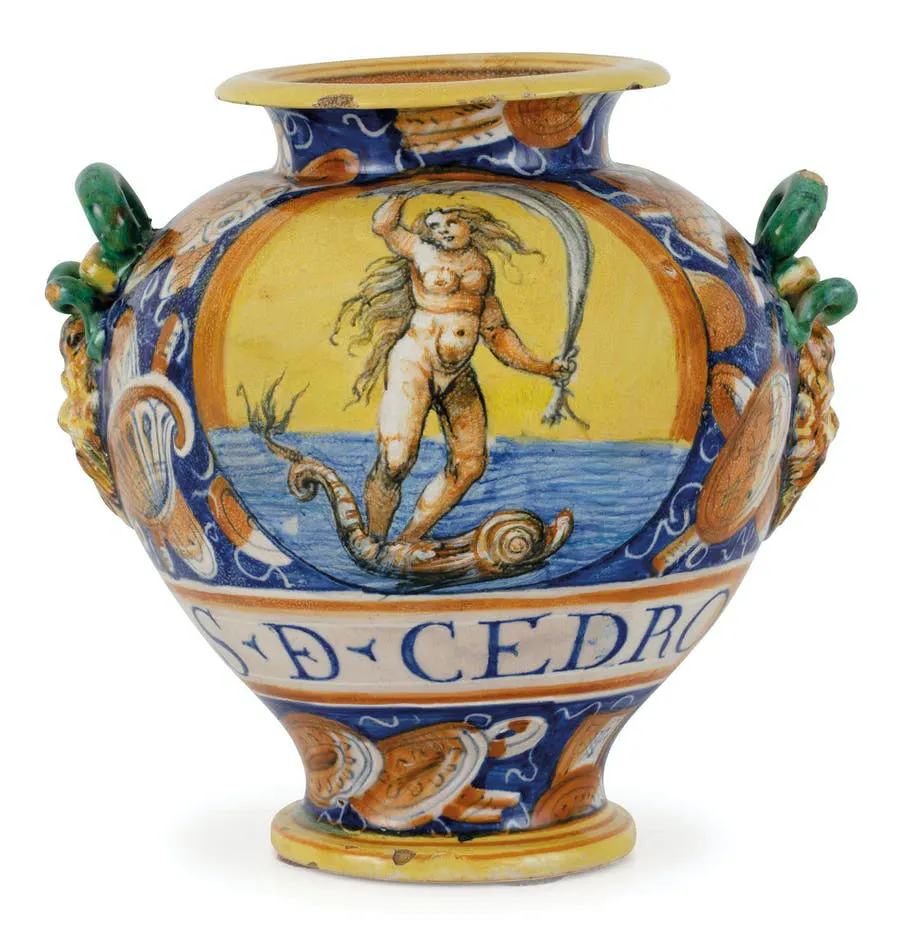
This beautiful two-handled vase decorated with the Triumph of Galatea is attributed to the Lanfranco family (active at the beginning of the sixteenth century). It belongs to the famous series decorated with the Allegory of Marine Fortune (or Galatea), examples of which can be found in various public and private collections.
The rich catalogue also includes sculptures, such as a sixteenth-century figure of Madonna that historians believe came from the ovens of the Patanazzi family in Urbino.