Irish auction house Adam’s had prided itself on developing a range of expertise in the fields of art and antiques since its founding over a century ago. This certainly comes to the fore in their upcoming 'Country Home Collections' sale, which is taking place on 15 October, and which comprises Georgian furniture, paintings, silverware and more.
There’s a wide variety of items on display, from benches and bowls and brandy warmers, to gardenware, urns, paintings, decorative items, and much more. With over 700 lots in total, all antiques collectors and connoisseurs can be rest assured that there’s enough to go around, however you can start diving into the collection below with a few of our selected favourites.
Founded in Dublin in 1857, the Royal Alfred Yacht Club, then known as the Irish Model Yacht Club, was established to put an end to the passive ownership of sailing boats. The club provided Victorian men with the skills necessary for manning their vessels and encouraged the practice of good seamanship. This was completely against the norm as, prior to this, yacht clubs had essentially taken the form of social clubs in which very few sailing events were actually held. Furthermore, when races did take place, the boats were manned by professional seamen, not the owners. In rebelling against this tradition, the club became the first specifically amateur yacht club in the world.
For the first time, yacht owners could proudly call themselves sailors, with the Model Yacht Club being so named in order to encourage others to follow in their stead. As active organisers and partakers in amateur races, the club called for a regulated set of rules to be enforced. This led to the current Yacht Racing Associations Racing Rules, for which the principal authorship can be accredited to Henry Crawford and George Thomson, two flag officers of the Royal Alfred.
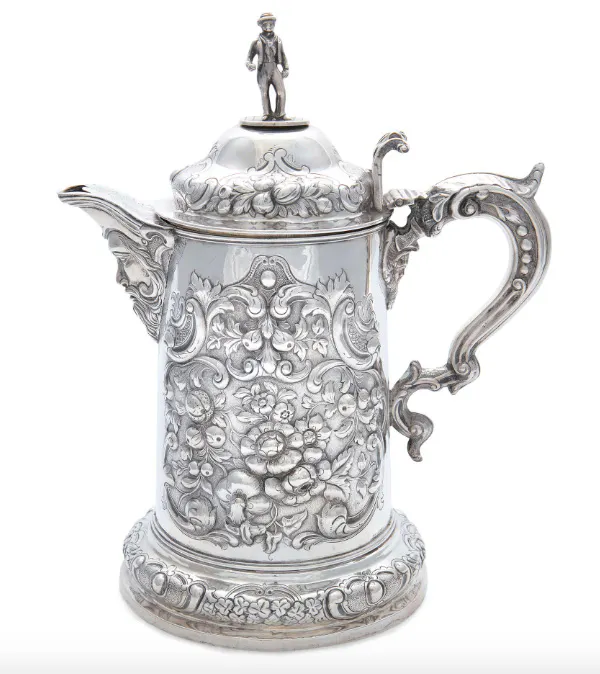
While the Royal Alfreds members were gentlemen and would not entertain the idea of being paid to sail, it is recorded that they were more than happy to accept prizes in the form of money or beautiful silverware, with the current lot being an excellent example.
The rare piece is from 1866 Dublin, with the mark of John Smyth in the form of an oversized beer flagon with hinged lid. The finial features the cast figure of a sailor, the body is profusely decorated with repousse and chased foliate scrolls, framed by shamrocks, thistles, and the piece is engraved, "THE PRINCE ALFRED YACHT CLUB KINGSTOWN, WON BY THE AQUILINE, 1866" THE WORLD'S OLDEST SPECIFICALLY AMATEUR YACHT CLUB, 1857".
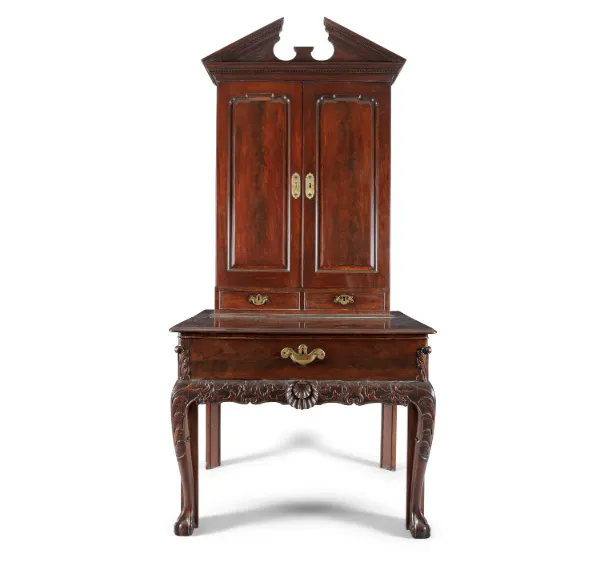
This 18th-century Irish mahogany gentleman's estate cabinet or architect’s desk features broken triangular pediment above fielded shaped panelled doors with an interior of folio racks and pigeon holes. The pull-out table base has a rising slope concealing a fitted interior above drawers with swivel pen tray, the apron a double scallop shell flanked by foliage, and all with leaf capped cabriole legs with claw and ball feet.
The cabinet comes from a distinguished school of Irish cabinet making identified by Knight of Glin from his research initiated by the example in the Victoria & Albert Museum and confirmed by the Newbridge House example.
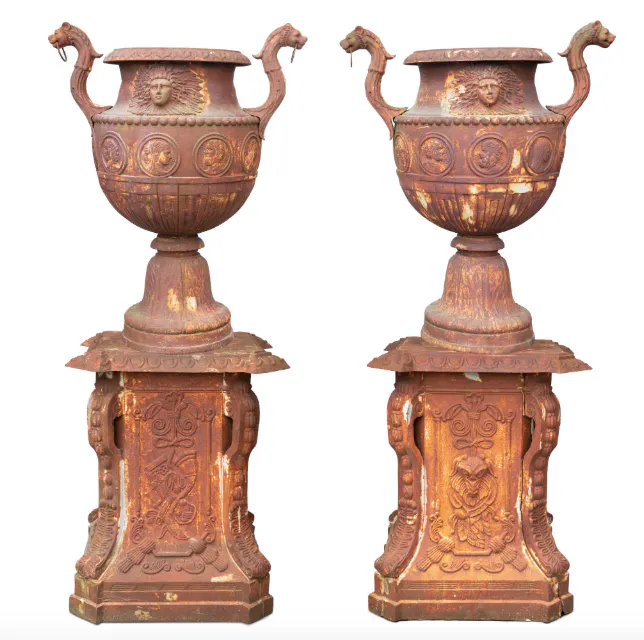
As the goldsmith of the Kings, and the king of goldsmiths himself, Claude Ballin undeniably contributed to the greatness of Versailles and Louis XIV. This 19th-century pair of monumental French cast iron urns and pedestals are after a design by Claude Ballin (1615-1678), after the originals situated in the Garden of Versaille. Each of these urns are of a classical design, with raised side handles, the bodies with sun mask, above a continuous row of portrait roundles, filled with individual classical figures, on acanthus cast circular feet and rectangular pedestals with stepped base.
They each measure 225cm in height and are possibly the work of the Val d'Osne Foundry. The firm Val dOsne was founded in 1835 by J.P.V. André and based at the Val dOsne in the Haute-Marne. By 1850s they had achieved international recognition and exhibited at the Great Exhibition of 1851. In the London 1857 exhibition they showed a large bronze fountain cast with swans and classical figures which further increased their reputation. Many of the best sculptors in Paris were commissioned by André including Carrier-Belleuse, Pradier and Delaplanche.
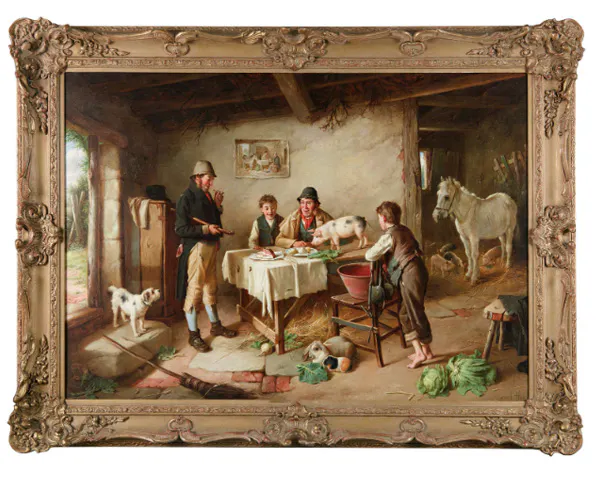
This oil on canvas by Charles Hunt is titled Irish Cottage Interior with Pig and Farmyard Animals and measures 88 x 62.5cm.
Born in 1803, Charles Hunt was a British painter who specialised in genre scenes. In particular, he was adept at portraying humans and animals and often sought to bring an element of humour into his pieces (note the pig on the table). Exhibiting at the Royal Academy between the years of 1862 and 1863, Hunt played into the artistic fashion of the Victorian era and presented romanticised scenes of rural peasant life to what would have been a largely aristocratic audience.
As with other artists at the time, such as Erskine Nicol, Hunt ventured further afield than his native countryside and produced several works of an Irish persuasion. As was the wont, the delicate issue of Irish deprivation, brought about by the famine years, was gently ignored and, instead, viewers in England were delighted with rosy cheeked, comical characters, such as the ones depicted in the current lot. Hunt’s figures, though slightly dishevelled, appear to be in a merriment of good health, their ripped and fraying clothes displaying a rustic charm rather than a financial shortfall.
In a similar manner, the basic interior nods towards a state of distress: the walls are cracked and flaking, the wood splintered and the thatch beginning to fall. However, despite this, the abode is clean. Hunt has ingeniously balanced along the line that separates mess and disrepair from that of dirt and a lack of hygiene. Nowadays, we could only imagine at the odours embalming a house filled with farmyard animals, yet the images themselves suggest nothing but the fresh, earthy smell of the countryside.
While Hunt’s improvised versions of Irish life cannot be accredited with the title of history painting, his works beautifully capture and preserve the artistic tastes of the Victorian era. At a time when truth and scientific discovery were at the forefront of society, it is interesting to acknowledge the fantasy present within the work of so many 19th-century painters. For the Victorian upper classes, it seems that art was an object behind which one could hide, a tantalising and light-hearted respite from the bombardment of factual revelation.
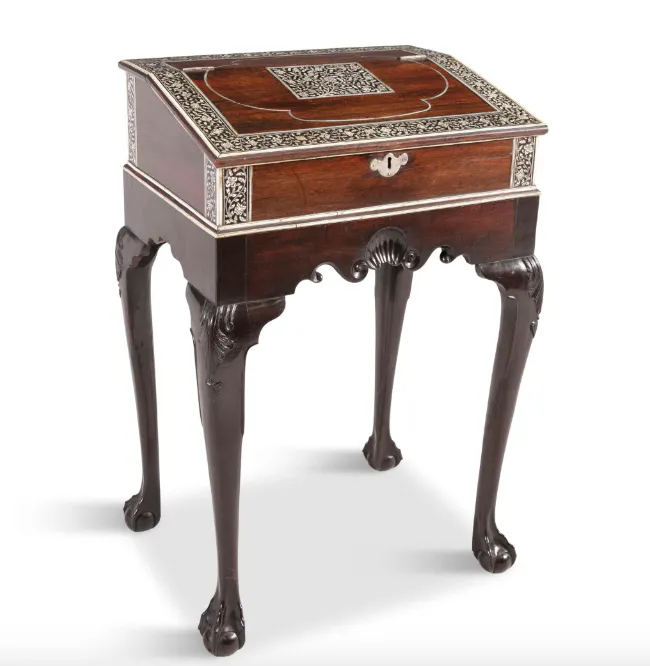
As a reminder, Adam’s auction will be taking place on 15 October, and the annual sale will be held at Townley Hall, Drogheda, Co. Louth, Ireland. This unique setting in the beautiful Irish period house in Drogheda creates an ideal surrounding for the collection of Georgian furniture, paintings and silverware.