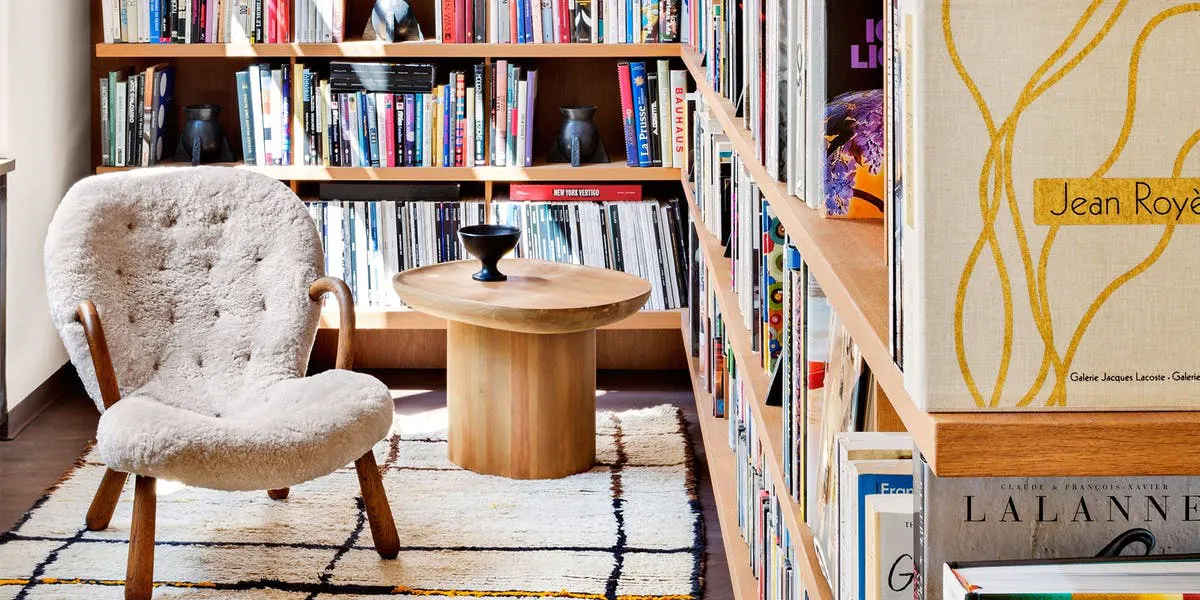
New sources claim that the Clam chair, which achieves tens of thousands at auction, has been incorrectly attributed... again. Here is the story of how the famous chair came to elude the entire design world.
The Clam chair has caused headaches for many people who work in the modern design industry. After confusions between similar models, from Ikea, among others, many thought that a consensus had been reached when it was suggested the original armchair was designed by the Danish architect Philip Arctander.
The investigation began in 2013 when the Danish auction house Bruun Rasmussen decided to trace the Clam chair's origins after they saw prices rising exponentially for several years at auction.
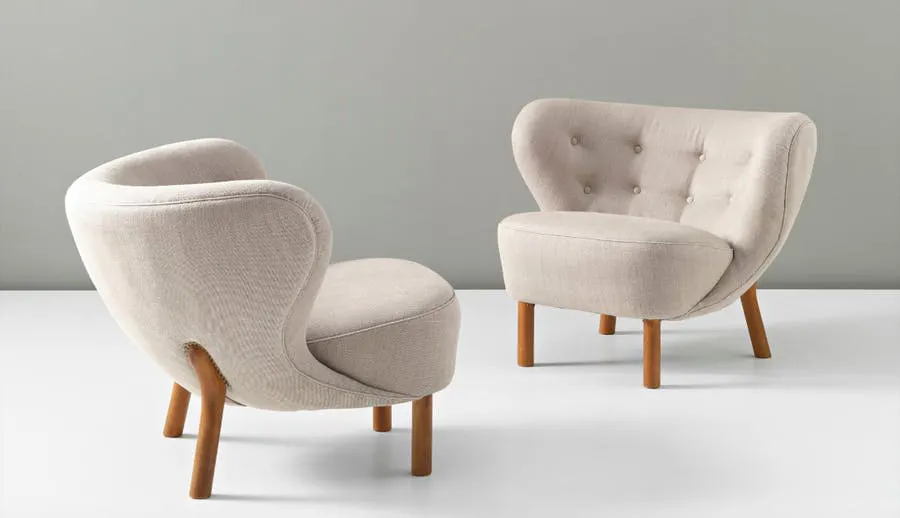
Previously, many had attributed the Clam chair to the Danish architect Viggo Boesen as it had certain similarities with other pieces of furniture by the designer, such as the chair Little Petra.
See also: The 10 Most Popular Furniture Designers
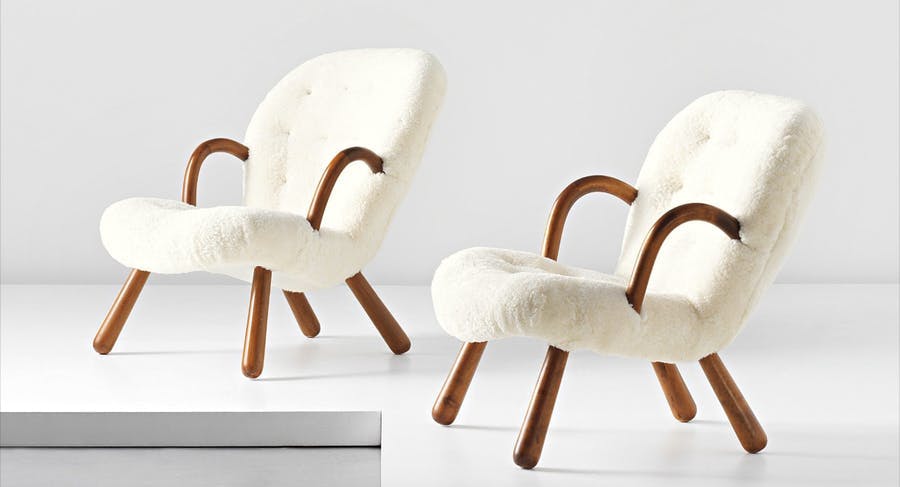
When the National Museum in Oslo came out with evidence that the chair was designed by the Norwegian designer Martin Olsen and produced by VIK & BLINDHEIM in the 1950s, it was believed that history had been rewritten. In 2013, the record was set when Phillips auctioned a pair of Clam chairs for £145,000 that were attributed to Martin Olsen.
But the confusion grew after information was found from an advertisement for the Danish Nordisk Staal- & Møbel Central in the magazine Bygge og Bo from November 1945. According to the ad, the armchair had been designed for Nordisk Staal & Möbel Central in Denmark but was also licensed by Vik & Blindheim, Sykkylven in Norway.
See also: Ikea's Sources of Inspiration
When Bruun Rasmussen's experts went through the literature and contacted friends of the Danish architect Philip Arctander, they concluded that the Clam chair was designed by him in 1944.

They concluded that it must have been first presented in 1945 at the boutique NY FORM A / S in Copenhagen. This was corroborated by Phillip Arctander's childhood friend and architect colleague Poul Erik Skriver, who was also the editor of the magazine Arkitekten.
With that background, the Danish auction house Bruun Rasmussen, together with many others, chose to re-catalogue the chair as the Clam chair, designed by Phillip Arctander and made during the 1940s at Nordisk Staal & Møbel Central.
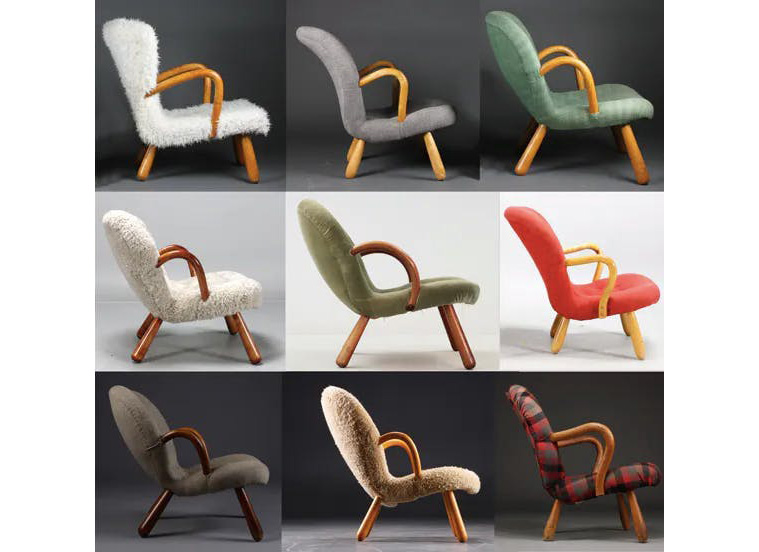
Today, the Scandinavian auction market is flooded with Clam chairs. Over time, you can see clearer differences between the chairs. When I do research in Ikea's catalogues from the 1950s, I find the Åke armchair and sofa, inspired by the Clam chair. The Ikea model differs from the original because of the 'ear flaps' of its curved backrest and sharper profile.
See also: IKEA's Most Expensive Designs
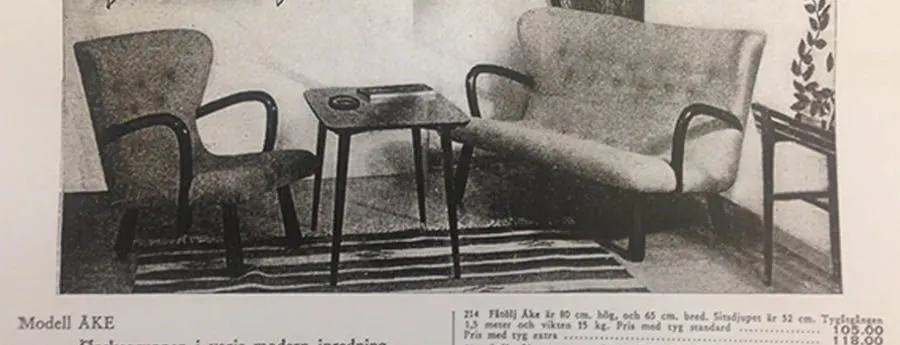
However, there is really no major difference in price between the different models. When I visited a Spanish retailer at one of the most exclusive fairs in London, a pair of Ikea's 'Åke' was centrally located in the stand with a price tag of about £55,000, a decent price development for a piece of furniture from Ikea. It was pretty obvious that the retailer had no idea that his chairs were made by the discount chain in the 1950s.
See also: Forget Ikea. Buy Antique Furniture and Revive It
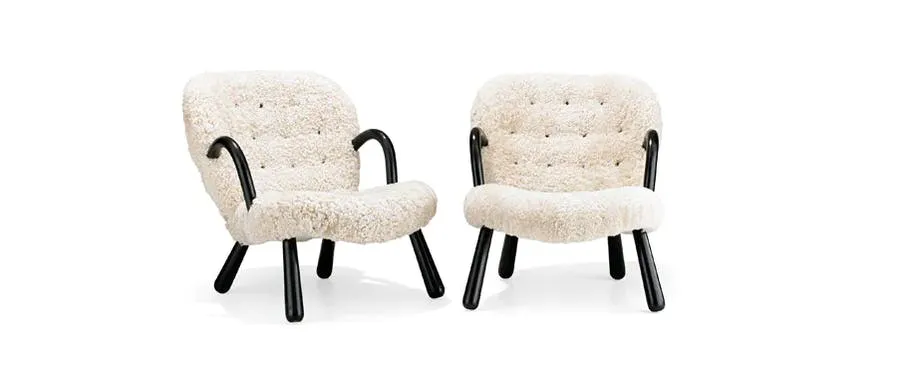
When prices rise for a certain item, there are unfortunately people who see a chance to make money from buyers' ignorance. The market is flooded not only with Clam chairs from the 1940s and '50s, but also by completely new armchairs that are dressed and patinated to look old. Today, most auction houses and design dealers continue to sell the older models and agree that the original designer is the Dane Philip Arctander.
Until now.
Evidence has emerged which indicates that it was actually Danish designer Arnold Madsen who designed the chair. Behind the recent discovery were the Instagram accounts @movablemodern, @oliverf54 and @arkivalium.
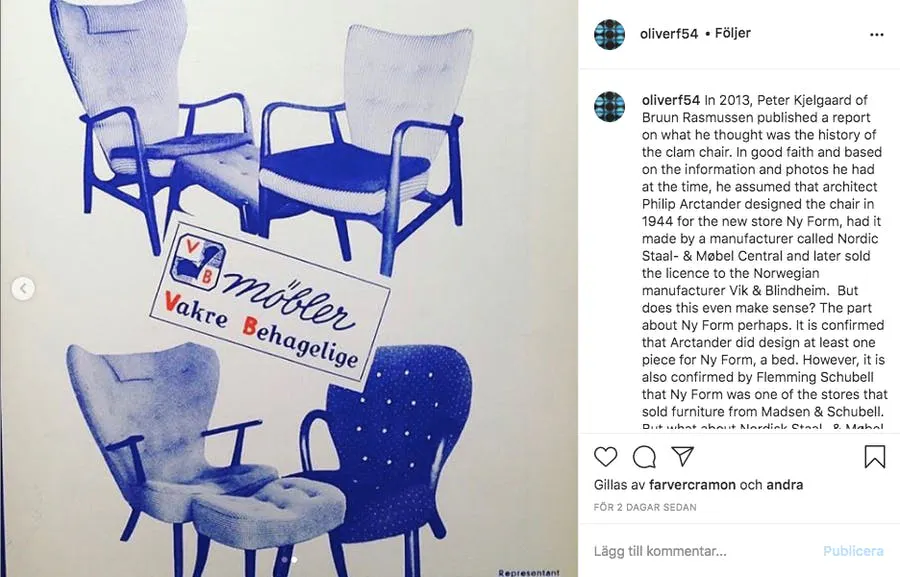
According to them, Madsen's daughter has certified that the now world-famous chair was created in his small basement room on Gothersgade in Copenhagen.
See also: Arne Jacobsen: The Father of Danish Functionalism
He is said to have contacted producer Henry Schubell to develop a frame that could be mass produced. The results were satisfactory, and Arnold Madsen was so impressed that he asked if Schubell wanted to start a joint company.
The Clam chair soon became an international sales success, and in 1953 the licence was sold to the Norwegian company Vik & Blindheim. According to Flemming Schubell, son of Henry Schubell, who has worked for the company since 1958, the plaster model of the chair remained in Madsen's basement room until the business was closed in the early 1980s.
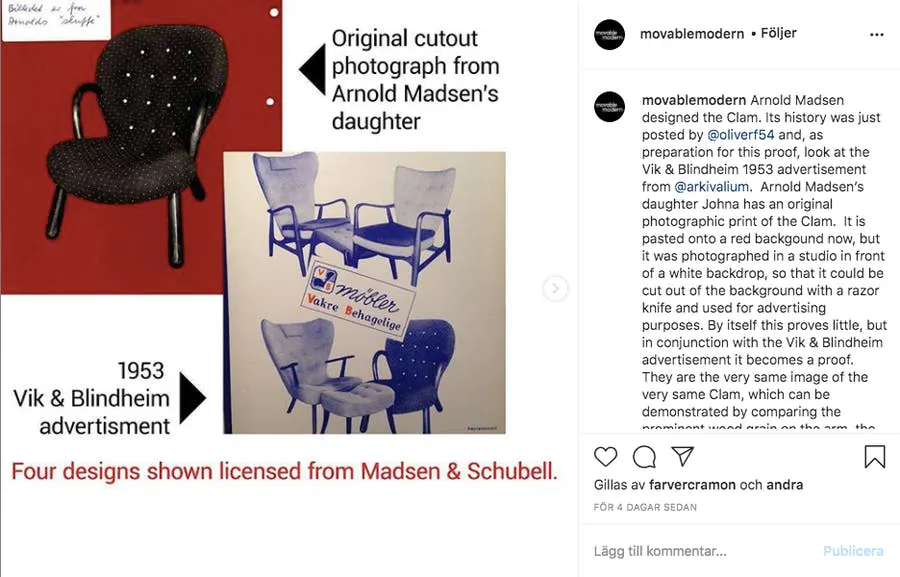
Another clue are the photographs that illustrate the chairs that appear in Vik & Blindheim's catalogue. The pictures are apparently from Arnold Madsen's own home.
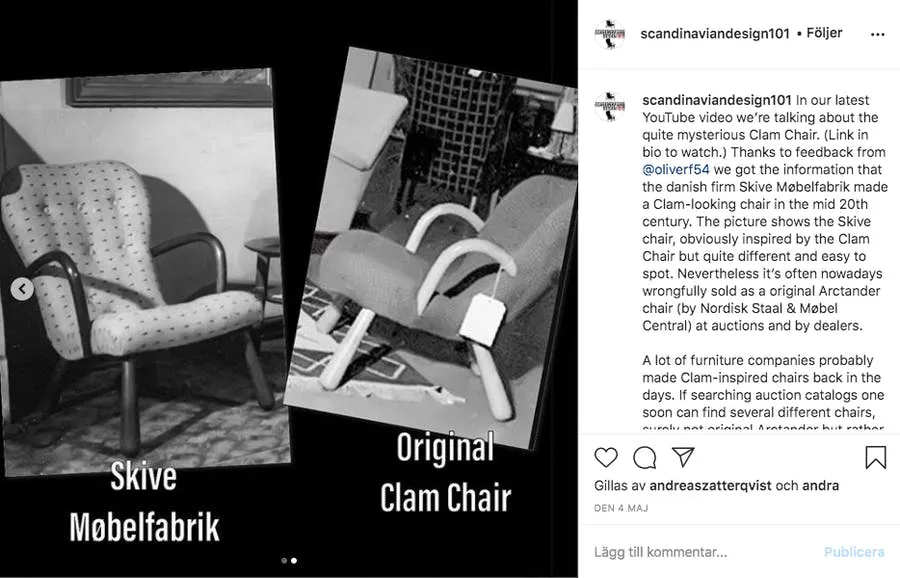
"There is a curse on the Clam chair," says Andreas Zätterqvist, expert in modern design who runs the Youtube channel and the Instagram account Scandinavian Design 101. "Arnold Madsen will now be the fourth person who is alleged to have designed it, and that is hardly good for credibility. Customers really need to raise their eyebrows. We can only hope that it is true this time, but when it comes to the Clam chair, nothing seems to be carved in stone." The chair would have been designed the same year as previously thought, 1944.
See also: The World’s Best Chair
Since the Clam chair has become an expensive international affair, both originals and copies have been traded on the market, but there are also new licensed chairs produced by Paustian. If the new evidence is correct and the Clam chair's designer is no longer Philip Arctander, is Paustian using an fraudulent licence?
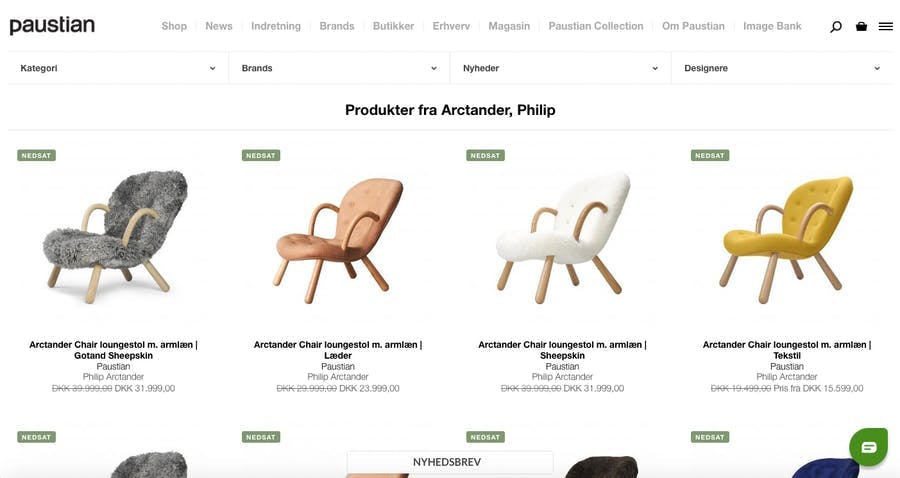
"When it comes to the question of who actually designed and manufactured the Clam chair from a researcher's point of view: Yes, we now have a final answer," says Zephyr Leif Renner behind the Instagram account Movable Modern. "We can hope that the Paustian family does the right thing and gives royalties to the rightful owner of the copyright. My second hope is that now that the Clam chair has its true story, perhaps design lovers can better understand what it is, and not just see it as a strictly commercial investment to buy and sell it."
See also: Hans Wegner: Master of Nordic Design
"If you are newly producing a piece of furniture, it is important to really keep your feet dry," Zätterqvist concludes. "In this case, it will be embarrassing to say the least for Paustian. This is not the first time similar errors have occurred, and therefore it is really time for producers to take responsibility. It will be exciting to follow the resolution of this story."
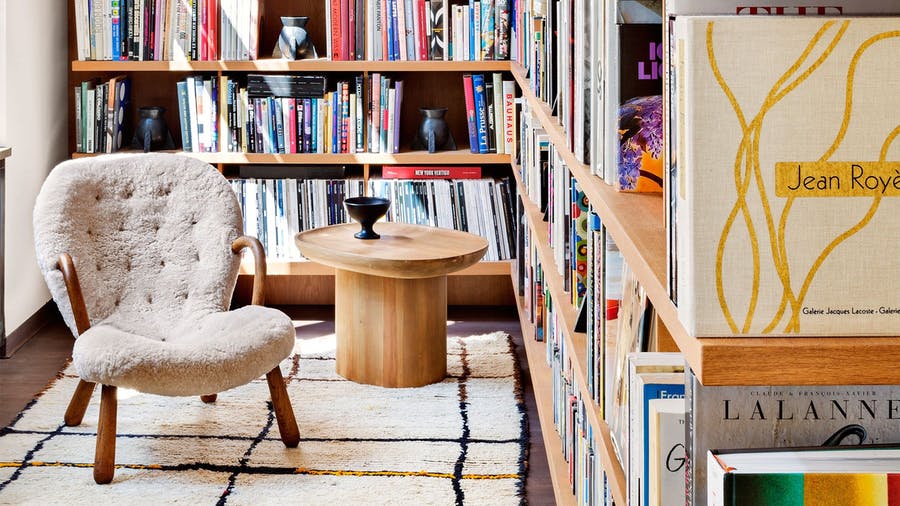
And Barnebys can only agree. The question is whether this is the last time the mystery of the chair found in Kim Kardashian's home, among many others, will arise.