
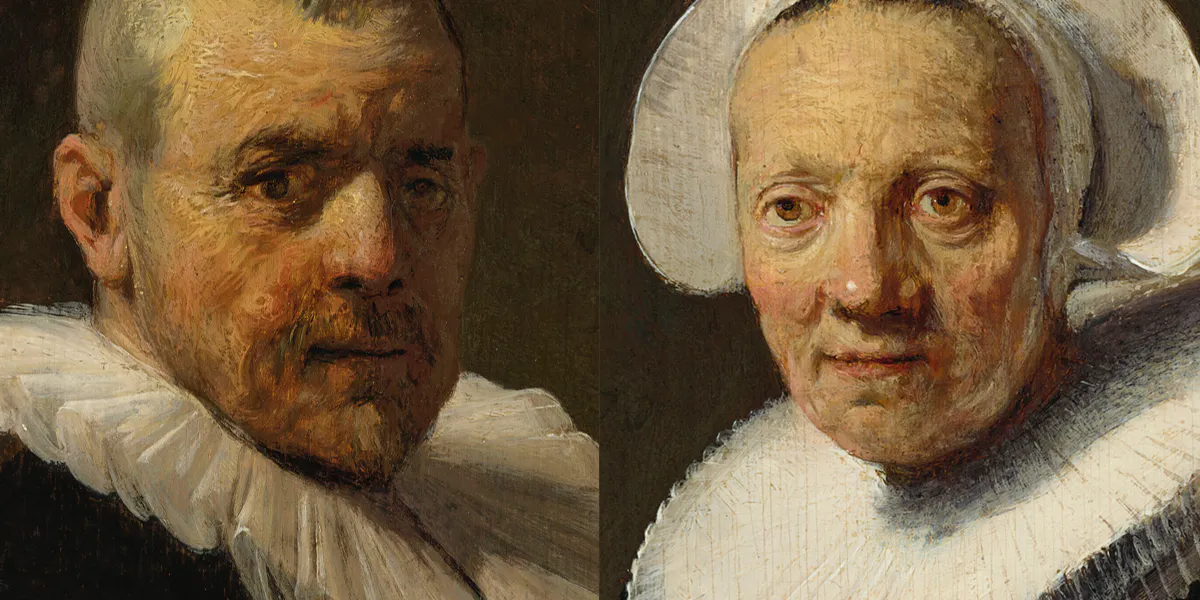
In 1824, the portraits of an elderly couple executed by Rembrandt were last seen in public at a Christie's auction, after which they seem to have been completely forgotten. Almost 200 years later, Henry Pettifer, International Deputy Chairman for Old Masters at Christie's, met face-to-face with them at a routine appraisal at the home of the descendants of the buyer at the time. He recommended that the signed and dated portraits be examined in detail to confirm their authenticity. This was done over a period of one and a half years by the experts of the Rijksmuseum.
See also: Small Pennsylvania Museum Discovers Rembrandt in its Collection
In 1635, the year in which it was painted, Rembrandt ended his collaboration with his art dealer Hendrick van Uylenburgh, whose niece Saskia he had married the year before. The collaboration had been very successful and had made Rembrandt a sought-after portraitist among Amsterdam's wealthy merchants. Uylenburgh had arranged many lucrative commissions for his protégé from 1631 onwards, but after four exhausting years, Rembrandt was probably longing for something new – perhaps he felt he had painted enough people in black robes and white lace collars. Now, able to support himself financially, he turned to history painting.
See also: Rembrandt: Painter of the Soul
Though he had largely renounced portraiture in 1635, Rembrandt executed the two portraits here, which, measuring 20.8 x 16.7 cm and 19.9 x 16.7 cm respectively, are among the smallest in his oeuvre. The two subjects are family members: the wealthy plumber Jan Willemsz. van der Pluym (ca.1565-1644) and his wife Jaapgen Carels (1565-1640) from Rembrandt's hometown Leiden, whose son Dominicus was married to a cousin of the artist (Karel, son of the two, later apprenticed with Rembrandt). It is very likely that Rembrandt and the van der Pluym couple had already known each other for many years when the portraits were painted. The paintings also identify the age of the sitters, inscribed with 'Æ 69' and 'Æ 70' respectively.
See also: 6 Iconic Dutch Paintings
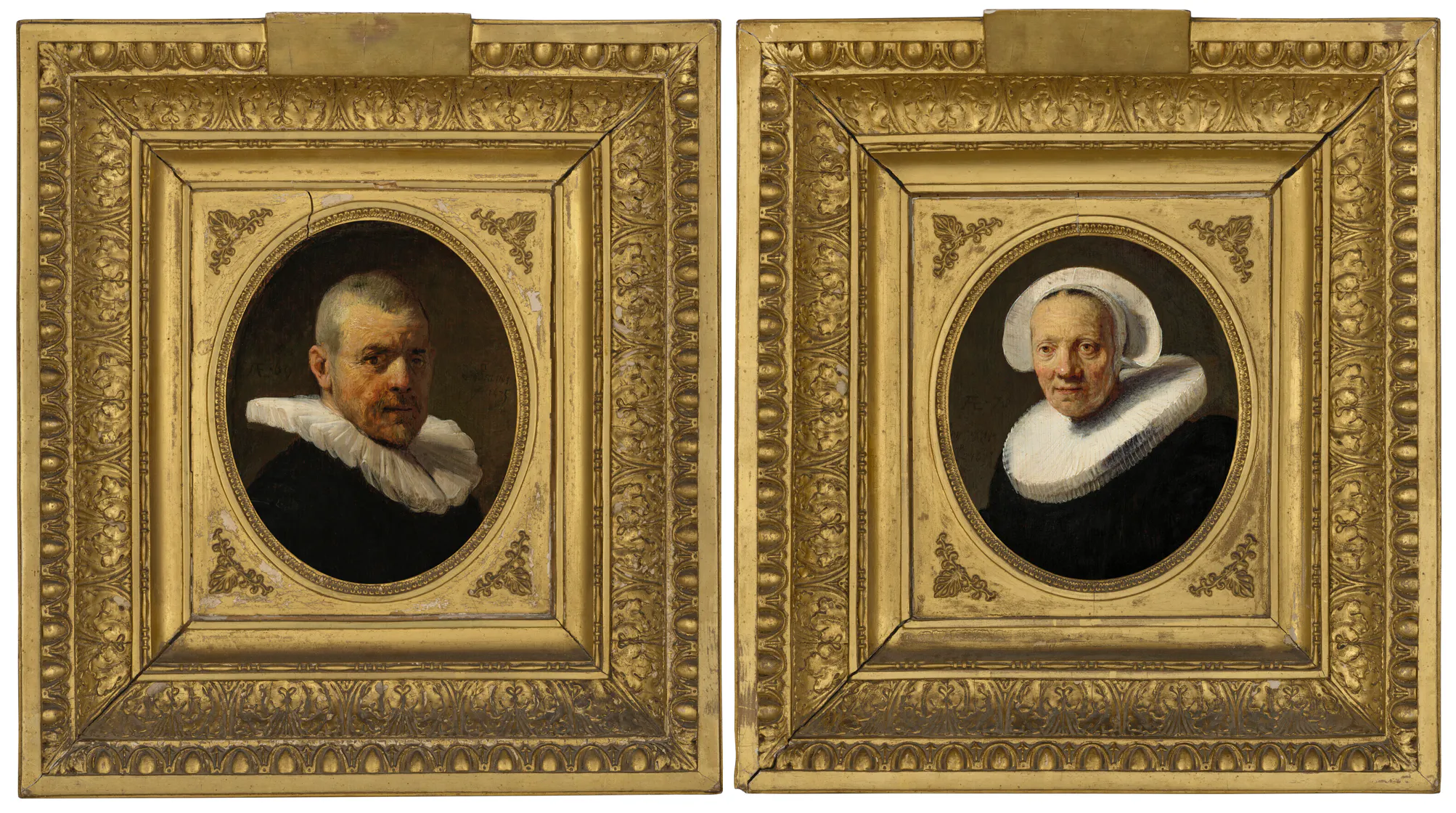
The slightly different ovals of the picture supports suggest that the portraits were not painted at quite the same time. They are, however, united by Rembrandt's characteristic chiaroscuro and skilful brushwork as well as 'an immediacy and intimacy', as Pettifer puts it.
See also: A £150m Rembrandt Painting is Going to the Rijksmuseum
The portraits of Jan Willemsz. van der Pluym and Jaapgen Carels remained in the family until their great-great-grandson had them auctioned in 1760. Subsequent locations were Warsaw, Paris and finally London, where they were auctioned at Christie's in 1824 and then disappeared from public view. Now, 200 years later, they will go under the hammer again at Christie's in London on 6 July as one of the highlights of the auction 'Old Masters Part I' (with an estimate of £5-8 million).
Want news like this delivered straight to your inbox? Subscribe to our free newsletter!
‘They date to a pivotal year in his career — and give a rare insight into the personality not just of Rembrandt’s sitters, but also of Rembrandt himself', says Maja Markovic, Old Master expert and Head of the Evening Sale at Christie's. It must also be emphasised that this is probably Rembrandt's last portrait pendant in private ownership and the only surviving pair of portraits depicting family members.



![‘Game Changer’ set a new record for Banksy. Proceeds from the sale will be donated to the NHS. Photo: © Christie's [detail]](https://images.prismic.io/barnebys/18202fd7-f56f-4e5d-a697-dde314b6c0d7_Cover.jpeg?auto=compress,format)


