Stay up-to-date with the antiques world

By subscribing, you are agreeing to the privacy policy. Unsubscribe anytime.

Barnebys

Barnebys HQ

Brahegatan 10
BOX 5038
114 37 Stockholm

Company

  • About Us
  • Join Barnebys
  • Our Partners
  • Press
  • Career

Explore More

  • Barnepedia
  • Buying / Selling at auction
  • Auction Houses / Dealers / Galleries

Support

  • FAQ
  • Terms of Use
  • Privacy and Cookies policy
  • Contact us
  • Barnebys Group AB
  • Barnebys.se
  • Barnebys.com
  • Barnebys.co.uk
  • Barnebys.de
  • Barnebys.fr
  • Barnebys.es
  • Barnebys.it
  • Barnebys.hk
  • All auction items
  • Categories
  • Auction results
  • Magazine
  • Ancient Art
  • Arts & Graphics
  • Asian Art
  • Books, Maps & Manuscripts
  • Carpets, Rugs & Textile
  • Coins & Banknotes
  • Contemporary Art
  • Ethnographical
  • Fashion & Vintage
  • Folk Art
  • Furniture, Design & Mirrors
  • Glass
  • Jewellery & Gems
  • Lighting
  • Medals, Arms & Armour
  • Miscellaneous
  • Music & Musical Instruments
  • Nautica, Technica & Optic
  • Photographs
  • Porcelain & Pottery
  • Postcards & Stamps
  • Sculptures
  • Silver & Gold
  • Sports & Leisure
  • Tin & Metals
  • Toys & Collectables
  • Vehicles
  • Watches & Clocks
  • Wine & Spirits
  • Works of art
  • All auction items
  • Auction results
  • Magazine
  • Get a valuation
  • Auction system

Barnebys Magazine

LatestEditor's picksTopics
Magazine/Glass/Tiffany Glass: Art Nouveau Illuminated

Tiffany Glass: Art Nouveau Illuminated

Tiffany Studios glass is one of the most recognisable icons of the Art Nouveau period.

25 August 2020Kira Reinke
Tiffany stained glass ceiling in the Gran Hotel de Ciudad de Mexico, Mexico City, Mexico. (Photo by: Robert Knopes/Education Images/Universal Images Group via Getty Images)

Tiffany stained glass ceiling in the Gran Hotel de Ciudad de Mexico, Mexico City, Mexico. (Photo by: Robert Knopes/Education Images/Universal Images Group via Getty Images)

The leading American glassmaker at the turn of the 20th century Louis Comfort Tiffany revolutionised the concept of art glass, creating stunning stained glass windows for churches, public institutions and other museums, as well as smaller scale lamps, chandeliers and more for households across the US and Europe.

Tiffany Studios Poppy Table Lamp. Image: Morphy Auctions

Tiffany started his career as a painter and studied with Hudson River School artists, his fascination for nature influencing his later passion for glassmaking. His father, Charles Tiffany, started the famous jewellery business Tiffany & Co. and Louis later became the Design Director there in 1902.
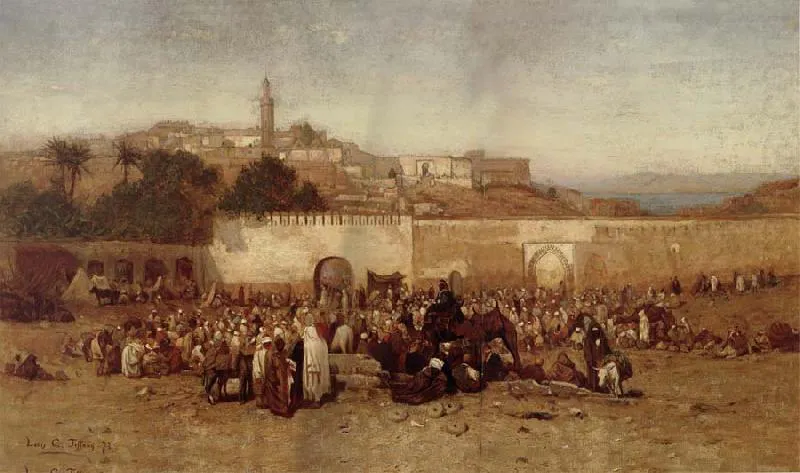
Louis Comfort Tiffany, Market Day Outside the Walls of Tangiers, Morocco. 1873, oil on canvas. Image: Smithsonian Art Museum

After he was commissioned by President Chester Arthur to redecorate the White House state rooms, Louis Tiffany founded Tiffany Studios in 1885 and established a factory in Queens, New York in 1893. That same year, Tiffany introduced his lamps to the public at the World's Columbian Exposition in Chicago. Afterwards, these beautiful lamps became popular in Germany and later France when he collaborated with Parisian dealer, Siegfried Bing.

See also: Art Deco: The Great Celebration

Tiffany glass is an Art Nouveau icon, known for its high quality, extraordinary colour and beautiful patterns inspired by nature, as if paintings conceived in glass. The Art Nouveau style began in 1890 as a response to the Industrial Revolution and modernisation, an ode to pristine nature and flowers, soft curvature, and swirling lines. The Art Nouveau style inspired painting, glass, jewellery, architecture and more between 1890 and 1910.
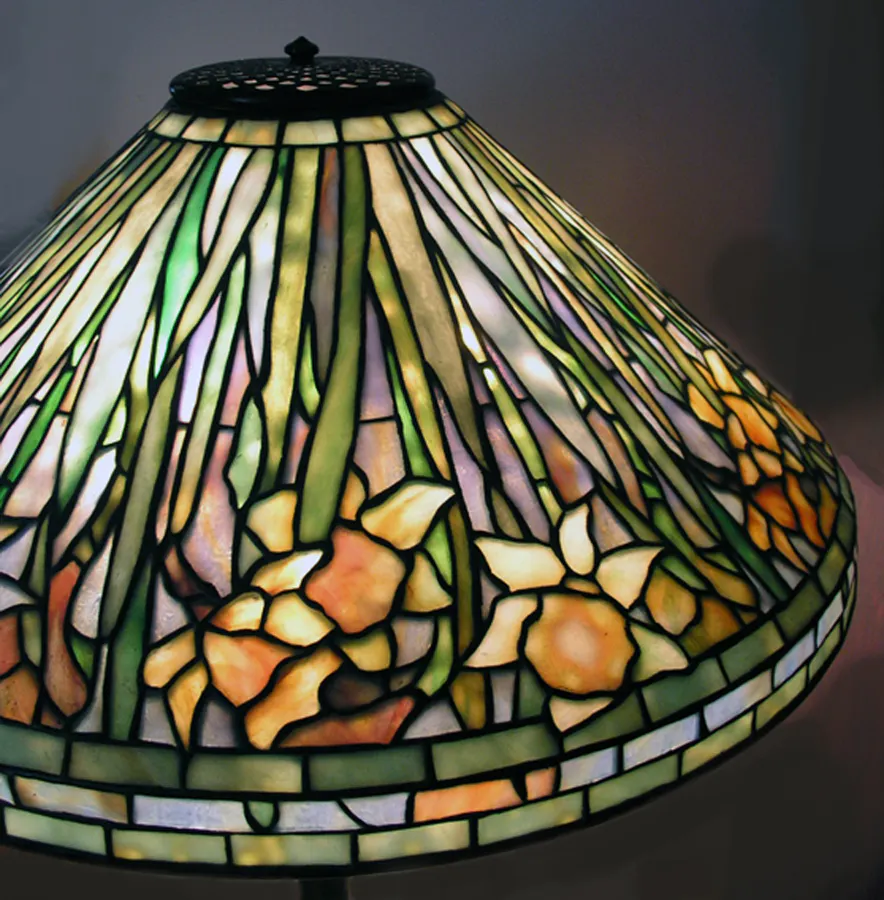
A very fine Tiffany "Daffodil" leaded glass table lamp (shade shown), designed by Clara Driscoll, Louis Comfort Tiffany & Co. head designer, Circa 1899-1920.

In 1888, Tiffany hired Clara Driscoll, who went on to design some of the most famous Tiffany lamps, such as the Daffodil, Dragonfly, Wisteria and Peony series. She worked for Tiffany on and off for 20 years and was one of the highest paid women in any profession at the time.

See also: Mirrors: A Reflection
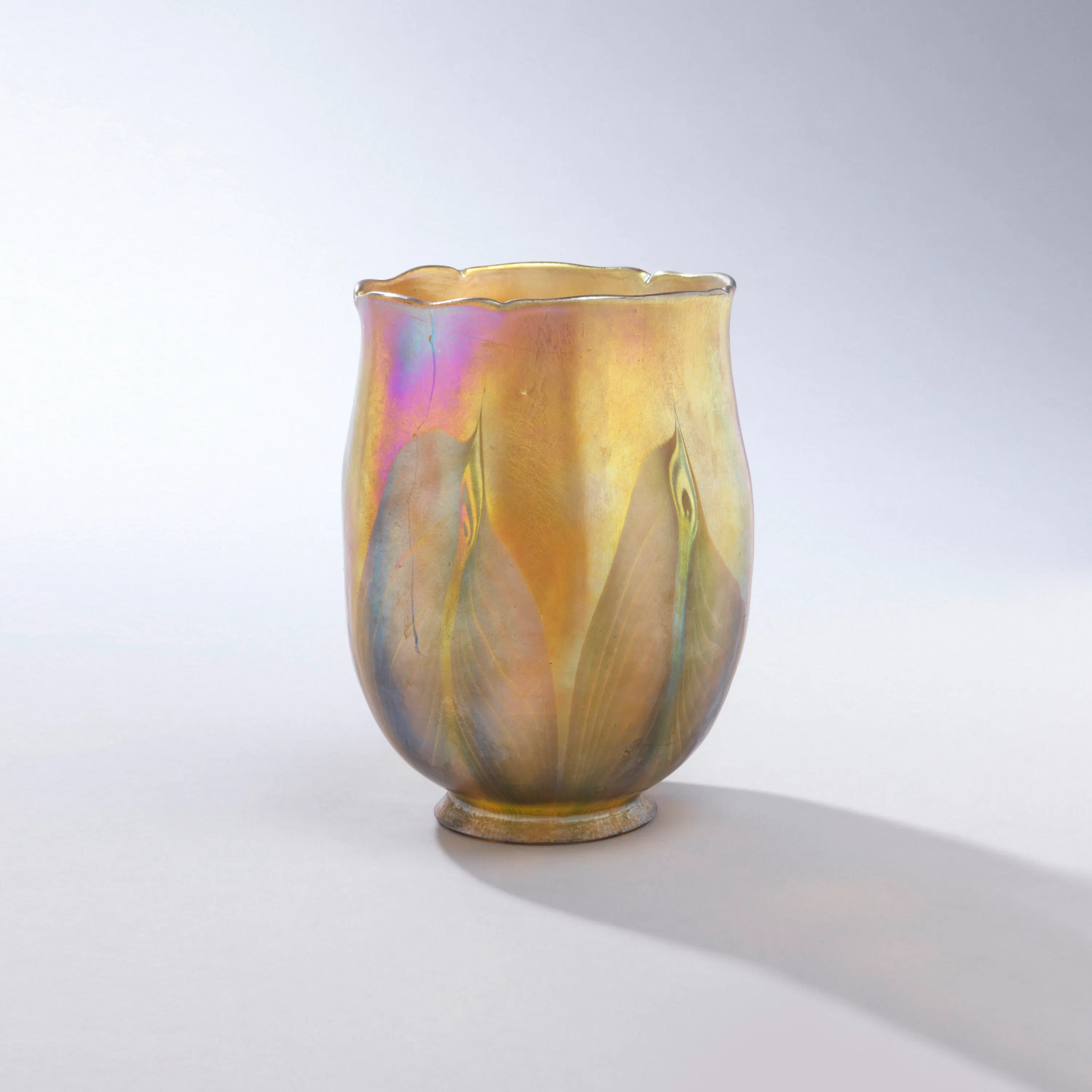
Tiffany favrile glass shade, 1907. Image: CC0

Louis Tiffany's famous glass invention was the iridescent glass that he called Favrile, which he patented in 1894. It was a process that infused colour into the glass, creating a unique shimmer that was inspired by ancient Roman and Syrian glass. At the Exposition Universalle in Paris in 1900, where Art Nouveau style was first exhibited in different forms, Tiffany won the grand prize for his Favrile glass.

See also: Venini: Glass and Light

His stained glass has adorned the ceilings and windows of many churches, museums and public buildings across North America. Some of his most famous masterpieces are the mosaic stage curtain of the Palacio des Belles Artes in Mexico City, the Angel of the Resurrection window at First Presbyterian Church in Indianapolis, and the idyllic landscape windows at the Metropolitan Museum of Art and Brooklyn Museum in New York.

Louis Comfort Tiffany (American, 1848–1933), A Wooded Landscape in Three Panels, c. 1905, stained glass, 219.7 x 334.1 cm (86.5 x 131.6 in), Museum of Fine Arts, Houston, Texas. (Photo by VCG Wilson/Corbis via Getty Images)

Tiffany retired from the company in 1918 and Tiffany production ended a decade later in 1928. Today, Tiffany glass, especially the exquisite lamps, are some of the most popular echoes of Art Nouveau and harken to an era of fine craftsmanship and inspired design.

Tiffany Studios, A Rare and Important 'Pond Lily' Table Lamp, circa 1903. Sold for $3.37 million in 2018. Image: Christie's

These lamps can achieve millions of dollars at auction: the Pond Lily table lamp sold for $3.3 million (£2.6 mil) at Christie's in 2018. It was designed in 1903 and was one of the most coveted Tiffany designs, inspired by the lily pond at Louis Tiffany's New York home.

Find more on Barnebys Magazine

tiffanytiffany glass

Subscribe to Barnebys Magazine

By subscribing, you are agreeing to the privacy policy. Unsubscribe anytime.

About the author

Kira Reinke

Kira Reinke is the US Editor at Barnebys Magazine. She majored in English and Art History at St. Olaf College and has a master's degree in Journalism from Columbia University. Prior to working at Barnebys, she worked in editorial at a travel agency. Her interests focus on fine art, design, and fashion on the auction market, and she enjoys attending auction previews, museum exhibits, and gallery openings in New York.

Read more from this author
Kira Reinke

Bring your auction to collectors worldwide!