The true secret of happiness lies in taking a genuine interest in all details of daily life.
Born in east London in 1834, William Morris enjoyed an idyllic and privileged childhood which shaped the beliefs that defined his career. As a young boy, Morris spent many of his days at his family’s country house in Essex, exploring the surrounding landscapes and reading the works of historical poet Walter Scott. These experiences created in Morris an appreciation for nature and historical romance, developing strong opinions about building and design. These beliefs were so strong that at the age of sixteen, Morris refused to enter the 1851 Great Exhibition dedicated to industrial design as he considered it too distasteful.

See also: The Woman Behind One of the World's Most Famous Patterns
His steadfastness only grew as he went off to attend Oxford University, where he met painter and soon-to-be life-long friend Edward Burne-Jones. The two joined what was known as ‘The Brotherhood’, a student group dedicated to mediaeval chivalry. It was here that the two young men were exposed to the reformative works of Thomas Carlyle, Charles Kingsley and John Ruskin, whose philosophies discussed labour reform, purposeful education and class inequality. This context heavily influenced Morris’s own criticisms of the rising industrial system and its ‘unnatural’ products. Morris became a quick advocate for the preservation of artisanship as well as environmentalism and socialism.

In 1851, Morris married model Jane Burden, and the two moved to the English countryside to escape the hustle and bustle of London. It was here that they established their home and creative project the Red House. Staying true to his values, Morris wanted their house to be built and furnished completely by the hands of independent designers. They commissioned architect Philip Webb to build the mediaeval-inspired structure, and worked together with their artist friends to make furniture, wall decorations and other household objects.
See also: How to Furnish Your Home with Modern Antiques
It was here that the idea for an interiors company dedicated to craftsmanship was born. The company became known as Morris, Marshall, Faulkner & Co., and consisted of almost all of the artisans who worked on Red House. This company allowed Morris to put his love of design and anti-industrialisation spirit into action, and even profit off of it. The business specialised in embroidered hangings and wall paintings, and all items were, of course, hand-designed and handmade.

In the late 1860s, Morris, Marshall, Faulkner & Co. received commissions from the South Kensington Museum, now the V&A, and St James’s Palace. These highly prestigious projects effectively solidified the company’s reputation within the interiors industry of Victorian England, and can fortunately still be seen today.
See also: Julia Margaret Cameron: The Visionary Victorian Photographer
In addition to these projects, Morris also began exploring other outlets for his passion and beliefs, including writing his epic poem The Earthly Paradise on anti-industrialisation. The Earthly Paradise established Morris as one of the most prominent poets of his time in addition to being a highly sought-after designer.

See also: Elizabeth Siddal: The Tragedy of the World's First Supermodel
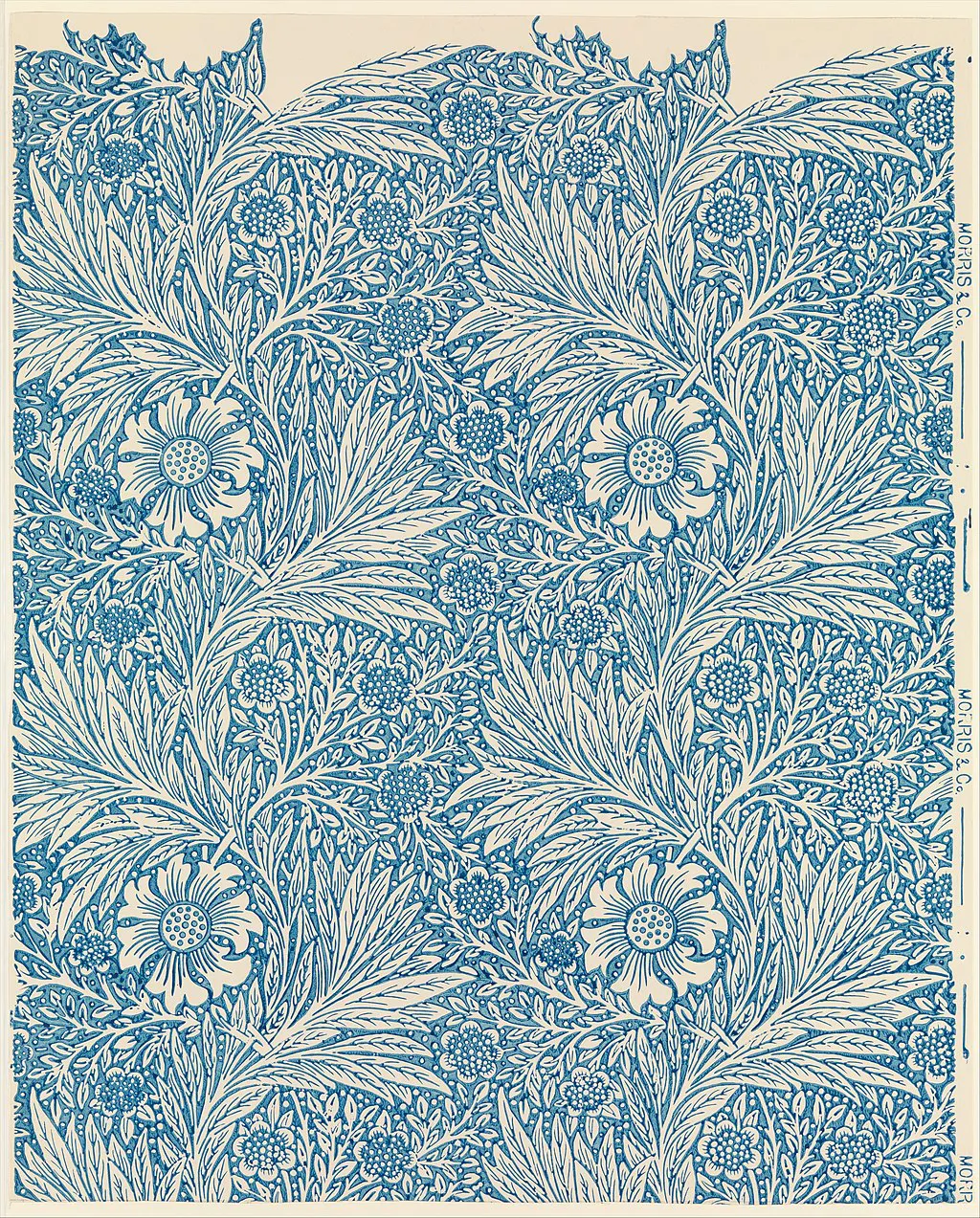
It was in 1875, when Morris became the sole director, that the company took off to be what we know today: Morris & Co. During this time, Morris began to develop a series of wallpapers inspired by English gardens as well as both printed and woven fabrics. By no surprise, Morris researched and used historical procedures to print and dye the materials in order to make the products ‘from scratch’. His handcrafted development process became a trademark of his career. Morris also continued using nature as inspiration, and throughout the 1870s, he designed some of his most beloved patterns, including ‘Marigold’ (1975) and ‘Chrysanthemum’ (1976-87).
As his works became more popular, Morris further expanded, and in 1877, he set up a shop with all of his produced goods on Oxford Street. His main goal was to create a one-stop experience for consumers as a way to discourage them from purchasing items that were mass produced.
See also: Paul Jacoulet: French Master of Japanese Prints
In 1881, Morris purchased a textile factory to expand his business further while still keeping a close eye on his production process. His revolutionary emphasis on careful production and natural inspirations are considered to be the start of the Arts & Crafts movement that spanned until the 1920s. It placed an emphasis on the decorative arts, and valued handcrafted objects in contrast to more popular industrially-produced interior goods.

See also: The Best Selling Novel of All Time
In addition to his iconic designs, Morris was also well-known in his period for his active political beliefs and writings. He set up Socialist clubs, went on marches and gave speeches. Despite his radical beliefs, he received very little negative consequences because of his status and wealth. Morris then focused more on his writings, dedicated to his beliefs in socialism and anti-industrialism. His best-known work remains his 1890 utopian novel News From Nowhere, where he explores a fantasy socialist society in which all work is enjoyable and creative. Staying true to his politics, Morris set up his own press to publish the book, printing a total of sixty-six copies using a mediaeval style. The work received great acclaim, and was even delicately illustrated by Geoffrey Chaucer. This rare version was published in 1896, only a few months before Morris’s death.

Today, William Morris’s legacy lives on. From clothing collaborations with global fashion retailers to art prints sold on Amazon, the iconic patterns and prints Morris so carefully designed can be found just about anywhere. Of course, one could only imagine what Morris would have to say about the mass production of his work. At auction, however, Morris’s original work is far more rare. Interestingly, Morris’s most popular objects are works from his personal press Kelmscott Press. His highest selling item was the last book printed by the press in 1898. It features a description of Morris’s goals in founding the press as well as detailed illustrations completed by Morris and woodcuts by Edward Burne-Jones. It sold for $53,463 in 2020 with Christies. Prior to this, Morris’s most expensive work was his Tapis Hammersmith tapestry which sold for $26,667 in 2013.
These impressive auction numbers are a testament to William Morris’s legacy with his whimsical products remaining a luxurious visual escape for everyone.
Discover more art and design articles on Barnebys Magazine
Article by Hania Hendrickson