One not only drinks the wine, one smells it, observes it, tastes it, sips it and… one talks about it.
King Edward VII said it best: wine is not only drunk but experienced with all senses – and this couldn't be truer when it comes to the ‘Super Tuscans’. They are perfect when paired with delicious meals, but also excellent when drunk on their own. They are in all respects true 'meditation' wines: the term that the Italian writer and connoisseur Luigi Veronelli coined for complex and unusual wines, which are great sipped just by themselves.
The origin of the Super Tuscans is linked to a sort of 'wine revolution', begun around the 1970s when some Italian producers wanted to bypass the rigid rules of wine production and ‘DOC’ regulations dictating what wines could earn the ‘designation of controlled origin’. The expression ‘Super Tuscan’ got to indicate innovative red wines produced in the central Italian region of Tuscany. These wines let go of the strict preparation standards in force at that time, and also used other types of grapes, especially the variety of Cabernet Sauvignon.
Rebellious and revolutionary, and often aged in barrels, they offered Bordeaux varieties grown on Italian territory. The result was a product destined to have global success, which broke tradition and created a superior blend. Here is a virtual tasting of the five most popular and most valuable Super Tuscans for collectors:
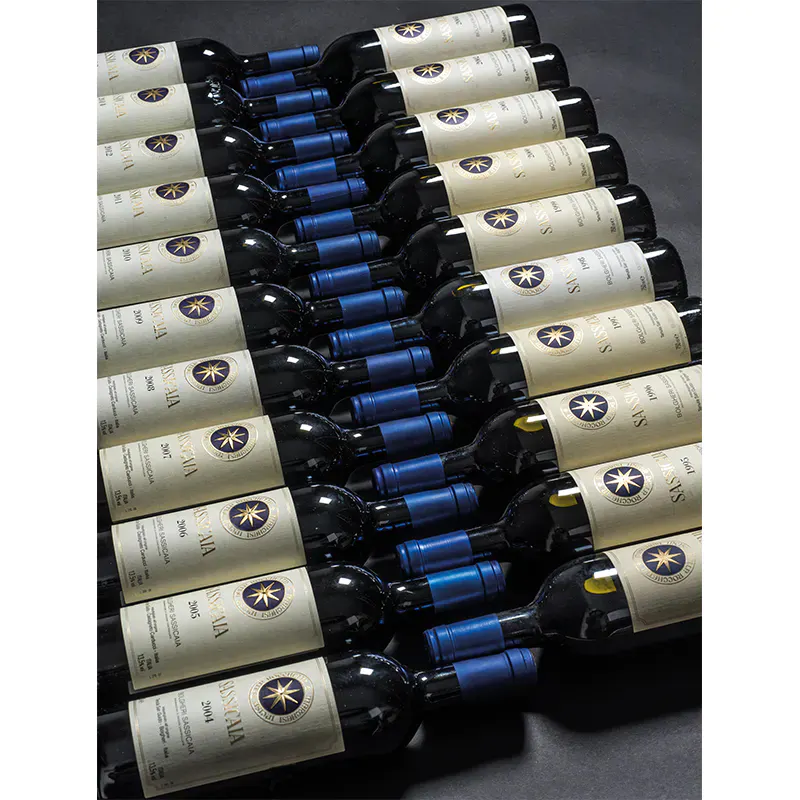
1. Sassicaia
Do you have a bottle of fine wine and want to know how much it is worth? Value it with our experts
Bolgheri Sassicaia, known simply as Sassicaia, is one of the finest Italian wines, produced by the company Tenuta San Guido, in the Castagneto Carducci area. The fascinating history of Sassicaia began thanks to the creative genius of the Marquis Mario Incisa Della Rocchetta, who had a great passion for good wine, idealised Bordeaux wines and dreamed of creating something new since he was a student at the faculty of Agriculture of the University of Pisa. Around the 1940s, the Marquis imported some cuttings of Cabernet Sauvignon and Cabernet Franc to Tuscany to create a Bordeaux blend wine. In 1944, he produced the first bottles of Sassicaia, which were initially reserved for the family to drink. It was 1968 when the first real vintage was offered to the market.
A curiosity about this wine: it is the first Italian wine to which an exclusive DOC was recognised, Bolgheri Sassicaia DOC, granted only to the wines of Tenuta San Guido with a minimum of 80% Cabernet Sauvignon. The bouquet of this wonderful wine is elegant, with fruity scents enriched by the notes of the Mediterranean scrub, spicy aromas and balsamic notes. With balanced tannins, the aftertaste is lasting and deep on the palate, giving off sensations of chocolate and vanilla, complemented by a harmony of rich spiciness and fresh vegetal touch.
The great popularity of Sassicaia has, unfortunately, also made it one of the most forged wines, and those who buy it should be aware of the risk, especially online.
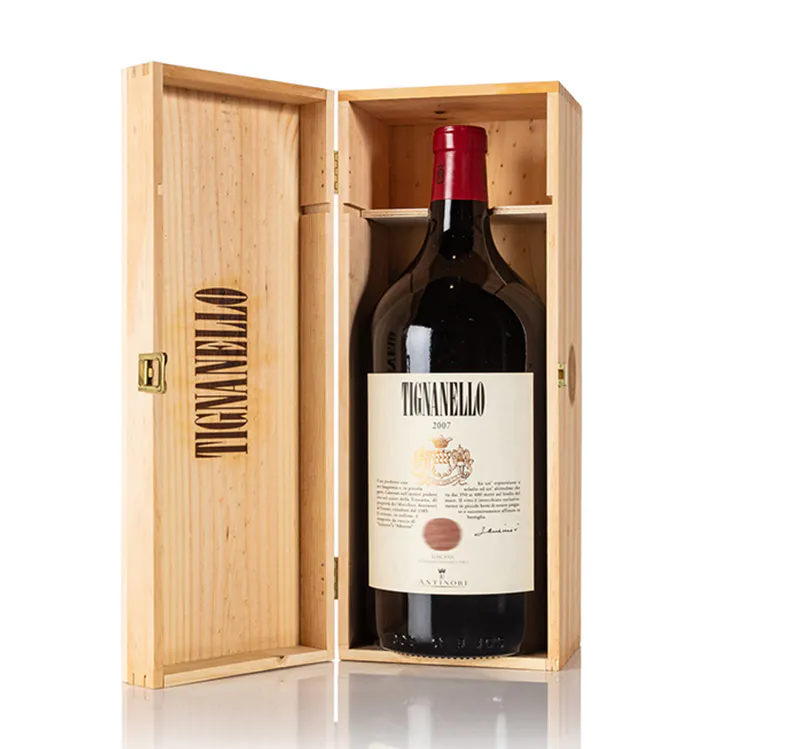
2. Tignanello
See also: The Cocktails that Inspired History’s Creatives
Silky and rich on the palate, with ripe tannins, and deep and clear on the nose, Tignanello is a label that's always highly sought after by wine lovers. A milestone of Italian oenology from the soft Tuscan hills between the Greve and Pesa valleys, it takes its name from the Tignanello Estate where its ‘brother’ Solaia is also produced. Both Tignanello and Solaia have been defined by critics as "among the most influential wines in Italian wine history".
Produced with a composition of 80% Sangiovese, 15% Cabernet Sauvignon and 5% Cabernet Franc, Tignanello boasts some firsts: it was the precursor of Super Tuscans, the first modern red wine blended with non-native varieties (such as Cabernet) and the first Sangiovese to be aged in barrels. It was also among the first Chianti Classico red wines not to use white grapes (which were completely removed from 1975 onwards). It was first produced in 1970 by the house Antinori, with the label designed in 1974 by Silvio Coppola, a graphic and interior designer known for minimalist lighting, robust furniture and covers of many famous books.
Winner of countless international awards over the years, Tignanello has been included several times in the international top ten wine list of the illustrious Wine Spectator magazine.
As the story goes, the name Tignanello might derive from the divinity Tinia, the Etruscan counterpart of the Roman Jupiter and the Greek Zeus.
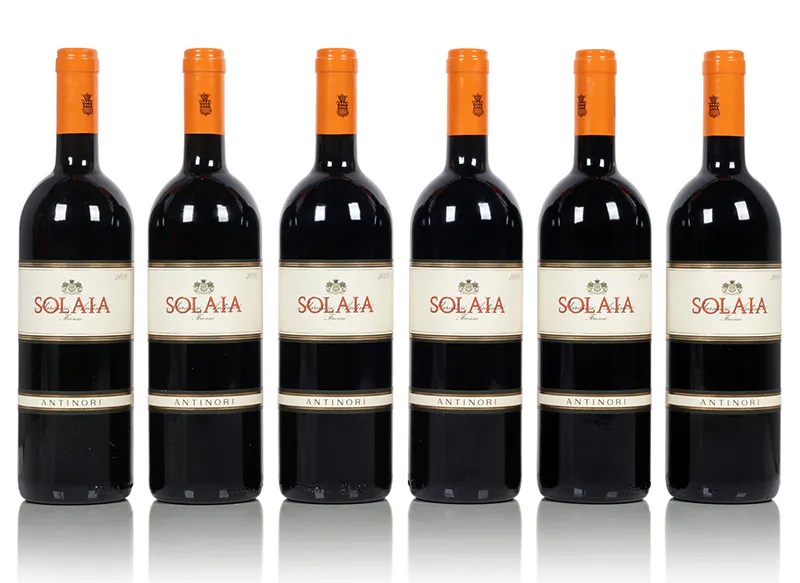
3. Solaia
Want more articles like this straight to your inbox? Subscribe to our free newsletter
Born on rocky calcareous soil, on lands rich in chalk and marlstone, Solaia is produced with passion and care, using the most carefully researched varieties of Cabernet Sauvignon, Cabernet Franc and Sangiovese grapes. The vineyard on which it is grown is located in the sunniest part of the hill at Tenuta Tignanello, in the Chianti Classico region.
The wine was produced for the first time by the Antinori family with the 1978 vintage and an initial blend of 80% Cabernet Sauvignon and 20% Cabernet Franc, maintained for the following year too. In the next years, a 20% Sangiovese was introduced with some corrections in the Cabernet Sauvignon / Cabernet Franc ratio, to then obtain the present composition of 75% Cabernet Sauvignon, 5% Cabernet Franc, and 20% Sangiovese. One of the peculiar characteristics of this wine is that it is produced only in exceptional vintages, meaning that, for example, it was not offered to the market in the unfruitful years of 1980, 1981, 1983, 1984 and 1992. 2002 is a production on its own: on that occasion the Sangiovese grape was not of satisfactory quality for the production of this wine, and therefore only Cabernet grapes were used. The best vintages for collectors are 2014, 2015, 2016 and 2017.
It is an elegant and creamy wine, intensely complex and fruity with sweet aromas of black currant and ripe cherry, which lead to a liquorice and cocoa aftertaste. Solaia offers layered aromatic sensations and well-balanced tannins. Adored by true connoisseurs, Solaia is a wine conceived with maniacal care in order to guarantee excellence in every bottle.
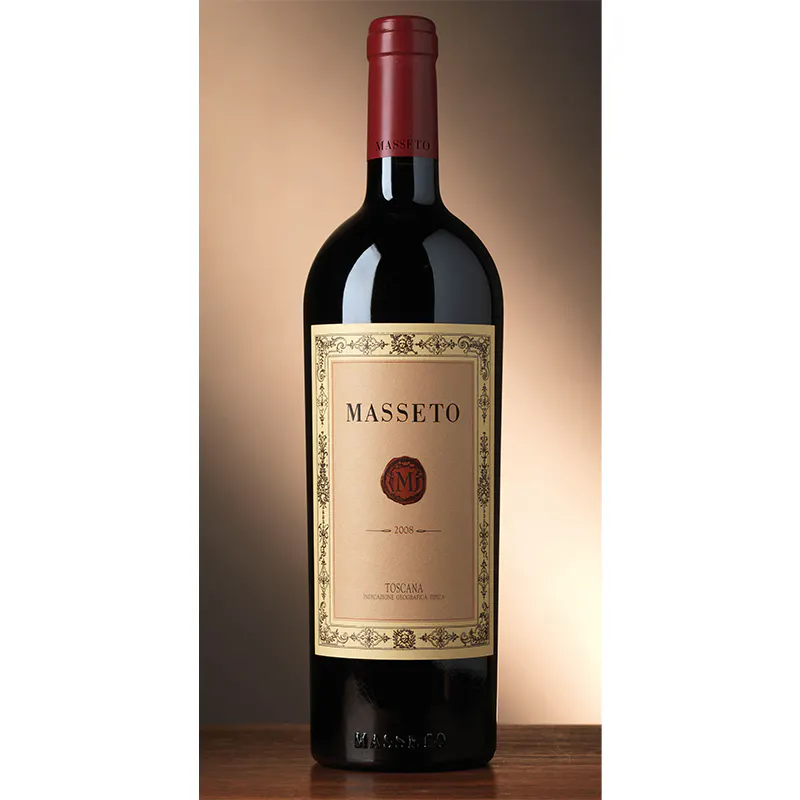
4. Masseto
See also: An Artistic Walk in the Footsteps of Bacchus
Masseto, made from Merlot grapes, is a true icon of Italian wine recognised all over the world. The name Masseto derives from the word 'boulder', due to the blue clay boulders from the Pliocene Era present in the area. The first bottle was released on the market in 1986, labelled simply as Merlot, while the following year the name Masseto appeared on the label. The wine was an immediate success and its reputation only increased thanks to the vintages of the '90s and the following decades.
Over the span of thirty vintages, Masseto has obtained various 100/100 scores from leading international critics, among whom is Robert Parker, American guru of world wine criticism and creator of The Wine Advocate. These results sealed its destiny as a collector's item and justify the high auction prices, contributed by a limited production of about 30,000 bottles per year only. On numerous occasions, Masseto has achieved amazing results under the hammer, with one auction in 2012 when a 2007 vintage went under the hammer by Sotheby's New York for a record figure of 50,000 dollars for a 15-litre format – also known as Nebuchadnezzar. One of the best vintages is certainly 2016, which scored 100/100 from both Robert Parker and James Suckling.
Masseto is one of the most expensive wines on the market, with prices exceeding €800 per bottle, but it has great value, both in terms of collecting prestige and sensory experience. Uncorking a bottle of this precious nectar triggers a liquid kaleidoscope of sensations: sumptuous opulence, high-impact tannic structure, softness and refined elegance are at once combined on the palate. An oenological masterpiece highly sought after by great enthusiasts.
5. Ornellaia
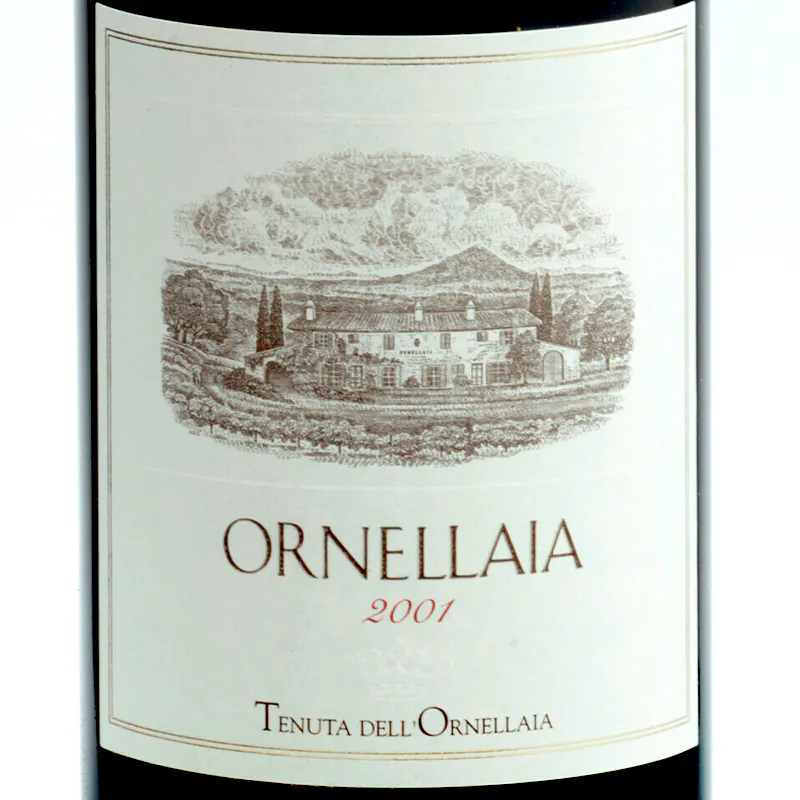
Ornellaia is a Bolgheri Superiore red wine, which combines Cabernet Sauvignon, Merlot, Cabernet Franc and Petit Verdot in a phenomenal blend that best represents the unique territory in which it is produced. Tenuta dell’Ornellaia was founded in 1981 by the Marquis Lodovico Antinori near Bolgheri, with the aim of creating a new wine in Italy that would combine experimentation and marketing. To accomplish this feat, the Marquis also enlisted the help of the well-known winemaker André Tchelistcheff. The estate soon established itself as one of the major Italian wine producers. In 2005 the Frescobaldi family took over the estate in full.
Like any self-respecting good wine, Ornellaia also often achieves great results at auction. In 2007, for example, a Salmanazar (a 9-litre bottle) from Ornellaia 2005 sold for $33,600 at Christie's New York.
Having a glass of Ornellaia in your hands means being able to appreciate its intense ruby red, almost blackish colour and savouring a robust, elegant and well-structured wine, with silky tannins, offering a cascade of aromas and sensations that last long on the palate.
A fun fact about this wine: a recent market survey sponsored by Vinitaly revealed that Ornellaia is the most preferred red wine by Italian women.
Let’s end this virtual tasting with a beautiful quote from Anton Chekhov: “Wine and music were always the best corkscrews for me”. All Super Tuscans, without distinction, are a symphony for the senses – as often happens with the best revolutionary ‘contaminations’.